
During the second week of October, the cryptocurrency markets exhibited a tendency to stabilize, even as many investors held onto hopes for another “Uptober” surge that would drive prices to new peaks.
Also making headlines was the return of a prominent Bitcoin (BTC) holder, who held a substantial $11 billion worth of the digital asset. Following a two-month pause, they initiated another transaction, moving $360 million in BTC. This move could suggest a potential shift of funds into Ether, the second-largest cryptocurrency. The whale still possesses over $5 billion in their wallet.
Adding to potential “Uptober” excitement, the U.S. Securities and Exchange Commission (SEC) has received a significant number of applications for crypto exchange-traded funds (ETFs). Of these, 21 were submitted in the initial days of October, totaling 31 crypto ETF applications.
However, the ongoing federal government shutdown might cause delays in the SEC’s response to these applications. The agency announced it would be functioning “under modified conditions” with a “severely limited workforce” until a new budget is approved.
With Democrats and Republicans failing to reach an accord for the seventh time this past Thursday, the government closure is set to continue into the following week. According to reports from CBS News, the Senate will adjourn until Tuesday.
$11 Billion Bitcoin Holder Resurfaces with $360 Million BTC Transaction After Two Months
An individual controlling a significant amount of Bitcoin, estimated to be worth $11 billion before they transferred over $5 billion of their holdings into Ether (ETH) two months prior, has become active in the cryptocurrency market once more, moving $360 million in Bitcoin.
The digital wallet associated with this entity transferred $360 million worth of Bitcoin into the “bc1pd” hot wallet of Hyperunit, a decentralized finance (DeFi) protocol, on Tuesday. This transaction marks the first activity observed from this wallet in the past two months, as reported by blockchain data platform Arkham.
The transaction could indicate a potential shift towards Ether, based on prior transaction patterns from this holder.
This $11 billion Bitcoin holder initially came to light two months prior and shifted around $5 billion worth of BTC into Ether. At the time, this briefly surpassed the second-largest corporate treasury firm, Sharplink, in total ETH holdings, reported by Cointelegraph on September 1st.
As of Wednesday, the whale’s primary wallet still contained over $5 billion in Bitcoin, potentially indicating further selling pressure for the leading cryptocurrency.
The Bitcoin whale initiated their fund rotation into Ether on August 21st, exchanging $2.59 billion in BTC for $2.2 billion in spot Ether and a $577 million Ether perpetual long position.
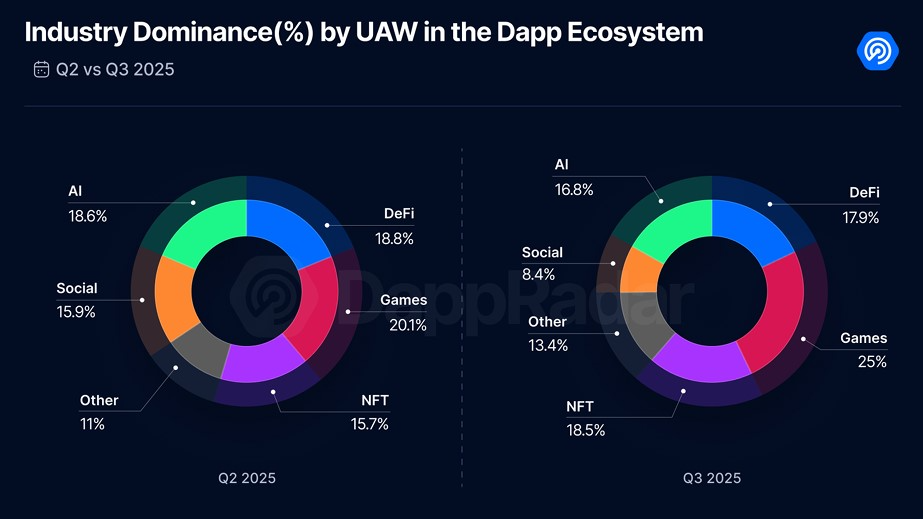
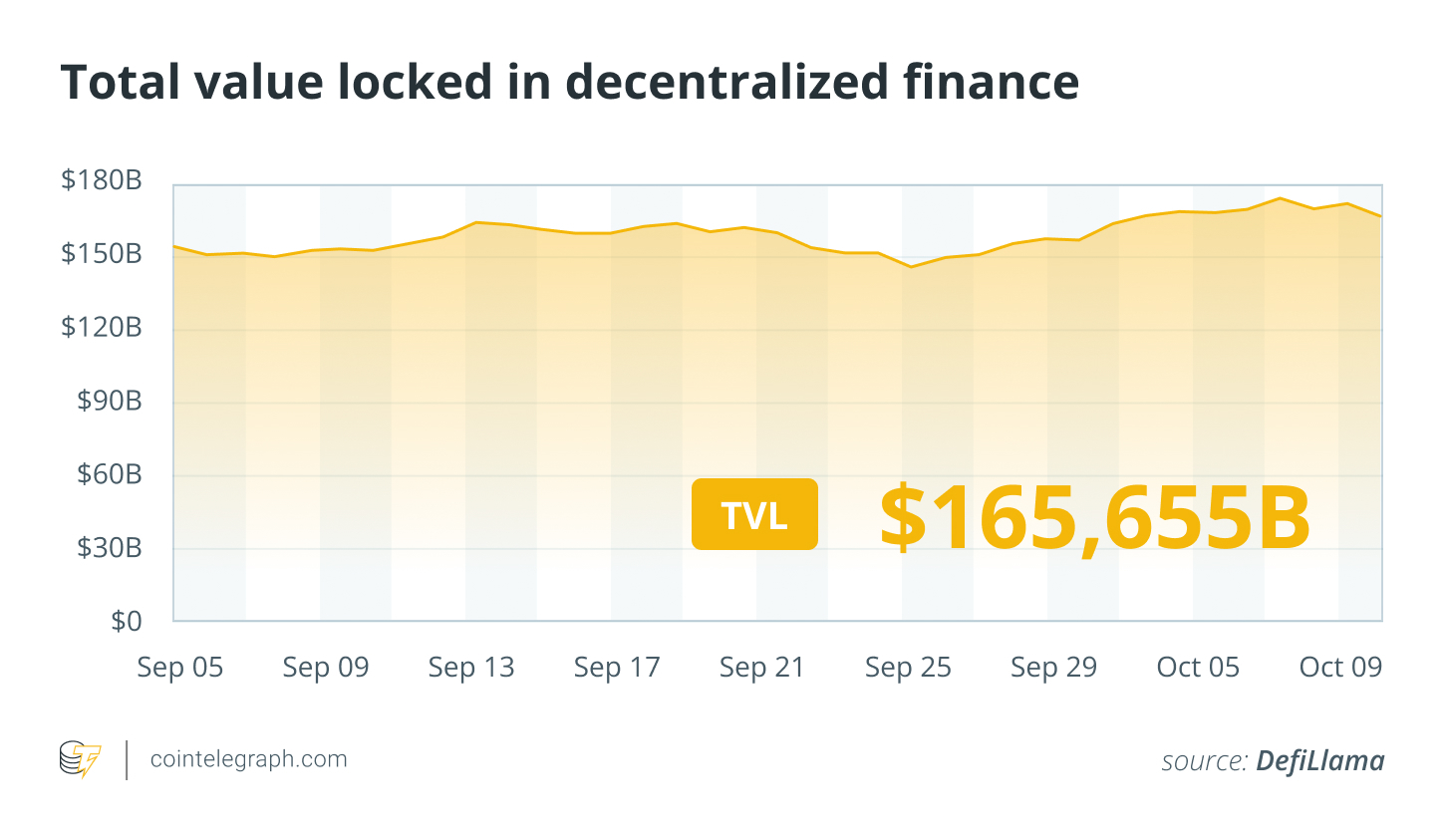
DeFi Total Value Locked Reaches Record $237 Billion as Daily Active Wallets Decline by 22% in Q3: DappRadar
Data from DappRadar suggests a mixed performance for the decentralized application (DApp) industry during the third quarter of 2025. Liquidity in decentralized finance (DeFi) saw record highs, while user engagement experienced a notable decrease.
According to a report shared with Cointelegraph, DappRadar reported that daily unique active wallets averaged 18.7 million in Q3, a 22.4% drop from the preceding quarter. Concurrently, DeFi protocols secured a combined $237 billion, representing the highest total value locked (TVL) ever achieved in the space.
The report draws attention to an emerging disparity between institutional investment in blockchain-based financial platforms and the level of retail user interaction with DApps. While DeFi TVL soared to unprecedented liquidity levels, general activity slowed down, indicating decreased retail participation.
“Throughout the entire quarter, every category experienced a decrease in active wallets. However, the most significant impact was observed in the Social and AI categories,” DappRadar stated. AI-focused DApps lost over 1.7 million users, falling from a daily average of 4.8 million in Q2 to 3.1 million in Q3, while SocialFi DApps dropped from 3.8 million to 1.5 million in Q3.
New Japanese Prime Minister Could Spur Crypto Economy, Streamline Blockchain Regulations
The newly elected Prime Minister of Japan, Sanae Takaichi, may potentially pave the way for more refined regulations that could benefit the country’s cryptocurrency economy. There is a chance Japan may become a leading global hub for crypto businesses.
Takaichi was elected as the leader of the Liberal Democratic Party (LDP) on Saturday and is projected to assume the role of Japan’s first female Prime Minister on October 15th.
Experts suggest that her leadership might foster a more receptive attitude toward technological experimentation, including innovations within blockchain technology, while maintaining Japan’s stringent regulatory standards.
Elisenda Fabrega, general counsel at tokenization platform Brickken, believes Takaichi’s election may have a significant impact on the perception and management of digital assets within the nation.
In prior public roles, Takichi has expressed support for “technological sovereignty,” and has highlighted the “strategic development of digital infrastructure, including blockchain technology,” Fabrega stated to Cointelegraph. “From a legal standpoint, this suggests her administration may adopt a stance that is not only permissive but potentially proactive in promoting the digital economy.”
Fabrega also noted that Takaichi’s political orientation could solidify “Japan’s commitment to legal certainty in the crypto space” and generate renewed interest in the country as an innovation-friendly hub for crypto.

According to Maarten Henskens, chief operating officer at Startale Group and head of Astar Foundation, the Japanese government recognizes blockchain as a “pillar of its digital transformation strategy.”
“A more relaxed monetary outlook under the new leadership could maintain liquidity and fuel investor demand for alternative assets, including cryptocurrencies,” Henskens explained to Cointelegraph.
“At Startale and Astar, we view this as a favorable environment to continue advancing Japan’s Web3 ecosystem,” he added.
Afghanistan Internet Blackout Serves as “A Wake-Up Call” for Blockchain Decentralization
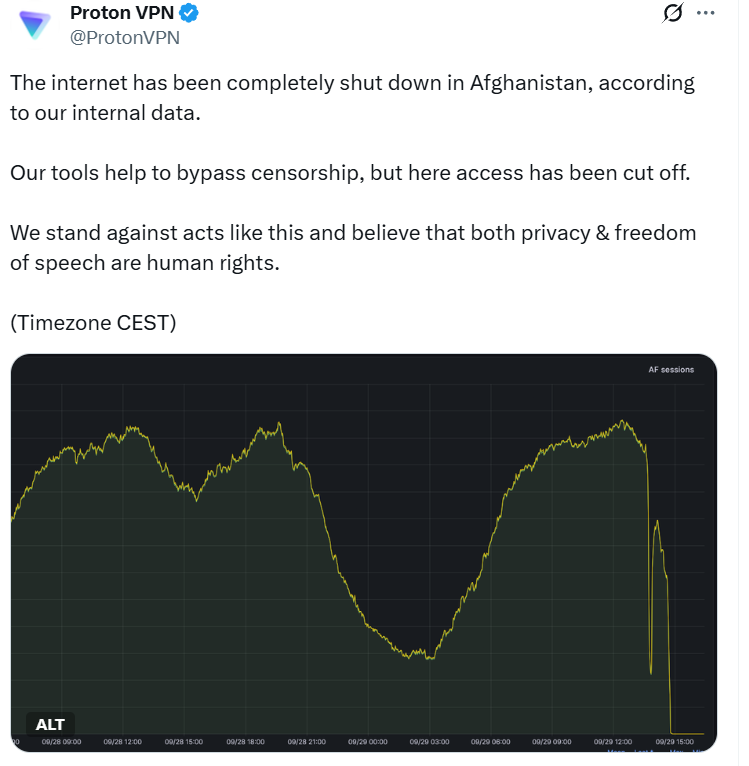
A recent nationwide internet outage in Afghanistan highlighted a significant vulnerability in leading decentralized blockchains: their reliance on centralized internet providers, which are susceptible to governmental control and technological failures.
The nation experienced a nearly complete internet shutdown that lasted approximately 48 hours before connectivity was restored on October 1st, as reported by Reuters. The disruption was allegedly ordered by the Taliban administration, although officials later attributed it to “technical issues” involving fiber optic cables.
While blockchains aim to offer individuals a public, censorship-resistant network for transferring value, their dependence on centralized internet providers makes these objectives challenging during outages.
“The Afghanistan blackout is more than just a regional connectivity crisis; it is a wake-up call,” stated Michail Angelov, co-founder of decentralized WiFi platform Roam Network. He added, “When connectivity is monopolized by a handful of centralized providers, the promise of blockchain can collapse overnight.”
Approximately 13 million citizens were affected by the nationwide outage of internet and mobile data services, according to a September report from ABC News. This was the first nationwide internet shutdown under Taliban rule, following regional restrictions imposed earlier in September aimed at curbing online activities deemed “immoral.”
The Taliban denied ordering the ban, attributing the internet outage to technical problems, including issues with fiber optic cables.
Iran has also faced issues with internet censorship since the start of its conflict with Israel.
The Iranian government shut down internet access for 13 days in June, restricting it to domestic messaging apps. This prompted Iranians to search for hidden internet proxy links for temporary access, as reported by The Guardian on June 25th.
$10 Billion in Ethereum Awaits Exit as Validator Withdrawals Surge
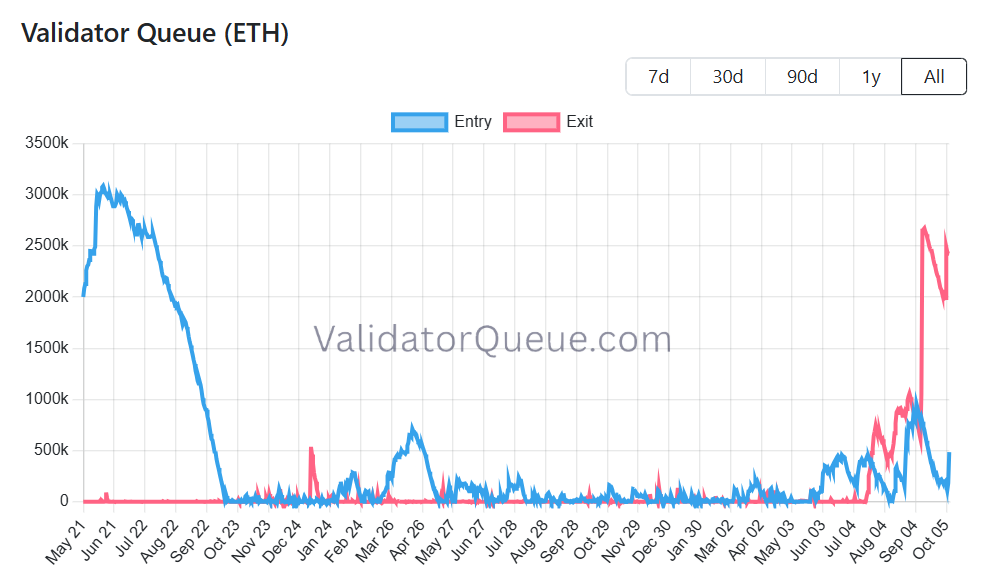
Ethereum witnessed a record surge in validator exits this week. Over 2.4 million Ether, valued at over $10 billion, is currently in the withdrawal queue from its proof-of-stake network. However, institutional participants are largely offsetting these withdrawals by entering as new validators.
The Ethereum exit queue surpassed 2.4 million Ether, exceeding $10 billion in value, on Wednesday. This surge in exits extended the validator queue time to over 41 days and 21 hours, as indicated by blockchain data from ValidatorQueue.com.
Validators play a critical role in the operation of the Ethereum network, being responsible for adding new blocks and verifying transactions.
“Large withdrawals always present the possibility of token sales, but this does not necessarily equate to tokens being sold,” explained Nicolai Sondergaard, research analyst at crypto intelligence platform Nansen. He added that “there is no need for concern based on this alone.”
Marcin Kazmierczak, co-founder of blockchain oracle company RedStone, suggests that while the $10 billion withdrawal queue is significant, validators are likely “consolidating from 32 ETH to 2,048 ETH stakes for operational efficiency.”
He told Cointelegraph that this consolidation includes increased inflows into liquid staking protocols for improved “capital efficiency,” adding:
“A large part of withdrawn ETH is redeployed within DeFi, not sold.”
“The 44+ day withdrawal wait time creates a natural throttle preventing supply shocks,” he explained. He also mentioned that Ether’s daily volume of $50 billion is still five times larger than the validator queue.
DeFi Market Overview
Data obtained from Cointelegraph Markets Pro and TradingView shows that most of the top 100 cryptocurrencies by market capitalization ended the week with gains.
The privacy-focused Zcash (ZEC) token increased by over 68%, becoming the week’s biggest gainer among the top 100 for the second consecutive week. The Mantle (MNT) token experienced an increase of over 18%, resulting in the week’s second-best performance.
Thank you for reading our summary of the most significant DeFi developments this week. Join us next Friday for more stories, insights, and education on this rapidly evolving space.