
Justin Sun, a notable figure in the cryptocurrency world, could not hide his excitement.
Just recently, Sun publicly displayed a $100,000 watch bearing the Donald Trump brand. This was presented to him at a private dinner hosted at Trump’s golf club in Virginia. Sun earned this reward for his significant $20 million investment in the crypto memecoin known as $Trump. This made him the top investor out of 220 who were invited to the exclusive dinner.
The highly anticipated dinner on May 22, hosted by Trump, along with a tour of the White House the following day for the top 25 memecoin buyers, were strategic moves to boost sales of the $Trump token. These events reportedly generated approximately $148 million for Trump and his associates, largely fueled by anonymous and international investors.
Memecoins are digital currencies often inspired by internet jokes, but they lack intrinsic value. These investments are typically high-risk due to their extreme price volatility. The $Trump memecoin launched shortly before Trump’s presidential inauguration, leading to a buying frenzy that generated tens of millions of dollars for Trump and his partners.
Trump’s private events on May 22, designed to reward major $Trump purchasers, have drawn considerable criticism from ethics watchdogs, former prosecutors, and academics. They argue that Trump is exploiting his position for personal financial gain in an unprecedented manner. This aligns with a broader trend of Trump leveraging the influence of his office to enrich himself and key allies through cryptocurrency ventures.
“Self-enrichment is precisely the concern the founding fathers had about leaders, which is why they included prohibitions against self-benefit in the constitution,” stated Paul Rosenzweig, a former federal prosecutor. “Trump’s profiting from his presidential memecoin perfectly illustrates what the framers aimed to prevent.”
Scholars also offer a critical perspective on Trump’s involvement in cryptocurrency.
Steven Levitsky, a Harvard University professor specializing in authoritarian regimes and co-author of “How Democracies Die,” remarked, “I have never witnessed such blatant corruption in any contemporary government globally.”
Ethical and legal concerns do not seem to have deterred Trump or Sun. Their relationship began before the dinner, with Sun investing $75 million in another Trump-linked crypto venture, World Liberty Financial (WLF), which Trump and his two eldest sons launched the previous fall and maintain a 60% stake in.
Since Trump assumed office and promptly moved to ease regulations on cryptocurrency ventures through the Securities and Exchange Commission (SEC) and other agencies, the political and financial standing of Sun, who was born in China, and other crypto magnates has significantly improved, effectively reversing Joe Biden’s policies.
As the SEC has relaxed regulations and suspended or closed 12 cryptocurrency fraud cases, three of Sun’s crypto companies, which were accused of fraud in a 2023 SEC lawsuit, had their cases put on hold in February, citing “public interest.” Settlement talks are reportedly underway.
The mutually beneficial crypto relationship between Trump and Sun illustrates how the US president has boosted his net worth by an estimated several billion dollars since returning to office, while working to reduce regulations. This fulfills his promises to establish the US as the “crypto capital of the planet” and end the “war on crypto.”
Following the May 22 dinner, Sun posted, “Thank you @POTUS for your unwavering support of our industry!”
Although Trump’s crypto ventures are less than a year old, the State Democracy Defenders Fund watchdog group estimates their value to be approximately $2.9 billion as of mid-March.
In late March, Reuters reported that WLF had raised more than $500 million in recent months and that the Trump family receives about 75% of crypto token sales.
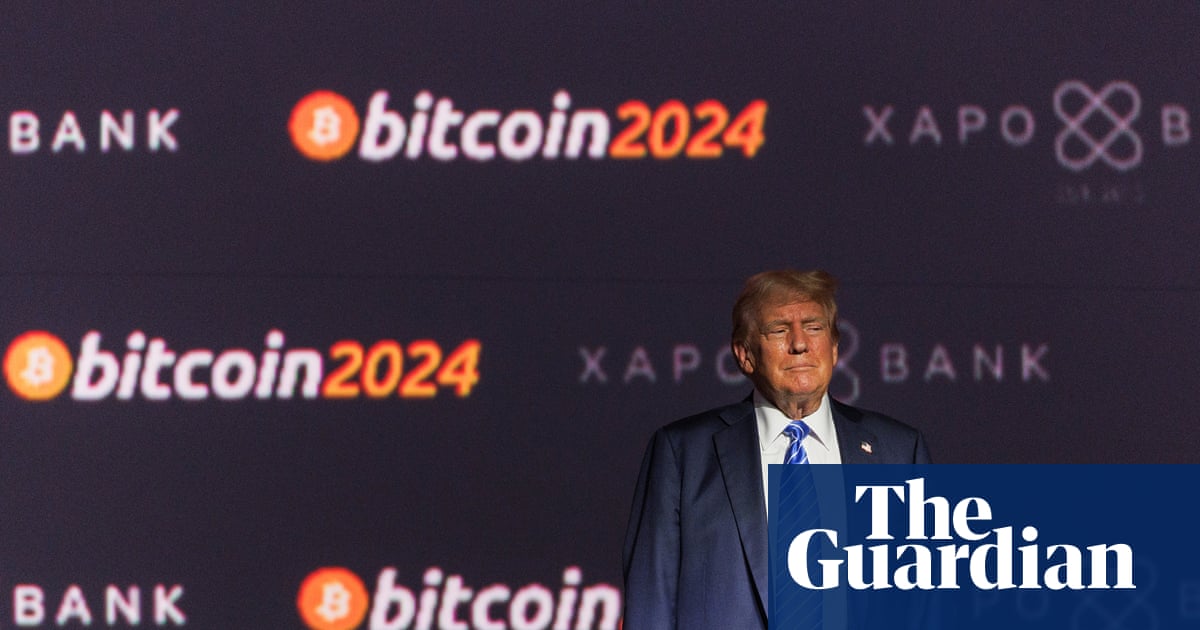
Trump’s pursuit of cryptocurrency riches and deregulation represents a significant shift from his 2021 comments on Fox News, where he described bitcoin, a well-known cryptocurrency, as “seeming like a scam.”
In July 2019, Trump stated that “Unregulated Crypto Assets can facilitate unlawful behavior, including drug trade” and emphasized their “highly volatile” and “thin air” value.
Trump’s current pro-crypto policies have benefited major campaign contributors who are leaders in crypto businesses as well as Elon Musk, the world’s wealthiest individual, who contributed nearly $300 million to support Trump’s election and has significant crypto investments in bitcoin through his electric car company Tesla and other ventures. While Trump and Musk have since had a falling out, Musk’s cryptocurrency holdings appear to have increased because of the president’s deregulation efforts.
Steve Witkoff, Trump’s special envoy to the Middle East, is a real estate billionaire and co-founder of WLF, in which he holds a stake. Trump’s two oldest sons, Eric and Don Jr., and Witkoff’s son, Zach, have played significant roles in promoting WLF in the Middle East and elsewhere.
According to academics, many congressional Democrats, and some Republicans, Trump’s leveraging of his position as President to boost his wealth through his growing crypto ventures, while his administration aggressively reduces regulations, is unprecedented and indicative of corruption.
“To me, Trump’s crypto dealings seem quite obvious,” Julian Zelizer, a political history professor at Princeton University, told the Guardian. “Policy decisions related to parts of the financial industry are being made not to benefit the nation but to serve his own financial interests… It’s difficult to see how what he’s doing benefits the nation.”
Rosenzweig emphasized that “Trump’s extravagant crypto ventures not only benefit him personally as his administration slashes crypto regulations and takes pro-crypto steps at the SEC, but they also benefit his tech backer allies, who will take full advantage of the end of regulatory enforcement.”
In Congress, key Democrats, including Richard Blumenthal, a senator from Connecticut, and Jamie Raskin, a representative from Maryland, announced separate inquiries in May by prominent committees where they hold high-ranking positions into Trump’s crypto dealings, and they condemned Trump for exploiting his office to enrich himself through crypto activities.
“With his pay-for-access dinner, Trump put presidential access and influence up for auction,” Blumenthal told the Guardian. “The scope and scale of Trump’s corruption are staggering – I will continue to demand answers.”
Democratic Senator Jeff Merkley from Oregon, and Senate Minority Leader Chuck Schumer also introduced the “End Crypto Corruption Act” last month, which has been endorsed by 22 other Democrats.
Merkley told the Guardian, “Trump’s crypto schemes represent the Mount Everest of corruption. We must prohibit Trump-style crypto corruption to prevent all elected federal officials, including the president, vice president, and members of Congress, from profiting from shady crypto practices.” Merkley’s bill aims to achieve this.
Some former congressional Republicans are also outraged by Trump’s blatant exploitation of his presidency to promote $Trump. “No one should be permitted to use their public positions while in office to enrich themselves,” said Charlie Dent, a former Republican congressman from Pennsylvania who previously chaired the House ethics panel. “A member of Congress would not be allowed to engage in the type of memecoin activities that the president has been involved in.”
Trump and his family have dismissed criticism regarding the May 22 events and his other cryptocurrency ventures.
Prior to the May 22 dinner, Trump’s press secretary, Karoline Leavitt, informed reporters that the president would attend his crypto gala in his “personal time” and that it was not a White House event. However, she declined to disclose the names of the numerous anonymous and foreign attendees.
To address criticisms, the Trump Organization announced in January that Trump’s business interests, including his assets and investments, would be placed in a trust managed by his children. The president, they claimed, would not be involved in decision-making or daily operations. Trump’s family also hired a lawyer as an ethics advisor.
These commitments have been overshadowed by Trump’s public embrace of his crypto ventures and his strong deregulatory agenda. For example, Trump hosted the first-ever “crypto summit” at the White House in March, attracting a couple dozen industry leaders who heard Trump vow to end Biden’s “war on crypto.”
Trump’s crypto critics are worried that the president’s strong push for industry deregulation could lead to serious problems. The crypto industry has been plagued by significant scandals, including those involving North Korean hackers, and concerns regarding the industry’s lack of transparency and risks.
For example, a report released last December by the leading research firm Chainalysis found that North Korean hackers stole $1.34 billion worth of cryptocurrency in 2024, a record amount that is double what they stole the previous year.
The report concluded that US and foreign analysts believe the stolen funds were diverted in North Korea to “finance its weapons of mass destruction and ballistic missile programs.”
Other crypto fraud schemes in the US have raised significant alarm.
In an annual report released last September, the FBI revealed that fraud related to crypto businesses soared in 2023, with Americans suffering $5.6 billion in losses, representing a 45% increase from the previous year.
Sam Bankman-Fried, founder of the now-bankrupt FTX crypto exchange, was sentenced to 25 years in prison in March 2024 by a New York judge for defrauding customers of $8 billion.
Nonetheless, a Justice Department memo in April announced the closure of a national cryptocurrency enforcement team that had been established in 2022, which had prosecuted major crypto cases against North Korean hackers and other crypto criminals.
The memo emphasized that the Justice Department was not a “digital assets regulator” and attempted to criticize the Biden administration for a “reckless strategy of regulation by prosecution.” The memo stated that a pro-crypto Trump executive order in January prompted the Justice Department’s policy shift.
Former prosecutors and ethics watchdogs are increasingly concerned that crypto scandals and conflicts of interest will worsen as the Trump administration accelerates its efforts to ease crypto oversight at the Justice Department, the SEC, and other agencies.
Some of WLF’s high-profile crypto deals have involved overseas crypto firms that have recently faced regulatory and legal challenges in the US, fueling new concerns, according to watchdogs and former prosecutors.
One lucrative deal that raised eyebrows involved WLF being selected to play a central role in a $2 billion investment by Abu Dhabi financial fund MGX, which is backed by the United Arab Emirates in Binance, the world’s largest crypto exchange.
As part of this deal, the Abu Dhabi fund acquired $2 billion of a WLF stablecoin known as USD1, to invest in Binance. Stablecoins are a popular category of cryptocurrency often pegged to the US dollar.
The WLF deal occurred after Binance pleaded guilty in 2023 to violating US money laundering laws and other violations, resulting in a hefty $4 billion fine from the Justice Department.
Additionally, Binance’s former CEO and founder, Changpeng Zhao, pleaded guilty in the US to violating the Bank Secrecy Act and failing to maintain an effective anti-money-laundering program.
Zhao, who continues to own 90% of Binance, served a four-month jail sentence last year.
WLF’s $2 billion deal was announced at a crypto conference in Abu Dhabi on May 1, which Eric Trump attended just two weeks before Trump’s official visit to the UAE capital, raising concerns about foreign influence and ethical considerations.
Further strengthening WLF’s ties with Binance, the crypto exchange announced on May 22 that it had started listing the stablecoin for trading purposes. Binance also received positive news at the end of May when the SEC announced the dismissal of a civil lawsuit filed in 2023 against the exchange for misleading investors about surveillance controls and trading irregularities.
Paul Pelletier, a former acting chief of the Justice Department’s fraud section, stated that the SEC’s actions in February to “emasculate its crypto enforcement efforts sent crypto fraudsters a welcoming invitation of impunity.”
He added, “The recent dismissal of the SEC’s lawsuit against Binance for mishandling customer funds, occurring days after it began listing the Trump family’s cryptocurrency on its exchange, seemed to be the natural consequence of such lax enforcement. Victims are the ones who suffer.”
Legal scholars contend that other deregulatory actions by agencies that benefit crypto interests may boost Trump’s own enterprises and his allies, but they also pose potential risks for ordinary investors.
Columbia Law Professor Richard Briffault noted that the Department of Labor revoked a Biden-era “extreme care” warning regarding 401K plans investing in crypto as part of the Trump administration’s broad and risky crypto deregulatory agenda, which could benefit Trump’s own crypto ventures.
Briffault said, “[The labor department] has rescinded the red light from the Biden years for 401K retirement plans, which is another sign of the Trump administration’s embrace of crypto.”
Briffault, an expert on government ethics, also told the Guardian that Trump’s crypto ventures and his May 22 memecoin event are “unprecedented.”
“I don’t think there’s been anything like this in American history,” he said. “Trump is marketing access to himself as a way to profit his memecoin. People are paying to meet Trump and he’s the regulator-in-chief. It’s doubly corrupt.”
In late May, Trump Media and Technology Group, the parent company of Truth Social, announced a new crypto business venture: a deal to raise $2.5 billion to be used to buy bitcoin, creating a reserve of the cryptocurrency.
Meanwhile, Trump’s stablecoin investments, along with those of many industry allies, could soon be boosted by a Senate stablecoin bill, called the “genius act”, that is on track to pass the Senate on Tuesday. Critics, however, argue that it dangerously loosens regulatory controls unless amended with consumer protections and other safeguards.
Senators Merkley and Elizabeth Warren of Massachusetts spearheaded unsuccessful efforts to amend the bill to prevent potential criminal abuses, protect consumers, and prevent Trump from using his office to profit from his cryptocurrency businesses.
“The ‘Genius Act’ fails to prevent sanctions evasion and other illicit activity and lets big tech giants like Elon Musk’s X issue their own private money – all without the guardrails needed to keep Americans safe from scams, junk fees or another financial crash,” Warren told the Guardian.
“Donald Trump has turned the presidency into a crypto cash machine,” Warren said. The Genius Act, Warren stressed, should have “prohibited the President AND his family from profiting from any stablecoin project.”
Kedric Payne, the general counsel and ethics director at the Campaign Legal Center, added, “President Trump’s financial stakes in the crypto industry at the same time that he is determining how the government will regulate the industry is unprecedented in modern history. This is precisely the type of conflict of interest that ethics laws and norms are designed to stop.”