

The cryptocurrency market experienced a swift downturn today, with panic selling taking hold across digital assets after a significant geopolitical development. Both Bitcoin and Ethereum saw nearly a 2% drop, contributing to a substantial loss of billions in overall market value. This reaction followed U.S. President Donald Trump’s announcement that the ceasefire with Iran had been declared “over.” Such statements have reignited concerns over possible military conflict in the Middle East, prompting investors to withdraw from riskier assets and causing a new wave of liquidations on major crypto exchanges.
As volatility spikes once again, traders are keeping a close eye on whether this selloff is merely a transient response to news or signals a larger market correction.
What Caused Today’s Decline in the Crypto Market?
The recent downturn stems from macroeconomic uncertainties rather than specific issues related to cryptocurrencies.
Market reactions were immediate when Trump indicated that the U.S.-Iran ceasefire had effectively disintegrated due to renewed military actions, raising alarms about escalating tensions in the region. This shift altered global investor sentiment towards a more risk-averse stance, leading many to reduce their exposure to volatile assets like cryptocurrencies.
Consequently, Bitcoin faced immediate selling pressure, followed by a similar trend in Ethereum and various altcoins. Historically, geopolitical disturbances have prompted traders to unwind leveraged positions and move funds into more secure assets until the environment stabilizes.
Over $400 Million in Crypto Liquidations Fueling the Decline
The geopolitical turmoil quickly influenced the derivatives market, magnifying losses among leading cryptocurrencies. Data from CoinGlass indicates that more than $400 million in leveraged crypto trades were liquidated within the past 24 hours, with long positions bearing most of the losses. A significant portion of these liquidations involved Bitcoin and Ethereum, as falling prices triggered automatic closures of leveraged positions, intensifying selling pressure.
The wave of liquidations escalated what began as a news-driven short-term pullback into a widespread market correction, driving numerous significant cryptocurrencies to their lowest intraday levels.
Panic Selling Drives BTC and ETH to Critical Support Levels
The geopolitical upheaval was quickly reflected in market charts, with both Bitcoin and Ethereum losing crucial intraday support levels as sellers gained the upper hand. Bitcoin fell nearly 2%, dropping below its short-term upward trendline and finding buying interest around the $62,000 support area. The long bearish candle combined with a surge in selling volume indicates panic selling rather than a slow pullback.
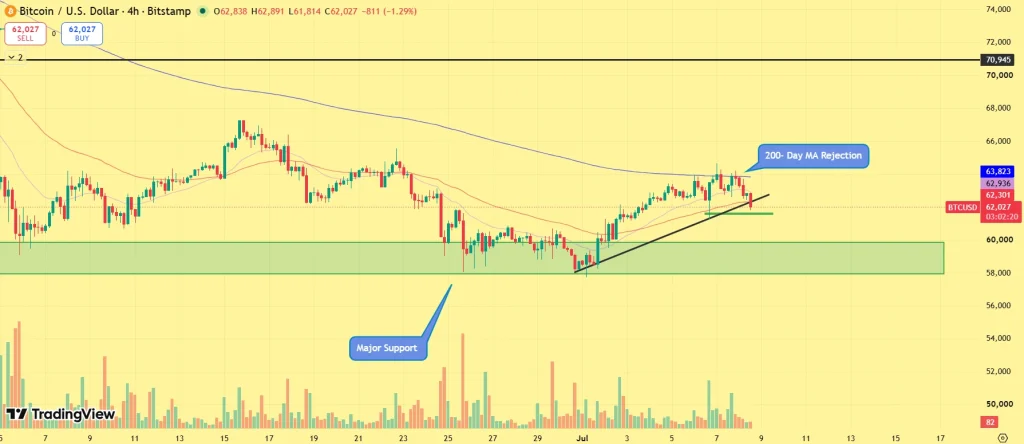
Despite this setback, Bitcoin is still attempting to maintain its overall higher-low pattern. If buyers manage to reclaim the lost trendline, the selloff might turn out to be a brief liquidity sweep. A decisive break below the $62,000 support could lead to further declines towards the next support zone around $60,000-$59,000.
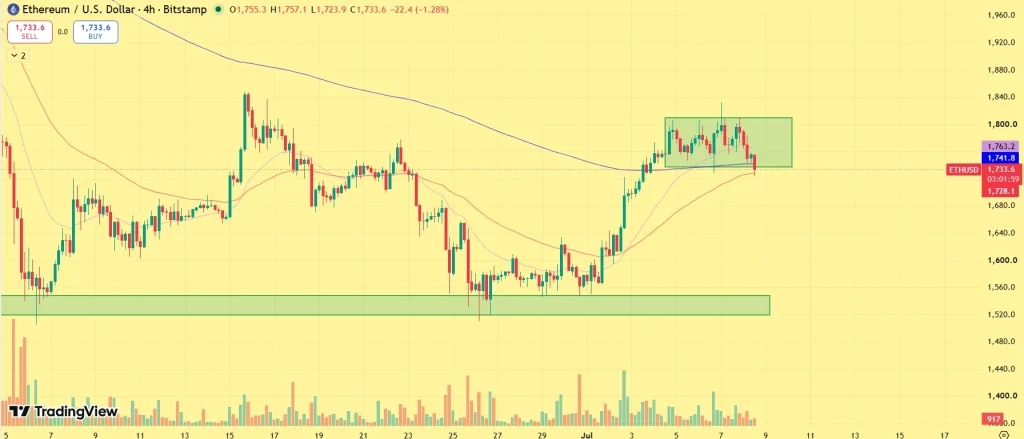
Ethereum mirrored Bitcoin’s downturn, slipping nearly 2% after breaching the lower boundary of its recent consolidation range. This movement pushed ETH towards its 200-hour moving average, where buying support has emerged. It is critical for bulls to hold above the $1,720 support level. Failure to do so may lead to further declines towards the $1,600-$1,550 demand zone, whereas a swift recovery above the broken consolidation range would suggest that today’s drop was primarily driven by headlines, rather than a solid bearish reversal.
At this moment, both Bitcoin and Ethereum remain significantly influenced by geopolitical factors, with price movements likely to stay volatile until market sentiment shows signs of stability.
Is Recovery Possible for the Crypto Market After This Selloff?
The next steps for the cryptocurrency market will largely hinge on developments beyond the blockchain sector. Should geopolitical tensions persist, risk assets may continue facing downward pressure as investors prioritize capital preservation over speculative ventures. Conversely, if signs of de-escalation emerge, today’s selloff might ultimately be regarded as a temporary reaction rather than a precursor to a prolonged downturn. Until that clarity is achieved, Bitcoin, Ethereum, and the wider crypto market will likely remain vulnerable to fluctuations based on updates regarding the U.S.-Iran situation.
Did you find this article useful?
End of story
Trustworthiness of CoinPedia:
Since 2017, CoinPedia has been providing reliable and timely updates on cryptocurrency and blockchain matters. Our content is crafted by an expert team of analysts and writers following strict Editorial Guidelines grounded in E-E-A-T (Experience, Expertise, Authoritativeness, Trustworthiness). Each article is cross-verified against trustworthy sources to uphold accuracy, transparency, and reliability. We guarantee impartial evaluations when recommending exchanges, platforms, or tools. Our commitment is to deliver timely updates on everything related to crypto and blockchain, from startups to major industry players.
Investment Advisory:
All opinions and insights presented reflect the author’s perspectives on current market conditions. We advise conducting your own research prior to any investment decisions. Neither the author nor the publication accepts responsibility for financial choices made based on this information.
Sponsorship and Advertisements:
Sponsored content and affiliate links may appear on our platform. Advertisements are clearly labeled, maintaining complete independence of our editorial content from our advertising partners.
Read the Next News