
January 28, 2025
Cryptocurrency Regulations in 2025: Will the EU and US Head in Different Directions?
As 2025 begins, the regulatory approach to digital currencies remains distinct between the United States and Europe, with each region focusing on separate strategies for managing digital finance. The implications of these diverging policies are significant, especially considering the increasing strain on the US dollar’s global dominance and the growing desire in Europe for more control over its payment infrastructure.
EU’s Unified Regulatory Stance
With the EU’s Markets in Crypto-Assets (MiCAR) regulation taking effect on December 30, 2024, the European Union has solidified its framework for overseeing digital assets. Combined with the Transfer of Funds Regulation and the Digital Operational Resilience Act, MiCAR extends regulatory standards similar to those applied to banks to stablecoins and other cryptocurrencies. The goal is to mitigate potential risks to financial stability and protect consumers from the risks associated with cryptocurrencies, a majority of which originate outside of the EU. The European Central Bank’s (ECB) December 2024 meeting minutes highlighted the perceived financial stability risks to the EU stemming from US-based crypto markets. ECB decision-makers consistently favor a Central Bank Digital Currency (CBDC), such as a digital euro, as a preferable alternative to cryptocurrencies, aiming to preserve economic independence and monetary control for European individuals and businesses.
MiCAR governs the issuance, promotion, and trading of crypto assets and associated services. Companies participating in these activities must adhere to bank-like regulatory requirements, including maintaining robust internal risk management systems and meeting minimum capital thresholds. This regulation encompasses three categories of digital coin (e-money) issuers, with two specifically addressing stablecoins. All e-money issuers are required to obtain licenses as either an electronic money institution or a credit institution (i.e., a bank) in accordance with the Second Electronic Money Directive. The emerging EU crypto industry has generally expressed support for this new framework, citing the legal clarity it provides.
The US’s Divergent Regulatory Path
The evolution of digital currency policy in the United States from 2021 to 2024 has been inconsistent. Rapid market expansion, political disagreements, and substantial losses resulting from fraud have the potential to destabilize the broader financial system and raise concerns about illegal activities within the US crypto sector. These factors led the United States to transition from supporting both crypto and CBDCs in 2022, to adopting a controversial enforcement-based regulatory approach in 2023, which was often overturned by the courts, and finally to considering numerous legislative proposals in Congress during 2024. Bipartisan legislation concerning stablecoins passed in the House of Representatives in 2024 but stalled in the Senate.
The new Trump administration has articulated a strong position. A recent executive order outlines a clear policy that directly contradicts the EU’s approach. The United States is now pursuing a strategy that favors blockchain technology while opposing CBDCs, arguing that they “threaten the stability of the financial system, individual privacy, and the sovereignty of the United States.” The order also asserts that “lawful and legitimate” stablecoins reinforce the “sovereignty of the United States dollar.” Digital finance policy development has been elevated to the White House level through the President’s Working Group on Digital Asset Markets. This policy change will be further supported by parallel pro-crypto initiatives in Congress and among financial regulators following the November 2024 election:
- Senate Banking Committee: The committee’s 2025 legislative priorities include crypto and stablecoin legislation designed to ensure “compliance with all applicable Bank Secrecy Act requirements.”
- House Financial Services Committee: Chairman Travis Hill’s initial public statement pledged to “establish a regulatory framework for digital assets that protects investors and consumers while maintaining innovation in America.”
- Both the House and the Senate have announced investigations and hearings into “Choke Point 2.0,” regulatory initiatives that have limited crypto sector access to traditional financial liquidity.
- Commodity Futures Trading Commission (CFTC): In November 2024, the CFTC expedited the use of non-cash assets as collateral by increasing reliance on distributed ledger technology.
- Securities and Exchange Commission (SEC): Acting SEC Chairman Mark T. Uyeda has established a new task force to accelerate the development of a crypto regulatory framework. Commissioner Hester Peirce, a prominent voice on distributed finance and crypto issues within the SEC, will lead the task force.
Potential Conflicts and Opportunities for Convergence
Prior to the 2024 presidential election, the legal certainty offered by MiCAR was seen by many as creating a competitive edge for emerging EU crypto asset markets. Some advocated for MiCAR as a model for crypto regulation, encouraging the US, UK, and other countries to align with the EU standard.
However, the Trump administration’s recent executive order indicates that MiCAR will not serve as a blueprint for US policymakers. The initiative to develop the first blockchain-native policy framework is supported by both the crypto industry and traditional banking executives. Discussions at the World Economic Forum in Switzerland have reinforced the idea that regulatory clarity will accelerate crypto adoption within the traditional banking sector.
Transatlantic regulatory alignment is still possible. Specifically, US initiatives that broaden the regulatory scope to include cryptocurrencies and mandate compliance with the Bank Secrecy Act could encourage transatlantic convergence simply because comparable financial regulatory requirements do not currently exist in the United States. EU alignment with the new US policy is also a possibility. Indeed, the European Parliament has noted that the EU Commission’s digital euro CBDC initiative is now viewed as a longer-term ambition rather than an immediate priority. Disagreements between the EU Commission and the European Securities Markets Authority (ESMA) regarding the next steps for MiCAR also suggest that more market-friendly regulations may emerge. These types of alignment should not be mistaken for transatlantic regulatory harmonization or convergence, which has been a difficult goal to achieve in the financial services sector for decades.
- Market dynamics: US-based crypto issuers and intermediaries currently dominate EU markets. The 2025 joint report from the European Banking Authority and ESMA on recent crypto-asset developments indicates that USD-based stablecoins represent 90 percent of market capitalization and over 70 percent of trading volume in Europe. The volume of crypto transactions in Europe has remained at 8 percent since 2022, even as digital payment volumes increase. Policy clarity could enable US crypto firms to further strengthen their global market position, potentially harming emerging crypto asset markets in Europe. This may lead EU businesses to pressure policymakers to seek closer alignment with the United States.
- Market access: Several aspects of MiCAR are inconsistent with the operational realities of crypto markets. For instance, the distributed nature of interconnected computers clashes with traditional regulatory requirements for a local physical subsidiary. MiCAR’s local subsidiary requirements could face trade policy challenges as non-tariff barriers, especially given the current US administration’s preference for using trade policy to achieve non-trade objectives. Furthermore, the anonymity of counterparties on blockchain platforms does not align easily with either MiCAR or the US Bank Secrecy Act.
- Financial stability: The rapid collapses of Silicon Valley Bank and Silvergate in 2023 created liquidity stresses for both stablecoins and the traditional banking system. Addressing financial stability risks often necessitates official sector liquidity support in conjunction with proactive regulatory oversight. Preliminary reports suggest that the United States may create a strategic bitcoin reserve. The BITCOIN Act of 2024 (S.4912), introduced by Senator Cynthia Lummis, proposed a strategic bitcoin reserve to function similarly to gold reserves. The legislation did not specify whether or how these reserves could be used to provide liquidity support to markets experiencing distress. Such a reserve could generate controversy and pressure for the creation of similar strategic reserves worldwide.
The EU’s crypto policy framework aims to broaden the scope of banking regulations designed to mitigate financial stability risks originating from non-local entities while promoting a regional CBDC. The US has yet to release details about specific regulatory policy choices. Nevertheless, US policymakers have clearly stated a set of priorities that are significantly different from those of the EU. US policymakers aim to foster private sector blockchain-based intermediation while asserting that CBDC initiatives introduce financial stability risks. A degree of high-level policy alignment remains possible. However, divergences, strong rhetoric, and dramatic events are almost certain to occur.
Hung Tran is a nonresident senior fellow at the Atlantic Council’s Geoeconomics Center and senior fellow at the Policy Center for the New South; a former senior official at the Institute of International Finance and International Monetary Fund.
Barbara Matthews is a nonresident senior fellow at the Atlantic Council’s Geoeconomics Center. She is also Founder and CEO of BCMstrategy, inc., a company that generates AI training data and signals regarding public policy.
At the intersection of economics, finance, and foreign policy, the GeoEconomics Center is a translation hub with the goal of helping shape a better global economic future.
Further reading
Thu, Jan 23, 2025
What is next for crypto regulation in the US?
Econographics
By
Ananya Kumar
What does success on the regulatory front actually look like? What does it mean for the rest of the world? We dive into the dozen bills under consideration in Congress and zoom in on the three big themes for crypto regulation in 2025.
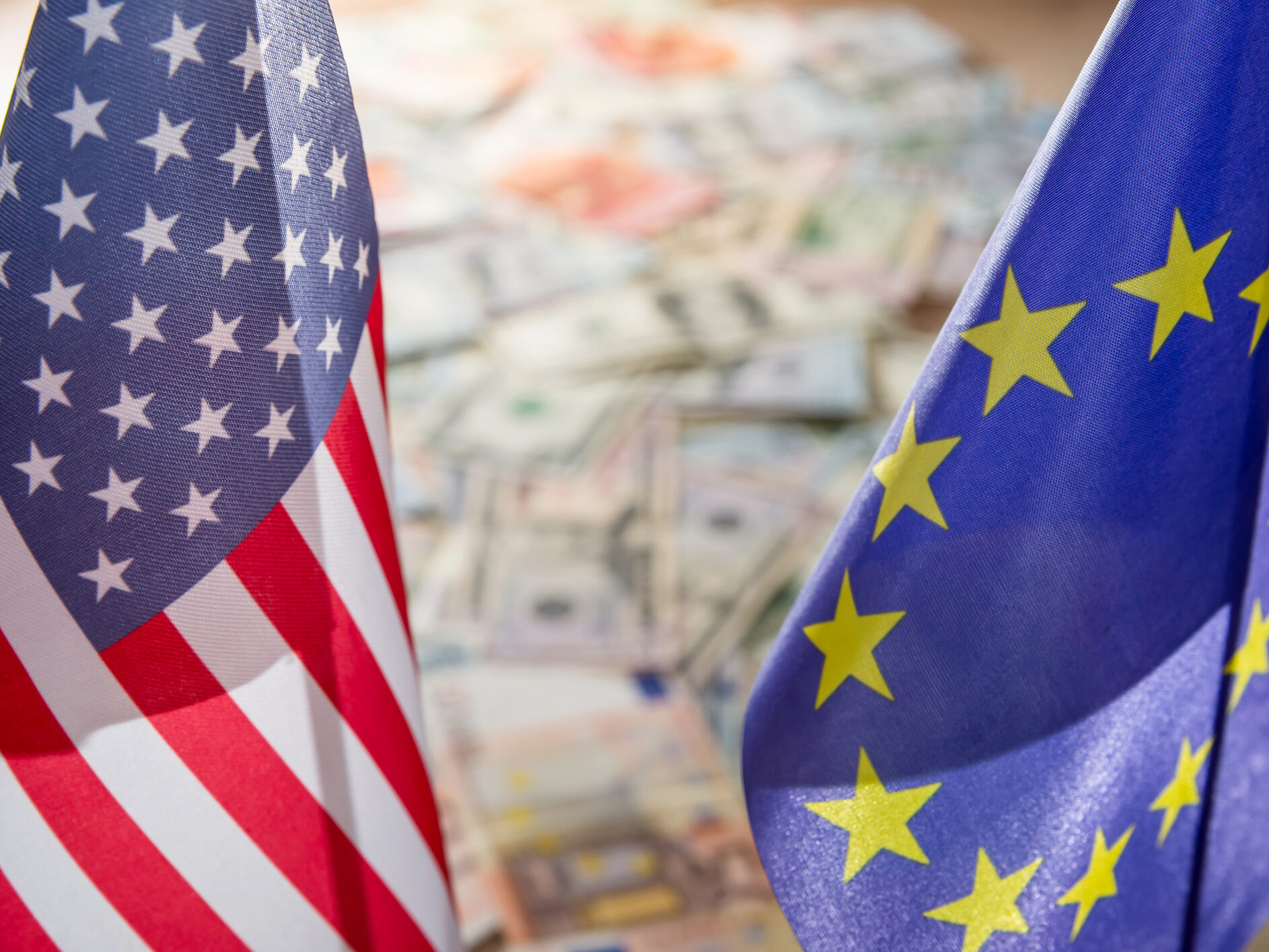
Image: US Dollar and Euro on flags of the United States and European Union.