


Once again, Bitcoin finds itself influenced by global political events, specifically the ongoing tensions between the United States and China. The repercussions of this situation are being felt throughout the cryptocurrency marketplace. This pattern is reminiscent of earlier events this year, as renewed trade disagreements between the U.S. and China have resulted in a
significant price drop for Bitcoin. When tariffs were initially increased, causing uncertainty in markets for many weeks, the price of BTC dropped by approximately 30%.
US-China Trade Issues Lead to Bitcoin Price Decline
“Uptober,” which began with Bitcoin experiencing almost an 18% surge, quickly turned negative after government announcements imposing substantial tariffs on imports from China and implementing restrictions on exports of important technologies.
The reaction was immediate. Bitcoin’s value fell by more than 13% from its high of around $126,000, briefly reaching lows of approximately $107,000. This resulted in the liquidation of over $19 billion in leveraged trading positions within a few days, with
over $9.4 billion disappearing in just 24 hours.
Trade-related news affected the crypto market, and a sense of historical repetition swept the market. It was difficult to ignore the similarities to the decline from March to May, where a similar geopolitical issue triggered a 30% downturn that lasted almost three months.
Liquidity Concerns and Market Impact
The mechanics behind the price decline were clear and decisive. As market volatility increased, liquidity decreased among various exchanges. The altcoin markets showed inconsistency, intensifying the selloff. The issues associated with the USDE stablecoin and the liquidation of numerous positions highlighted how closely crypto liquidity is linked to worldwide economic risks and important news from Washington and Beijing.
Even with the Federal Reserve’s encouraging statements regarding risk, the speed and intensity of the deleveraging demonstrated an underlying vulnerability. Cryptocurrency is a high-risk, liquid asset, and when systematic risk arises, it can be negatively impacted.
Underlying Industry Strength Despite Volatility
Even with the volatile market, the crypto industry is not giving up. Although institutional investors may have reduced risk, Bitcoin remains a macro hedge. Currently, over 172 companies hold Bitcoin as part of their holdings. Even as ETF withdrawals increased, retail investors contributed more than $1.1 billion to spot markets during the price decrease.
However, challenges could persist. Ecoinometrics
notes
that similar downturns in the past often did not recover until risk appetite returned about three months later.
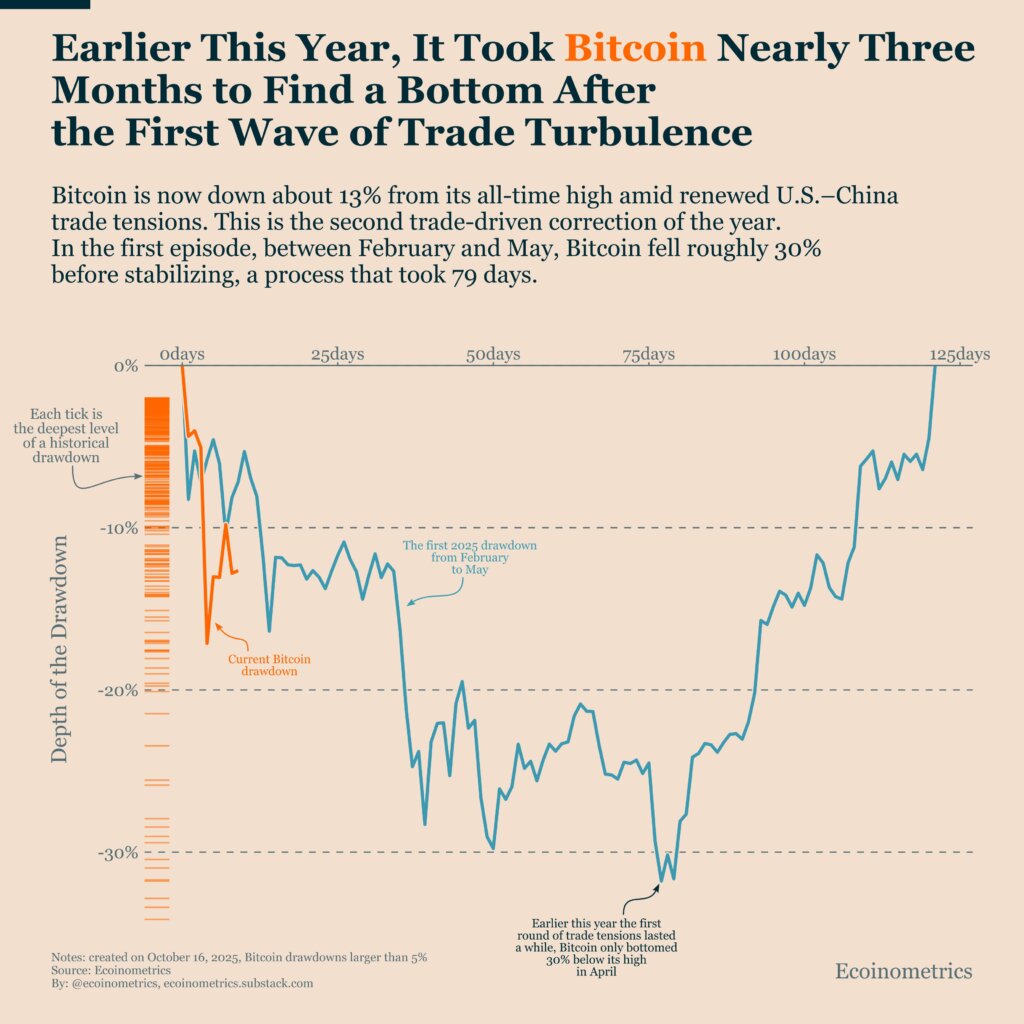
Bitcoin is struggling to remain above the $107,000 mark and as October turns into a more extended period of challenges, the focus remains on U.S.-China trade relations. If the events of March to May are any indication, trade-related challenges may extend into November before Bitcoin’s longer-term trend returns.
For now, market fluctuation is inherent, and if past results are a good indicator, the crypto market’s recovery will come from an increase in risk tolerance and liquidity, rather than specific forecasts.