
Digital currency acquisition is increasingly achieved through crypto mining, offering an avenue to earn without direct purchasing. In this role, miners validate blockchain transactions, fortifying network integrity and receiving cryptocurrency rewards. However, the array of available digital currencies can make selecting the most suitable one challenging, particularly given the nuances of cost structures, computational difficulty, and potential returns.
This guide will present a curated list of seven promising cryptocurrencies for mining in 2025, accompanied by recommendations for optimizing your selection based on computing equipment, power consumption expenses, and overall mining objectives.
Mining Profitability: A Cryptocurrency Comparison
|
Digital Currency |
Block Reward Amounts |
Mining Algorithm Employed |
Hardware Needed |
Block Generation Duration |
|
Bitcoin (BTC) |
6.25 BTC (Anticipate Reward Halving) |
SHA-256 |
ASIC (Application-Specific Integrated Circuit) |
10 minutes |
|
Monero (XMR) |
0.6 XMR |
RandomX |
CPU or GPU (ASIC-Resistant) |
2 minutes |
|
Litecoin (LTC) |
6.25 LTC |
Scrypt |
GPU |
2.5 minutes |
|
Zcash (ZEC) |
3.125 ZEC |
Equihash |
GPU |
1.25 minutes |
|
Dash (DASH) |
2.48734 DASH |
X11 |
GPU |
2.5 minutes |
|
Ravencoin (RVN) |
2,500 RVN |
KAWPOW |
CPU or GPU (ASIC-Resistant) |
1 minute |
|
Ethereum Classic (ETC) |
2.5 ETC |
Etchash |
GPU, ASIC Preferred |
13 seconds |
Top Cryptocurrencies for Mining in 2025: An Overview
1. Bitcoin (BTC)

Bitcoin
, launched in 2009, is often the first name that comes to mind in crypto mining discussions. Bitcoin mining involves leveraging potent computing systems to tackle intricate mathematical challenges. Each successful computation contributes a transaction “block” to the blockchain, rewarding the miner with BTC.
Currently, successful miners receive
3.125 BTC for each resolved block
. This reward amount is structured to decrease by half every four years, a process known as “halving.” This progressive reduction will proceed until the entire supply of 21 million BTC is extracted, with projections estimating completion around 2140.
Bitcoin mining requires specialized equipment comprised of
ASICs (Application-Specific Integrated Circuits)
. Standard computers or graphic cards cannot compete with ASICs’ performance. High-performing ASICs can compute trillions of hashes per second (TH/s), surpassing what GPUs (Graphics Processing Units) can achieve.
The highly competitive field of Bitcoin mining has pushed many participants to join
mining pools
, which leverage collective computing resources for better success rates. Pool members share earned rewards relative to their contributed computational power. While individual mining endeavors are feasible, the elevated difficulty involved means success is uncommon without significant resources. The mining difficulty automatically readjusts every two weeks to maintain an average block resolution duration close to
10 minutes
.
2. Monero (XMR)

Monero
coin mining is considered one of the most accessible starting points into the sphere of crypto mining. Monero’s algorithm,
RandomX
, is uniquely designed for efficient CPU mining, standing in contrast to cryptos such as Bitcoin that require specialized ASIC hardware.
Individuals with suitable computers, such as gaming PCs equipped with AMD Ryzen or Intel i9 processors, can mine XMR from home. Certain CPUs, such as
AMD’s Ryzen 9 5950X or Intel’s i9-10900K
, are noted for their high hash rates, which translate to fast resolution of the mathematical equations required for earning Monero rewards.
For mining Monero, specific mining software is necessary, with
XMRig
as a favored choice for CPU-based crypto mining due to its compatibility across CPUs and GPUs. Typical rewards for Monero miners include
0.6 XMR every two minutes.
Monero employs a “tail emission” model to maintain ongoing incentives for miners to remain active, thus ensuring the continuity of block rewards. Paired with Monero’s robust privacy features, the platform is favored by privacy-conscious, small-scale miners. Compared to Bitcoin, Monero mining demonstrates energy efficiency, making it an advantageous option for novice miners.
3. Litecoin (LTC)
Similar to Bitcoin but engineered for speed,
Litecoin (LTC)
is another cryptocurrency suitable for beginner miners because of its established status and dependability. Created in 2011, Litecoin is intended to expedite transaction processing with block processing times of around
2.5 minutes
, as opposed to Bitcoin’s 10 minutes.
It employs a proof-of-work (PoW) system with an algorithm termed “Scrypt”, differentiating it from Bitcoin’s mining. Scrypt demands less energy and memory, easing the mining process but still calling for strong hardware.
Mining Litecoin typically requires an ASIC miner, a piece of equipment designed exclusively for crypto mining. Due to Litecoin’s increased mining difficulty, solo mining is generally impractical. Miners typically join mining pools like LitecoinPool or F2Pool. Other key components for Litecoin mining include crypto mining software (such as CGMiner or EasyMiner), a secure cryptocurrency wallet, and a stable internet connection.
4. Zcash (ZEC)
Zcash (ZEC)
is prized for its heightened privacy and comparatively accessible mining parameters. The algorithm employed, Equihash, integrates smoothly with GPUs, empowering home-based miners to participate with suitable graphics cards.
Nvidia cards, like the GTX 1070 or RTX 3070, are common choices for GPU mining rigs. While ASICs are viable, Zcash was initially engineered to favor GPU usage for enhanced decentralization. While ASIC miners are more effective, their configuration costs are significant.
Software options such as
EWBF
,
Gminer
, and
NiceHash
are popular with Zcash miners, particularly those utilizing Nvidia GPUs. Block rewards for Zcash miners are around
3.125 ZEC
.
5. Dash (DASH)
Dash
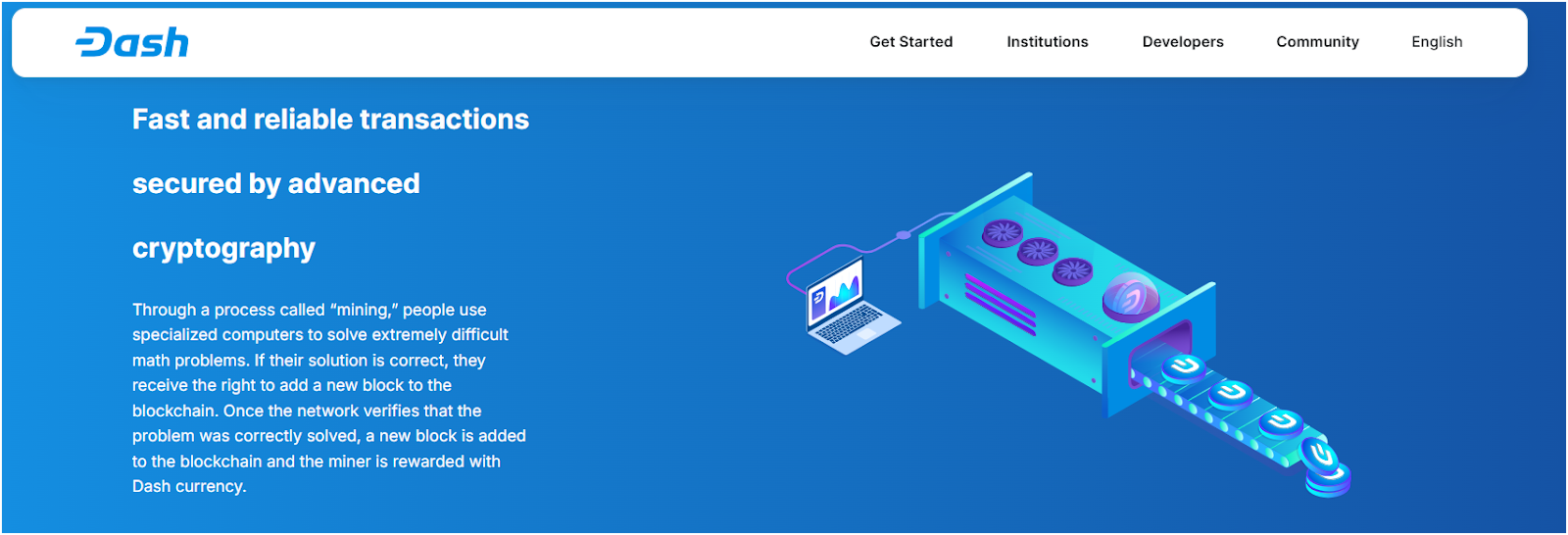
mining uses the X11 algorithm, which integrates 11 distinct hashing functions, improving efficiency and security.
Dash mining is less power intensive than Bitcoin mining and provides more consistent profits due to a block reward reduction model where the reduction is 7% per year instead of halving every four years.
Dash uses a two-layer system featuring “masternodes”, which manage important network features like InstantSend and PrivateSend. Masternodes receive rewards, splitting earnings with miners and promoting network decentralization. Mined blocks provide rewards of
about 2.48734 DASH
, making Dash appealing for smaller operations.
6. Ravencoin (RVN)
Ravencoin (RVN)
is suited for GPU mining, especially on a budget. RVN employs a KAWPOW algorithm, making it ASIC-resistant and suitable for GPUs. Standard GPUs can be used without requiring high-end, expensive equipment.
Mining pools such as
RavenMiner
or F2Pool are common, as miners share mining power for consistent rewards. RVN offers a block reward of
2,500 RVN every minute
, making it accessible for beginners.
7. Ethereum Classic (ETC)
Ethereum Classic
(ETC) utilizes a Proof-of-Work (PoW) system, similar to the original Ethereum, supporting decentralized mining and network security. It uses a modified Ethash algorithm called Etchash, simplifying the process for miners without expensive hardware.
A GPU with 4GB of VRAM is sufficient, and some miners use ASIC rigs like the
Jasminer X4
. A GPU-based setup should include high hash rates and lower power usage.
For improved earning potential, joining a mining pool is advised, with Nanopool, Ethermine, and F2Pool being popular choices (at approximately 1% fees). Miners can expect around 0.64 ETC per day per standard GPU rig, depending on electricity costs and current ETC value.
Understanding Cryptocurrency Mining
Cryptocurrency mining is the process of creating crypto coins, such as Bitcoin or Ethereum Classic, and validating transactions on a blockchain network through mathematical solutions.
Miners use computers to guess a “hash” that confirms transactions in a “block”. Successful resolution adds a block to the blockchain, and the miner is rewarded.
Early mining of Bitcoin was possible with home computers, but increased demand and difficulty have required more powerful machines.
Most successful miners now use specialized hardware and join “mining pools”. Mining maintains blockchain security by verifying transactions in a decentralized manner.
What Essential Tools Do You Need to Begin Mining Crypto?
Mining Hardware
There are three main types of hardware used for cryptocurrency mining, which are CPU, GPU, and ASIC mining.
CPU Mining
CPU mining utilizes a computer’s central processor for mining. While it was popular at Bitcoin’s start, it has become slow and unprofitable for major cryptocurrencies. CPU mining may still be suitable for smaller coins.
GPU Mining
GPU mining involves graphics cards to resolve mining puzzles. GPUs can handle more data than CPUs and are useful for mining coins like Ethereum Classic or Ravencoin.
GPU mining setups, or “rigs”, can be cost-effective and adaptable, as they can mine various coins, depending on mining profitability.
ASIC Mining
ASICs (Application-Specific Integrated Circuits) are custom-built devices for mining specific coins like Bitcoin or Litecoin. They are fast and efficient, but expensive and suited only for certain coins.
New ASIC models are frequently released, causing older models to lose profitability. ASIC mining remains the most effective option for high-demand coins.
Mining Software
Crypto mining software allows hardware to perform the calculations needed to mine cryptocurrencies by connecting it to the blockchain network and managing the mining process.
Some of the best Bitcoin and crypto mining software include CGMiner and EasyMiner. They are optimized for connecting to the blockchain, managing hardware, and maximizing mining profitability.
Cloud Mining
Cloud mining does not require owning hardware. Users pay to access professional mining farms and benefit from their hardware. The company handles the mining, and users receive a share of the reward.
Cloud mining is easy and maintenance-free, but high fees and scams pose risks.
Mining Pools
Mining pools combine computing power to mine more efficiently and split the reward based on each person’s contribution. Pools are almost essential for solo miners since individual success is improbable.
Selecting the Optimal Cryptocurrency for Mining
Crypto mining profitability hinges on factors such as equipment, electricity costs, and the coin’s value. Consider the following steps to identify a favorable mining cryptocurrency.
1. Profitability
Profitability calculators, such as
whattomine.com
, estimate potential earnings from mining different coins. After entering hardware and electricity costs, a list of potentially profitable cryptos is provided.
Bitcoin is currently the most profitable cryptocurrency due to its value and liquidity. Litecoin and Ethereum are also popular due to high demand.
2. Block Reward and Halving
Each crypto has a specific block reward. For instance, Bitcoin currently rewards 3.125 BTC per block, but this reward halves every four years.
Halving reduces mining rewards, making the coin scarcer. Understanding a coin’s reward cycle is crucial for choosing a long-term profitable coin.
3. Mining Difficulty
Difficulty refers to the challenge of mining a new block. As more miners join, the difficulty increases, making it harder to earn rewards.
Bitcoin’s difficulty has risen, making solo mining impossible without high-powered ASICs. Mining smaller or newer coins may yield better results for smaller miners.
4. Electricity Costs
Mining requires significant electricity. Miners calculate energy usage to determine if they are covering costs.
Areas with cheaper electricity or green energy options help miners achieve better profit margins.
Type of Mining Hardware
The type of coin chosen often depends on the mining hardware and its compatibility with the coin’s algorithm. ASIC mining hardware is powerful but limited, while GPUs can mine various coins but may be less efficient. Match existing hardware to appropriate coins.
Market Value and Liquidity
Check a coin’s market value and ease of sale. Coins with low value or trading volume can be difficult to convert into money.
Bitcoin, Litecoin, and Ethereum Classic are widely traded and have high demand.
Community Support and Development
Coins with strong development teams and active communities are generally more reliable and have regular updates.
Bitcoin and Ethereum have large communities, and projects like Ravencoin show good support and growth.
Is crypto mining still profitable
Yes, crypto mining can still be profitable. However, key factors like electricity costs, mining difficulty, and current market conditions greatly affect profitability. Electricity costs are a major factor, as mining operations require significant power.
Bitcoin mining is still profitable, but more challenging due to the halving in April 2024, which reduced block rewards, necessitating careful consideration of electricity, hardware, and pool fees.
Mining crypto becomes easier with cheap electricity and efficient hardware such as ASIC miners. ASIC miners can cost between
$2,000 and $10,000
each, and electricity accounts for
60-75%
of a miner’s expenses. It costs around $45,000 to mine one Bitcoin, making monitoring the coin’s price essential.
Careful planning and efficient hardware is necessary. New and small miners may face limited profitability without cheap power or mining pool participation.
Key Strategies for Profitable Cryptocurrency Mining
-
Select the Right Hardware
: The most important tool for mining is your hardware. ASIC miners are essential for Bitcoin and some other cryptos, while GPUs are popular for smaller coins like Ravencoin. Efficient hardware can save power and increase your mining speed. -
Choose Cheaper Electricity
: Since electricity is a major cost in mining, having access to cheap power is key. Countries with low energy costs are often favored. -
Join a Mining Pool
: Mining pools combine the computing power of multiple miners, increasing your chance of earning rewards. F2Pool is one of the largest mining pools. -
Consider Cloud Mining for Lower Setup Costs
: Cloud mining allows participation without owning the equipment. Platforms include Binance Cloud and Hashmart, though fees reduce profits. -
Optimize Cooling and Maintenance
: Mining hardware can overheat, causing performance issues. Good cooling systems and regular checks can prevent costly repairs. -
Pick the Right Coin
: While Bitcoin is the biggest cryptocurrency, mining coins with lower competition, like Monero or ZCash, might be more profitable. -
Stay Updated on Mining Difficulty:
It refers to how complex the mining algorithm is, and it adjusts based on the network’s computing power. Monitor it to determine which coins may be easier to mine at different times.
Conclusion
Mining cryptocurrency in 2025 faces high costs and competition. Bitcoin mining suits powerful hardware and affordable electricity. Casual miners can consider cloud mining or joining a pool.
The future depends on electricity prices, the crypto market, and technology. Have a plan, choose efficient tools, and carefully calculate costs. Mining is worth it with the right approach and resources.
Frequently Asked Questions (FAQs)
Is mining crypto legal?
Yes, crypto mining is legal in most countries. However, some countries, have banned it due to its high energy use. Always check your country’s laws before starting.
What’s the most profitable crypto to mine?
The most profitable cryptocurrency to mine depends on your hardware, electricity rates, and investment capacity. Profitability also fluctuates over time as coin values and hardware efficiency change.
-
For powerful ASIC mining rigs, Bitcoin, Litecoin, or Dash may offer higher mining profitability, especially with low electricity costs.
-
For low-cost setups using CPUs or entry-level GPU mining rigs, consider Monero or ASIC-resistant coins.