
Author
Eric Huffman

Author
Eric Huffman
Share

Fact Checked by
Dassos Troullides

Author
Dassos Troullides


Bitcoin’s recent price increase to over $104,000, in combination with the global cryptocurrency market exceeding a $3 trillion valuation, has heightened the market’s instability. Furthermore, the approval of Bitcoin ETFs and wider acceptance by large financial institutions are driving opportunity in crypto day trading.
This guide explores leading strategies for crypto day trading, enabling you to potentially gain during the current upward market trend. From monitoring trends to taking advantage of price differences, these techniques provide options suitable for various trading styles.
Given the breadth of possible approaches, there’s often a chance to find a trade somewhere within the crypto market that could be profitable.
The Top Crypto Day Trading Strategies
Considering the significant price swings characteristic of the cryptocurrency space, the constant arrival of new digital currencies, and the fact that trading is possible around the clock, crypto markets might seem like an ideal environment for day traders. While the sheer number of possibilities is undeniable, this situation also comes with a greater degree of inherent risk.
Although the crypto world may appear less regulated than standard financial venues, achieving consistent profitability in day trading still calls for a well-thought-out plan to secure gains over the long haul. Adopting a professional-level trading mindset can be very beneficial, especially when many inexperienced traders are investing in digital currencies without doing sufficient research into which cryptocurrencies are best suited for day trading.
The complexity of strategies used in crypto day trading varies widely, and each one typically demands substantial time and practical experience to fully master. It’s advisable to select an approach that aligns well with your personal level of risk tolerance and individual strengths, in addition to making use of the best platforms available for crypto day trading. Let’s explore some frequently used day trading strategies within the crypto market and dissect the specifics of each.
1) Trading New Exchange Listings – Ideal for Significant Gains
Cryptocurrency values often jump when coins are introduced on major exchanges like Coinbase or Binance. To capitalize on this day trading strategy, quick action is essential.
One method involves employing automated systems to buy immediately upon listing announcements. Such bots can act faster than humans, offering a timing edge before prices rise. However, the field is competitive, and using these tools involves costs for setup and requires some technical skills.
Another route is buying the coin at a discount during its initial presale phase. Aim for tokens that are almost through their presale, where you can often get them cheaper. Sell soon after the exchange listing to take advantage of the price surge.
Timing is crucial in both strategies. Coins often see an instant increase in value, followed by a rapid drop. It’s wise to be cautious with projects that are overly hyped or have low trading volumes, as their prices can collapse after listing.
For example, Peanut the Squirrel (PNUT) saw its value climb from $0.09 to $0.46—a 411% increase—when it was listed on Binance on November 11, 2024. This shows the possible rewards of getting in early.
This approach is most effective if you can act quickly and have a well-defined plan for when to exit the trade. Always assess the project’s underlying quality and how much it’s being traded before investing.
Pros
- Potential to get in on quick and significant price changes
- Opportunity for large profits from low initial prices
- Increased interest from buyers due to hype
- Enhanced visibility and credibility through exchange listings
- Multiple chances to enter and exit due to volatility
Cons
- Risk of early investors selling off and causing prices to drop
- Possibility of inflated prices due to excessive hype
2) Scalping – Ideal for Fast Gains
Scalping, or scalp trading, involves executing a high volume of trades to capture small profits from minor price fluctuations. Scalpers aim to make numerous trades daily, focusing on accumulating small wins rather than seeking large, single-trade gains.
Traders often use chart indicators like stochastic oscillators, parabolic SAR, and the relative strength index (RSI) to provide insights into short-term price direction.
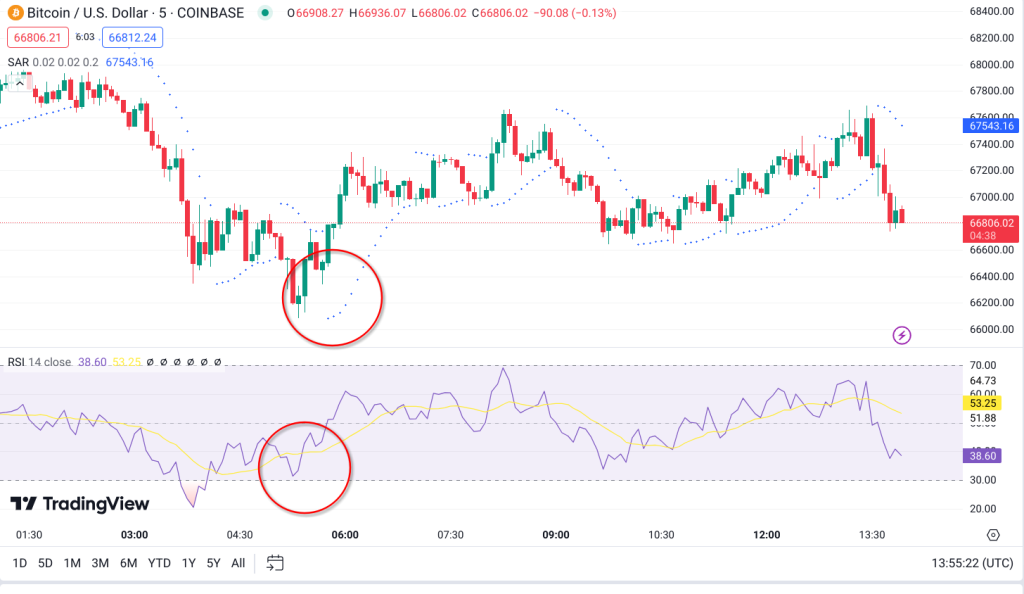
As shown in the 5-minute chart, the parabolic SAR signaled an increasing trend, confirmed by the RSI. Following these indications, Bitcoin’s value went up by about $1,000. Many crypto exchanges offer TradingView charts, providing access to these indicators. For scalping, one-minute and five-minute charts are particularly useful.
Given the rapid movements in crypto markets, traders often use stop-loss and take-profit orders to protect their funds and secure earnings. When short-selling Bitcoin, these indicators can also highlight multiple opportunities to profit from a downward trend, as seen at the chart’s end.
Pros
- Leverage not required
- Simple for beginners to understand
- Chart indicators offer multiple confirmations
Cons
- Demands careful monitoring due to small profit margins
3) Trend Following – Ideal for Longer-Term Positions
The saying “the trend is your friend” is relevant here. Observing the success of recent meme coins demonstrates trend following in action. This strategy involves identifying an upward trend, establishing a position, and selling once the trend weakens. The goal is not to be first or last, but to profit by riding the wave.
With major assets like Bitcoin, this may require trades lasting several days. However, altcoins and meme coins can experience daily price movements that present shorter-term opportunities. The right choice of crypto to trade is critical, as some options will inherently offer more potential than others.
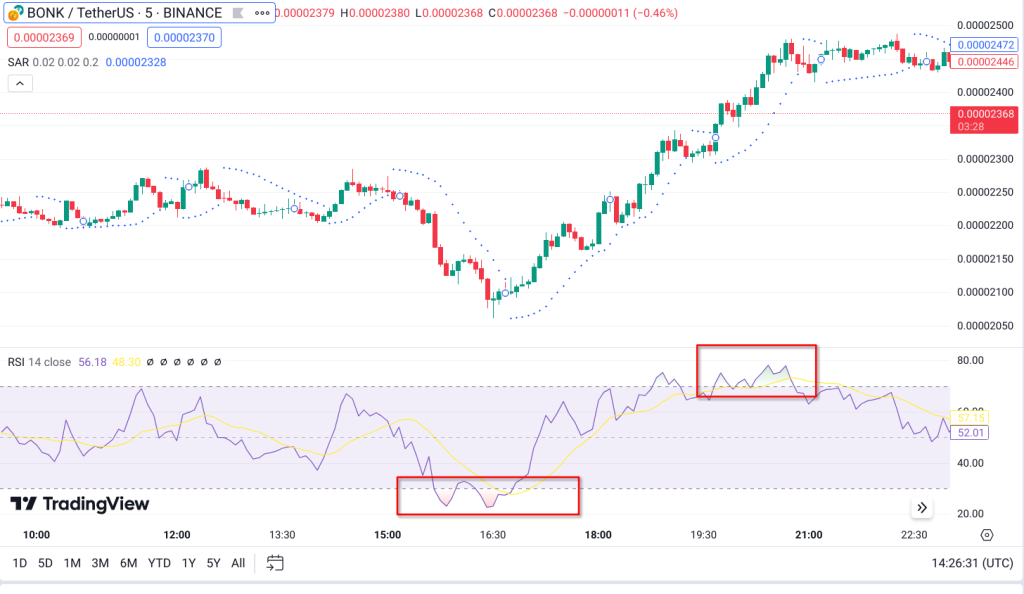
In the 5-minute BONK chart, the RSI showed oversold conditions, and then signaled overbought conditions roughly 13% later. Although it didn’t capture the absolute peak, the RSI effectively alerted traders to exit before a price reversal, marking a conservative trading strategy.
AI tokens and Solana meme coins are currently popular for day trading in August 2025, with coins such as dogwifhat (-40.98% YTD), Nosana (-76.22% YTD), and Goatseus Maximus (+1859.58% YTD) providing higher-than-average returns.
X (formerly Twitter) provides a lot of crypto discussions about popular coins. Many trending coins are on decentralized exchanges, which can be more complex than trading on centralized exchanges. Dextools provides an overview of trending crypto investments, many with significant returns and only a few days (or hours) old.
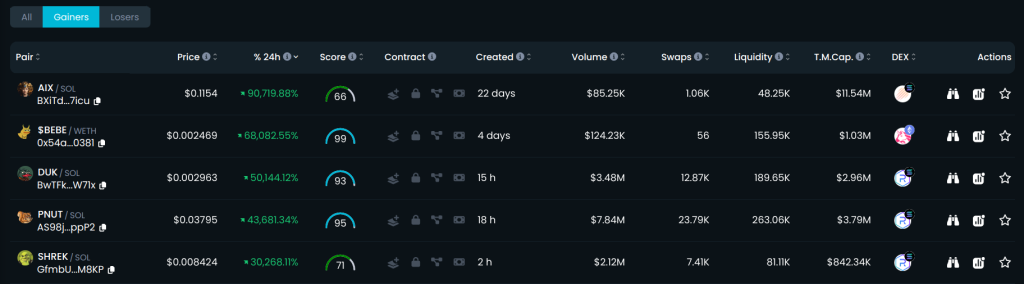
However, the “Losers” section on Dextools shows the potential consequences of holding positions for too long; many meme coins tend to decline to zero.
Pros
- Substantial potential for profit
- Ability to generate significant returns from small investments
Cons
- Often requires trading on decentralized platforms
- Most trending altcoins are likely to become worthless
4) Range Trading – Best for Consolidation Patterns
Range trading involves trading within a specific range observed during consolidation phases. Here, support levels act as entry points, preferably confirmed by other indicators, while resistance levels serve as exit points.
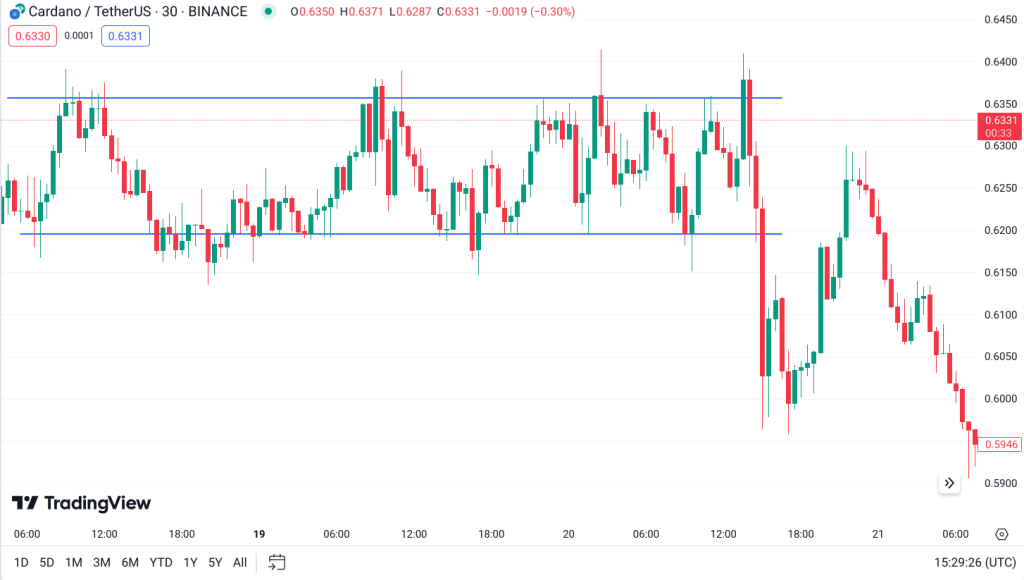
Crypto assets often trade sideways for extended periods, which limits opportunities for large gains. However, range-bound coins and tokens still offer chances for profit.
In the chart, Cardano (ADA) is trading within a narrow range, presenting four opportunities for long trades, as well as four short trade chances, the last of which is considerably larger.
Consolidation patterns indicate uncertainty but can also signal accumulation. Like other strategies, using stop-loss and take-profit orders is often wiser due to the possibility of market uncertainty breaking either way from news or price moves in other assets.
TradingView technical indicators for support and resistance can guide trades, or traders can draw their own lines for a shorter time frame.
Pros
- Easily identifiable patterns
- Reduced trading frequency
- Easy to implement on centralized exchanges
Cons
- Potential for quick shifts in trading conditions that can break the range
5) Breakout Trading – Ideal for High-Percentage Profits
Seeking price breakouts is a strategy that may provide substantial gains. It involves identifying assets set for a significant rise and buying based on confirming indicators.
Tools are available to help spot crypto assets ready for a breakout. For instance, in the chart below, ETH shows a sharp increase against BTC. The subsequent chart pattern forms a falling wedge, also referred to as a descending wedge. This pattern suggests that while ETH’s value is decreasing relative to BTC, each declining phase tightens the wedge, often leading to an upward breakout.
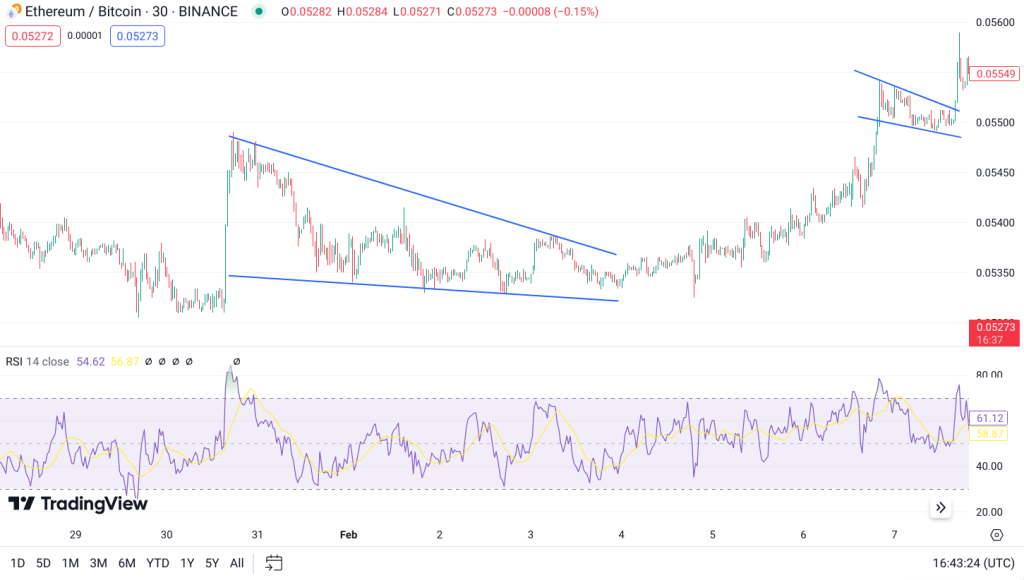
TradingView offers some premium indicators that are useful for identifying falling wedge patterns, although the patterns themselves are relatively easy to identify. Here, the RSI shows overbought conditions at the wedge’s start, suggesting a temporary consolidation before further gains.
Pros
- No requirement for paid tools
- Patterns are easily recognizable
- Useful for both short-term and longer-term trades
Cons
- Finding breakouts requires monitoring multiple assets
- New events can halt breakouts
6) News-Based Trading – Ideal for Those Who Follow News
Keeping up with interest rates can provide insight into market reactions when figures like Fed Chairman Gerome Powell speak. Trading crypto allows for capitalizing on news events if you can accurately predict market response.
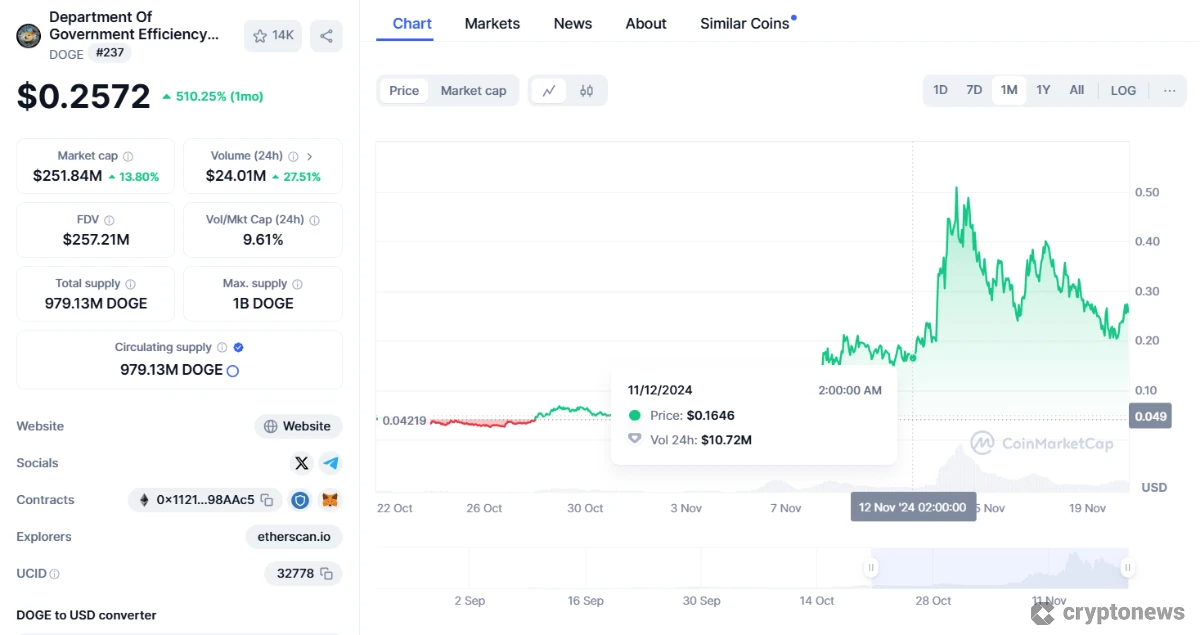
The Department of Government Efficiency (DOGE) cryptocurrency saw significant growth, climbing from around $0.1670 on November 12 to a peak of $0.5085 on November 13, an increase of over 204.49% in just 43 hours.
 Share.