

Back in 2022, when I ventured into the world of cryptocurrency day trading, I quickly realized that embracing specific principles and strategies was crucial for success.
In this article, I aim to share the insights that enabled me to achieve profitability as cryptocurrency values fluctuated, established trends, and sometimes remained within defined ranges. These concepts and the strategies I adopted significantly improved my trading outcomes and those of many other thriving crypto traders.
Here’s what we’ll explore:
- Effective cryptocurrency day trading strategies
- A practical step-by-step guide
- Key Dos and Don’ts for successful day trading
Understanding Crypto Day Trading
Cryptocurrency day trading involves initiating a trade in a particular cryptocurrency and then closing that position within a short period, generally during the same trading day. For instance, I might buy Bitcoin at 10:00 AM and then sell it at 3:00 PM, completing a day trade.
Cryptocurrency markets operate continuously, 24/7, without formal daily opening or closing times. This means crypto day trading can occur around the clock. The standard definition of day trading involves opening and closing a trade position on the same calendar day. However, for the purposes of this discussion, I also categorize trades held open slightly longer than a single day as day trading.
Essentially, day trading requires a focus on short-term market movements, demanding precise timing to capitalize on immediate opportunities.
The Appeal of Day Trading Cryptocurrencies Like Bitcoin
Leveraging Liquidity and Volatility
The most advantageous markets for day trading possess both liquidity and volatility. Cryptocurrencies, especially Bitcoin, exhibit high levels of both, making them ideal candidates for this type of trading.
Liquidity describes how easily an asset can be bought or sold without substantially affecting its market price. A liquid asset typically has a substantial market capitalization and significant trading volume. Bitcoin’s market cap exceeded $1 trillion in February of 2024 and grew to over $2 trillion the following year.
However, high market capitalization alone isn’t sufficient; a market must also exhibit price movement. This is where volatility becomes crucial. Fortunately, cryptocurrencies generally show considerable daily price fluctuations. From 2020 to 2024, Bitcoin’s annual volatility was between 3.7 and 4.9 times greater than that of the S&P 500 Index and gold, respectively.
This heightened volatility translates into significant daily price changes, creating numerous opportunities for profitable day trades.
Abundance of Crypto Brokers and Diverse Trading Options
The popularity of cryptocurrencies has driven a corresponding increase in the number of brokers offering crypto trading and the variety of trading methods available. Traders can now engage with crypto using futures or ETFs on regulated platforms, CFDs through specialized brokers, or by directly buying and selling cryptocurrencies on crypto exchanges. Futures and CFDs provide considerable leverage and the ability to execute short positions.
Creating a Crypto Day Trading Plan
- Choose your cryptocurrencies. Bitcoin and Ethereum are currently the most liquid options. For most crypto day traders, sticking with these two is advisable. Other cryptocurrencies often have smaller market caps and are less liquid, which can complicate technical analysis.
- Determine your charting timeframes. The 5-minute and 15-minute charts are excellent for crypto day trading. I also monitor the 4-hour and daily charts to identify significant support and resistance areas. Utilizing multiple timeframes has been instrumental in my success.
- Establish clear entry criteria. Most crypto day trading strategies rely heavily on technical analysis. This approach is particularly suitable for Bitcoin and Ethereum because their large market capitalizations and trading volumes mean a significant number of traders are monitoring them, resulting in well-defined technical levels. Price action analysis (examining support and resistance, along with chart patterns) or the use of indicators, such as moving averages, the MACD, and the RSI, are effective for crypto day trading. Volume-based analysis, such as Volume Profile, is also popular among traders (and a personal favorite). Some traders incorporate relevant news announcements to inform their trades. For example, the easing of cryptocurrency regulations in the U.S. could positively impact crypto values. However, unlike markets like Forex, cryptocurrencies lack substantial underlying fundamental data (such as interest rates or GDP figures). This limits the application of fundamental analysis to cryptocurrencies.
- Define your take-profit targets. Base these on support and resistance levels or indicators that signal a shift in momentum against your position, such as a price crossing a moving average.
- Set your stop-loss points. Exit the trade at a predetermined level where the initial trading thesis would be invalidated. For example, if you buy near a support level, position your stop-loss just below it.
- Implement sound money management practices. When day trading, I typically risk no more than 1% of my account on any single trade. This ensures that if my stop-loss is triggered, my account value decreases by no more than 1%. You may prefer a different percentage, but it’s important to have a rule in place to control your trade size and overall risk.
Crypto Day Trading Strategies for Newcomers
Strategy 1: Range-Bound Trading
The first step in range trading is to identify periods when the price moves sideways, creating horizontal support and resistance levels. Bitcoin and Ethereum spend a significant portion of their time trading within ranges. I utilize a 15-minute chart to pinpoint intraday ranges.
Next, determine the broader timeframe’s trend. For instance, if the price has declined before forming the range, I interpret this as part of a larger downward trend. This should be evident on a 4-hour or daily chart.
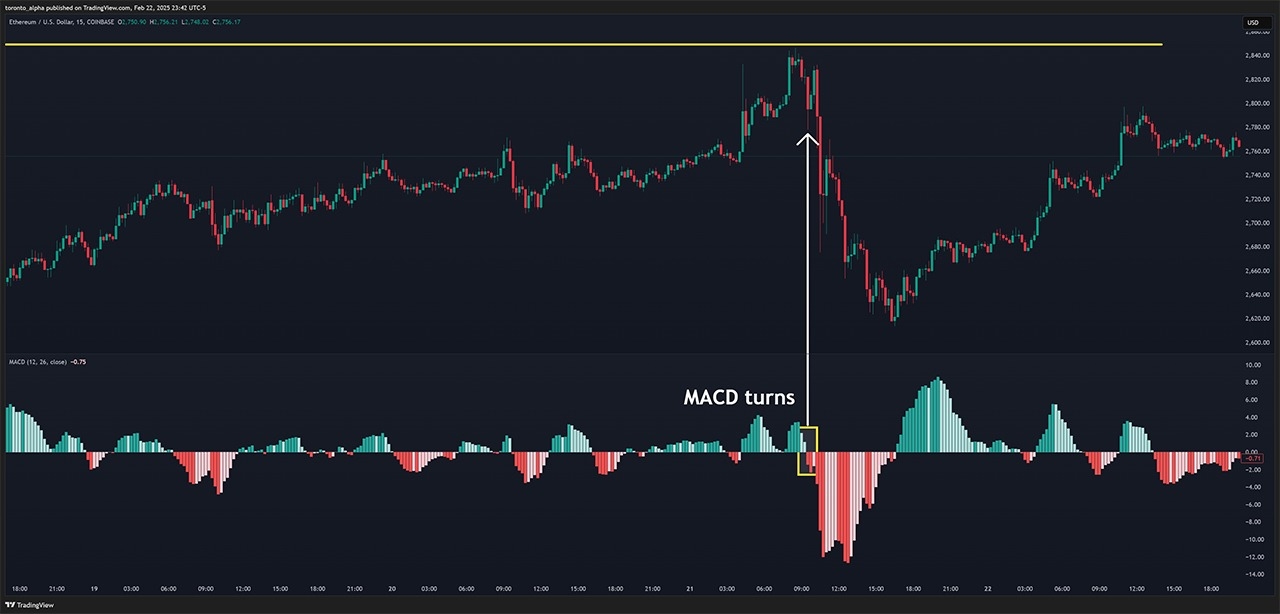
I use the MACD (with settings of 12, 26, and 9) to help time my entries. Ideally, the price should align near a support or resistance level before I consider entering a trade. The MACD then provides confirmation by showing the histogram turning from green to red.
The example below illustrates Ethereum trading within a defined range, with a clearer resistance level compared to the support level. Given the recent price decline, I am more inclined to short from the resistance than to long from the support.
Strategy 2: Exploiting Higher Timeframe Breakouts
Bitcoin and Ethereum frequently exhibit strong breakouts from long-term support and resistance levels, offering excellent short-term trading opportunities.
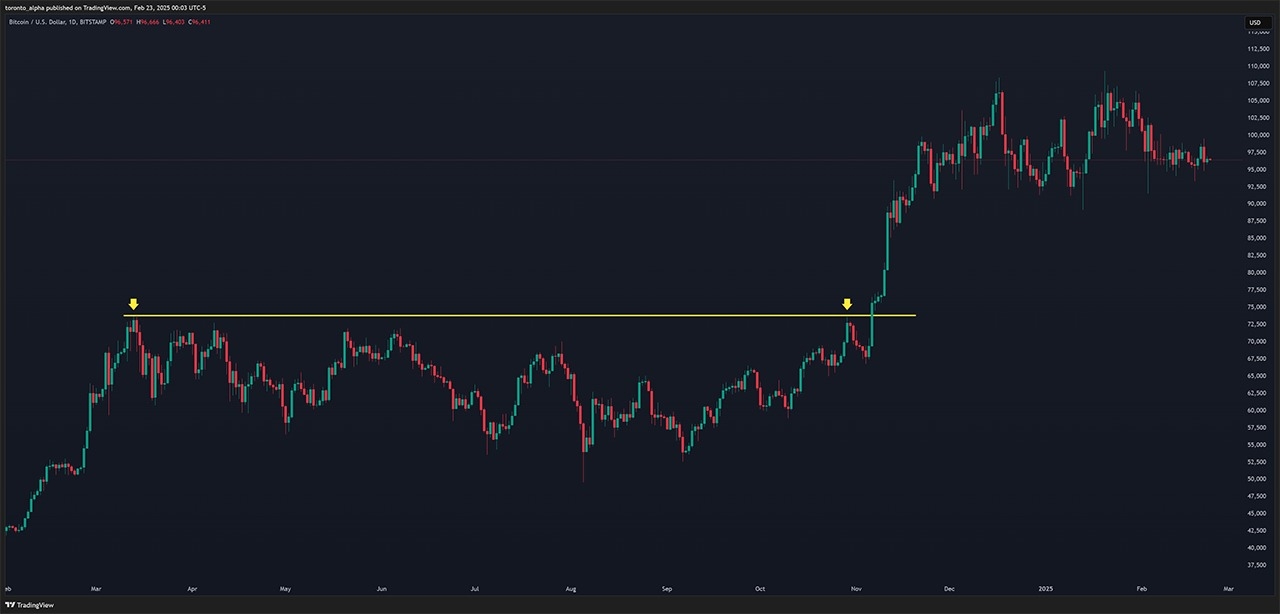
First, identify significant support and resistance levels using the daily chart. The chart below displays a clear resistance level for Bitcoin. Upon a breakout, evidenced by a long green candle, I switch to the 15-minute chart to buy on dips, riding the resulting uptrend on the shorter timeframe. Executing on the 15-minute chart based on longer-term levels allows me to achieve favorable reward/risk ratios.
Strategy 3: Capitalizing on Arbitrage
Unlike trading on centralized exchanges, the cryptocurrency market is less mature than Forex. This can lead to “arbitrage” opportunities, where the same cryptocurrency trades at different prices on different platforms or exchanges. The strategy involves selling the cryptocurrency where the price is higher and buying it where the price is lower. When the prices converge on both platforms, close both positions. The profit is equal to the difference between the initial purchase and sale prices. Arbitrage is arguably the closest you can get to risk-free trading in any market.
Arbitrage trading necessitates operating multiple accounts and acting swiftly. While there are software tools available to identify and execute arbitrage opportunities, manual execution is also possible.
Key Steps to Becoming a Profitable Crypto Day Trader
- Develop a trading strategy and rigorously test it using a demo account or with a small amount of real capital. A comprehensive strategy must include clear entry, take-profit, stop-loss, and money management rules.
- Be actively involved during peak trading hours. Although cryptocurrency markets function 24/7, most activity occurs during the New York and European trading sessions.
- Carefully select a crypto broker. Spreads, trading costs, and regulatory oversight can vary substantially across the cryptocurrency landscape. Opt for a reputable broker operating in a well-regulated jurisdiction. CFD and futures brokers often offer superior regulation and the ability to short cryptocurrencies.
- Maintain detailed records and track your progress. I closely monitor my average reward/risk ratios, win rate, and profit factor (total profit from winning trades divided by total losses from losing trades). I also analyze whether I consistently exit trades too early and identify any days of the week where my performance is weaker.
Essential Dos & Don’ts for Crypto Day Trading
Dos
- Adhere to your strategy’s predefined rules. Maintain discipline. A strategy is designed to guide you toward trades with favorable probabilities and reward potential.
- Thoroughly research various instruments and platforms that align with your trading style. There are multiple avenues for trading cryptocurrencies, each with unique advantages and disadvantages.
- Continuously expand your knowledge. I’ve become a significantly better trader over the past five years by networking with other traders and learning new, more effective execution methods.
- Pay close attention to trading costs. Day trading involves more frequent trades compared to longer-term strategies, leading to higher costs in spreads and commissions.
Don’ts
- Avoid overtrading by taking positions that fall outside of your established strategy. This often stems from emotional decisions rather than strategic thinking. Avoid chasing trends out of fear of missing out (FOMO).
- Never use unregulated brokers or services. Cryptocurrency exchanges have faced incidents of hacking and instances where client funds have been misappropriated.
- Don’t rush in with all your available capital before rigorously testing your strategy over a series of trades using a demo account or a small, funded account.
- Do not risk an excessive amount on each trade. I’ve encountered traders with high win rates who have nonetheless lost their entire trading account due to a single, substantial loss on a seemingly “sure thing.”
Crypto Day Trading—Advantages & Disadvantages
Advantages
- Recent years have seen Bitcoin exhibiting volatility levels 3-4 times greater than the S&P 500 and gold, creating ample opportunities for day traders.
- Bitcoin and Ethereum tend to produce reliable technical levels and chart patterns due to their substantial market capitalizations and trading volumes.
- The cryptocurrency market offers diverse trading methods, ranging from futures to CFDs and direct trading via crypto exchanges.
- Cryptocurrencies have low correlation with many other financial markets, offering independent trading opportunities even when other markets are range-bound.
- Day trading offers the potential for generating daily and weekly income streams.
- Due to the high volume of trades, day trading provides a quicker path to testing and refining new strategies.
Disadvantages
- Only two cryptocurrencies, Bitcoin and Ethereum, are truly suitable for day trading due to liquidity and market capitalization concerns.
- Pinpointing the exact fundamental drivers behind cryptocurrency price movements can be challenging. Markets like equities and Forex have established fundamental factors that significantly influence prices.
- Day trading incurs higher trading costs due to the increased frequency of trades, leading to more significant expenses in spreads and commissions.
- The rapid decision-making required can make day trading emotionally demanding.
- While cryptocurrency markets are open 24/7, the most substantial intraday price movements typically occur during the New York and European market hours, which may not suit all time zones.
- Day trading necessitates significantly more screen time than longer-term trading strategies.
Final Thoughts
Cryptocurrencies provide sufficient liquidity and volatility for potentially profitable day trading. Bitcoin and Ethereum stand out as the primary candidates for this approach due to their high market capitalizations. The majority of crypto day traders rely on technical analysis, as Bitcoin and Ethereum generate clear technical levels and chart patterns. It’s also beneficial to stay informed about news events that may impact crypto values, such as changes in government regulations. Many of the tools, strategies, and indicators that are effective in Forex trading can also be successfully applied to cryptocurrencies.
Successful day trading demands a well-tested strategy, a reliable and cost-effective broker, and, above all, unwavering discipline.