
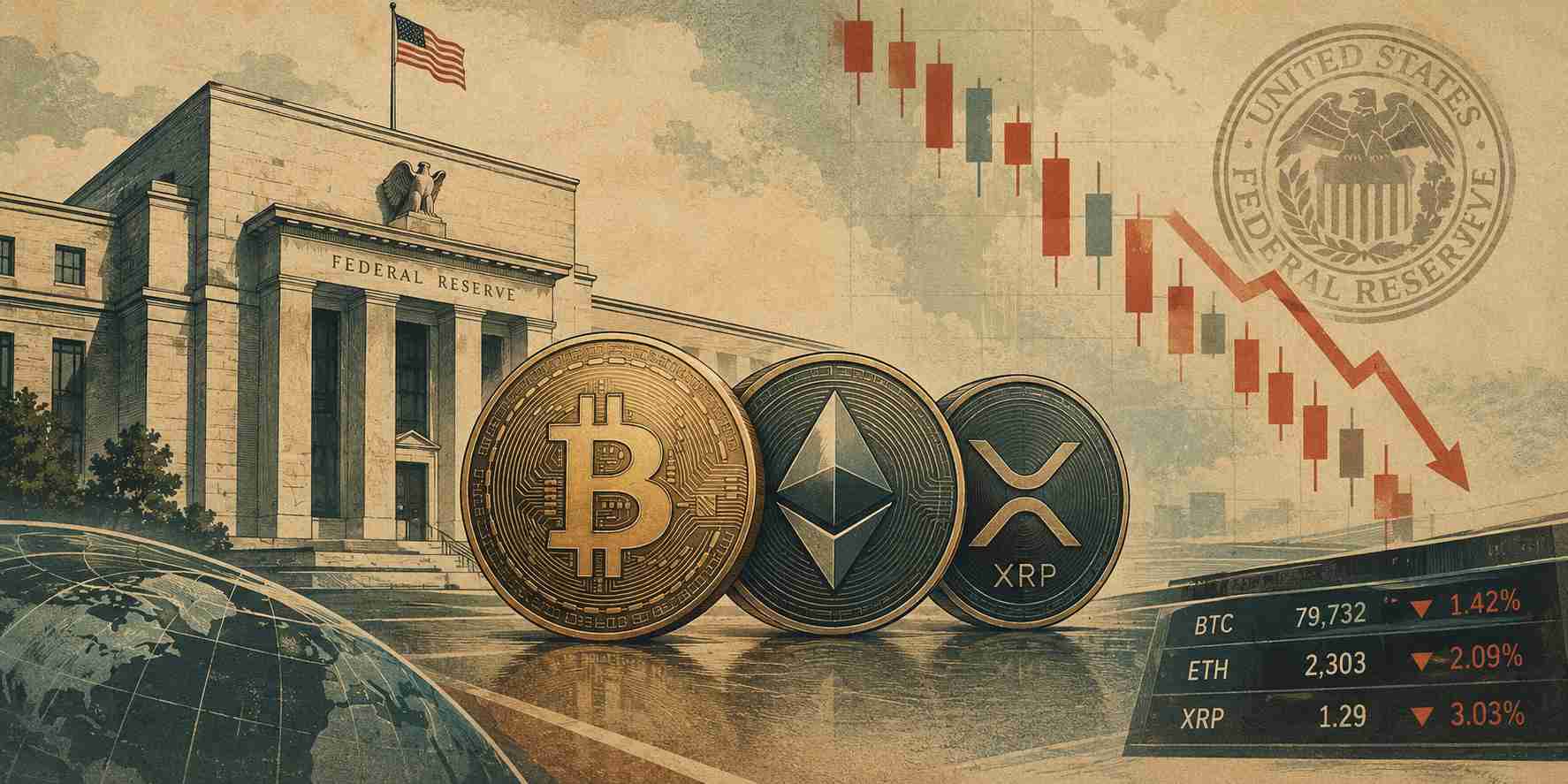
On October 28, the Federal Open Market Committee (FOMC) opted to keep interest rates steady, but its evaluation of inflation and economic growth provided limited indications for a quick transition towards monetary easing.
According to data from CoinPaprika at 03:34 UTC on October 29, Bitcoin was trading around $79,732, while Ethereum was at $2,303, and XRP stood at $1.29. These figures indicated 24-hour drops of 1.42%, 2.09%, and 3.03%, respectively. The total market capitalization for cryptocurrencies decreased by 1.41%, settling at roughly $2.80 trillion.
FOMC Maintains Interest Rates, Inflation Remains a Priority
The Federal Reserve kept its federal funds target range unchanged at 3.75%–4.00%, aligning with expectations for the October meeting. The 10–2 vote indicated divisions among policymakers regarding the sufficiency of current monetary policy measures.
Federal Reserve Chair Kevin Warsh pointed to almost six years of inflation above the target, with the FOMC voting 10–2 to keep rates at 3.75%–4%, focusing on price stability. Source: Coin Bureau via X
Dissenting opinions from Federal Reserve Governor Lisa Cook and Cleveland Fed President Beth Hammack favored a quarter-percentage-point hike, reflecting ongoing inflation concerns even with interest rates unchanged.
The subsequent FOMC statement adjusted the central bank’s review of economic activity from “solid” to “strong,” citing robust domestic spending, impressive productivity growth, ongoing investments, and a labor market where job creation matched workforce expansion.
Nevertheless, the committee reiterated that inflation “remains elevated,” emphasizing that additional information will be vital to align inflation with its 2% target.
During his post-meeting press briefing, Chair Warsh defended the overall economic outlook, suggesting the economy isn’t “overheating” and asserting that the Fed’s aim is not to hinder economic activity.
Warsh refrained from committing to another rate change in December, leaving investors to rely on incoming data concerning inflation, employment, and economic growth to guide future policy decisions.
Current Bitcoin Price: BTC Experiences Post-Fed Corrections
Initially, Bitcoin reacted positively to the Fed’s decision, climbing above $81,000 as traders appreciated the lack of an immediate rate hike. However, subsequent declines brought BTC below the key $80,000 mark.
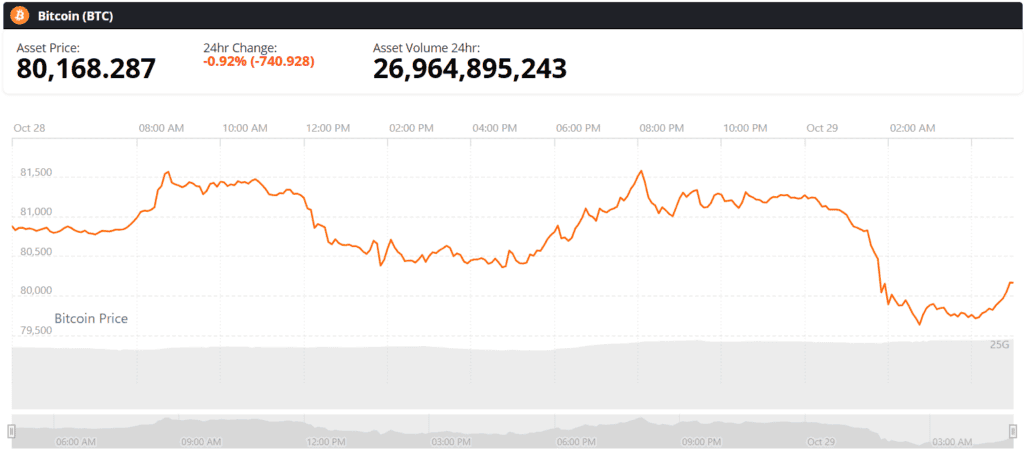
Bitcoin (BTC) pricing chart. Source: Brave New Coin
This decline signifies that mere anticipation of a rate hold wasn’t sufficient to sustain buying momentum. Investors had largely forecasted this outcome, making the FOMC’s economic review and Warsh’s remarks critical in determining if this announcement would promote further gains.
The performance of Bitcoin also reflects a broader market sentiment where traders exercise caution regarding possible additional monetary tightening. Elevated interest rates may enhance the attractiveness of cash and interest-earning instruments, potentially restraining demand for volatile assets like cryptocurrencies.
Returning BTC below the $80,000 threshold refocuses attention on the price zones analyzed in earlier discussions by Brave New Coin regarding Bitcoin’s support and liquidity.
Currently, the post-Fed decline suggests Bitcoin has encountered difficulty in converting the rate hold into a prolonged recovery. Stabilizing prices and regaining the $80,000 level would provide clearer signs that buyers are regaining strength, while ongoing weakness would reflect continuing downside risks.
Current Ethereum Price: ETH Faces Increased Selling
Following the FOMC announcement, Ethereum also saw a decline, with ETH dropping to around $2,303 in the snapshot from October 29. This 2.09% drop was sharper than Bitcoin’s, indicating a relative weakness in the second-largest cryptocurrency during that timeframe.
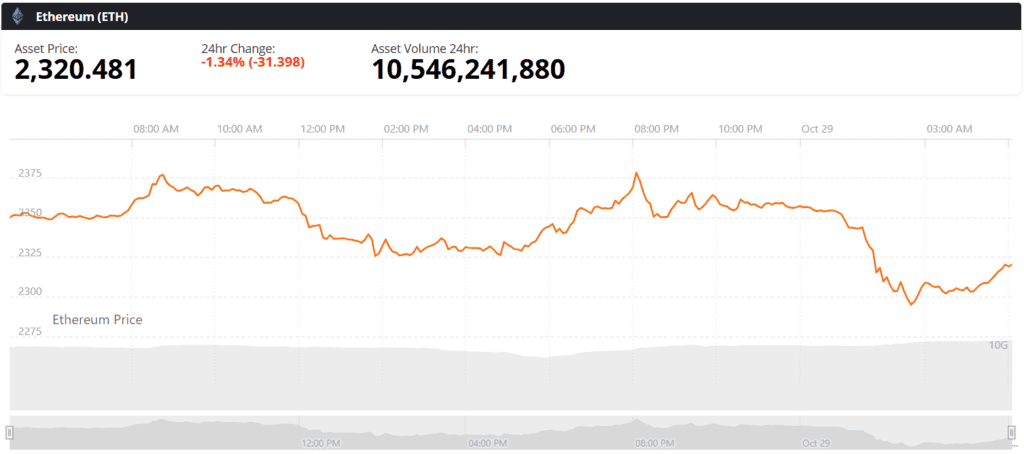
Ethereum (ETH) pricing chart. Source: Brave New Coin
Initially, the response to the rate hold was promising, with Ether trading around $2,360 earlier. However, subsequent declines indicate that stable interest rates did not provide sufficient backing to uphold those gains.
Ethereum remains sensitive to overall market sentiment, which is critical for assessing its short-term price trajectory. If risk appetite declines among investors, selling pressure can extend beyond Bitcoin into other assets perceived as riskier.
The Fed’s statement adds complexity to the outlook, as it emphasizes ongoing inflation and a robust economy, indicating that borrowing costs may either remain high or increase. This uncertainty complicates expectations for a near-term improvement in market conditions.
The recent performance of ETH does not conclusively imply that only monetary policy drove the decline. Still, its larger drop compared to BTC illustrates that the pullback post-decision affected more than just Bitcoin.
XRP Price Update: XRP Faces a Larger Decline
On October 29, XRP lagged behind both Bitcoin and Ethereum, trading at $1.29 after experiencing a 3.03% decrease over 24 hours. The token was valued at around $1.33 during the previous session, making its descent more pronounced than BTC and ETH.
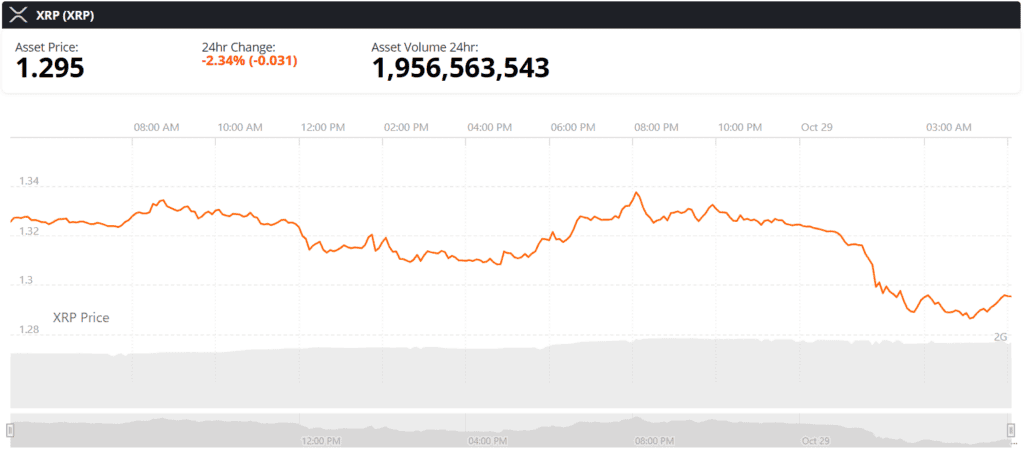
XRP pricing chart. Source: Brave New Coin
This downturn coincided with a general weakening of the crypto market following the Fed’s announcement. Thus, XRP’s recent performance needs to be examined alongside the broader market decline rather than solely attributed to the Fed’s decision.
The FOMC’s lack of signals regarding a quick shift to lower interest rates left investors without a definitive macroeconomic catalyst for renewed buying interest. For assets like XRP, such uncertainty can pressure traders already looking to lessen their exposure to the crypto market.
The different performance metrics among the three assets are noteworthy; all declined, yet XRP experienced the most significant 24-hour drop, followed by ETH and then BTC. This divergence highlights that the recent downturn was not uniformly distributed across major digital currencies.
Future price movements will clarify whether XRP’s drop is a fleeting reaction to broader market conditions or the continuation of a longer-term downward trend. Current market data does not yet ascertain which of these factors will prevail.
Outlook for the Crypto Market: December Fed Meeting is Key
The immediate market response to the FOMC’s decision on October 28 was mixed. Bitcoin and other major cryptocurrencies initially rose following the rate hold, but subsequent sell-offs indicated that investors were cautious about the policy outlook.
Movements in traditional financial markets also mirrored this uncertainty. As reported by Reuters, Treasury yields fluctuated following Warsh’s press conference, with shorter-term yields falling while longer-term yields rose. Additionally, the US dollar index saw a slight decline.
These shifts didn’t signify a unified move towards softer financial conditions but instead reflected differing anticipations regarding economic growth, inflation, and potential further interest increases.
For cryptocurrency markets, differentiating between a steady interest rate and a dovish policy forecast is significant. While a rate hold prevents immediate borrowing cost increases, it doesn’t ensure lower rates, enhanced liquidity, or sustained demand for digital assets.
The next scheduled policy meeting for the Fed is set for December 8–9, 2026. Until then, investors will evaluate incoming reports on inflation and employment alongside trends in Treasury yields and the broader market.
Monitoring Bitcoin’s efforts to surpass $80, Ethereum’s stability within its recent range, and XRP’s reaction to increased selling pressure will be crucial market indicators. However, recent declines alone do not dictate the direction of the next sustained price movement.
The FOMC’s decision ultimately left monetary policy intact while fostering ongoing uncertainty about the upcoming months. Until upcoming economic data clarifies the Fed’s next actions, the crypto market’s reactions are anticipated to remain sensitive to fluctuations in interest rate expectations and shifts in investor risk appetite.