
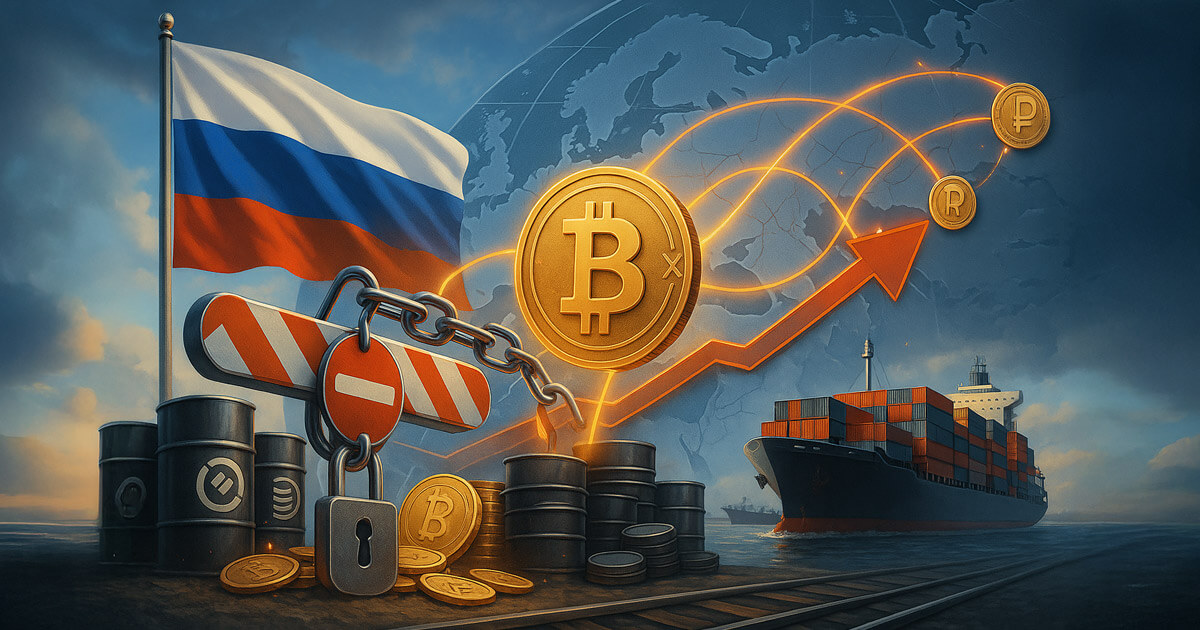

A recent analysis by Elliptic, a firm specializing in blockchain intelligence, reveals a network of cryptocurrency wallets potentially linked to
Russian governmental entities facilitated the movement of over $8 billion in digital funds. The report, dated September 26th, suggests this activity
may be an attempt to circumvent established Western economic sanctions.
The investigation stemmed from a newly surfaced dataset exposing how Russian enterprises facing sanctions utilized stablecoins, with a particular focus
on Tether’s USDT, to maintain international trade operations.
Elliptic’s analysis indicates that many of these transactions are linked to businesses managed by Ilan Shor, a Moldovan politician currently under
sanctions and considered an associate of Russian President Vladimir Putin.
Shor, who remains subject to U.S. sanctions, is alleged to have employed digital assets to provide vital financial support to Russian organizations
that are restricted from participating in the global banking system.
During a virtual conference in early September, Shor reportedly informed Putin that his company, A7, processed 7.5 trillion rubles (approximately
$89 billion) in international payments over a ten-month period, with over half of these transactions involving partners located in Asia.
Elliptic’s data corroborated these claims, confirming that wallets associated with A7 received over $8 billion in stablecoin deposits in the
preceding 18 months.
A7, established in 2024, was reportedly created to assist Russian businesses in navigating sanctions and executing cross-border financial settlements.
Notably, 49% of the company is owned by Promsvyazbank (PSB), a Russian state-owned bank that provides services to the defense industry.
Both PSB and A7 are currently under U.S. sanctions due to their alleged connections to Russia’s military-industrial complex.
Transitioning to a Ruble-Based Stablecoin
According to Elliptic, internal communications that were leaked indicate that A7 relied heavily on USDT for its treasury management and payment
processing activities.
In one instance, an A7 employee requested a transfer of 2 million USDT, which led to the discovery of a wallet that had handled approximately
$677 million in transactions.

However, the capability of Tether to freeze wallets associated with sanctioned entities presented a problem earlier this year. This became apparent when
regulatory bodies took action against Garantex, a cryptocurrency exchange based in Russia, and subsequently froze $26 million worth of USDT held on the
platform.
Consequently, Shor’s network reportedly restructured its wallet infrastructure during August 2025. The company has since been promoting its own
ruble-backed stablecoin, known as A7A5, as an alternative solution to circumvent Tether’s centralized control mechanisms.
Despite these efforts, the endeavor has not yet gained significant traction, with the digital asset possessing a supply of only $496 million and having
facilitated an estimated $68 billion in transactions.