

Key Advantages
-
The UAE’s lack of income or capital gains tax, coupled with recent value-added tax (VAT) exemptions on cryptocurrency transactions, positions it as a leading location for cryptocurrency investment.
-
Regulatory frameworks in Dubai (VARA) and Abu Dhabi (FSRA) support both retail and institutional investors, while emerging regions like RAK and Sharjah are crafting specialized zones for Web3 innovation.
-
Business-focused free zones such as DMCC, ADGM, and DIFC, coupled with high-speed internet and advanced cloud services, make the UAE a ready-to-use base for cryptocurrency companies.
-
The Golden Visa, combined with safety, global connections, and modern city living, provides cryptocurrency millionaires not just financial benefits but also a secure, opulent place to call home.
Over the last several years, the United Arab Emirates (UAE) has become a popular destination for individuals who have made fortunes in the cryptocurrency market. Across all seven emirates — from dynamic Dubai and Abu Dhabi to up-and-coming hubs such as Ras Al Khaimah and Sharjah — the UAE offers an attractive blend of no taxes, clear regulations, advanced infrastructure, forward-thinking government support, and an unmatched quality of life.
Specifically, an increasing number of affluent cryptocurrency investors are choosing Dubai and Abu Dhabi as their primary residences. This is a significant trend, as the UAE is now the premier global destination for migrating millionaires, with approximately 9,800 millionaires expected to relocate to the UAE in 2025 alone.
The country’s appeal is driven by strategic decisions by the government, including regulatory updates, favorable tax policies, and long-term residency options such as the Golden Visa. In essence, the combination of a business-friendly environment and a desirable lifestyle is attracting the crypto community to the UAE.
The following sections will explore the five primary reasons behind this trend.
1. No Tax on Crypto Earnings: Complete Exemption on Income and Gains
The UAE’s policy of zero taxation on crypto gains—no income tax, no capital gains tax—is a major advantage for cryptocurrency investors worldwide. Crypto millionaires in the UAE benefit from complete tax exemption on their cryptocurrency earnings because the country does not impose personal income tax or capital gains tax on individuals.
This implies that Bitcoin owners, NFT creators, and startup founders can liquidate or reinvest their digital assets without tax obligations, which is a marked contrast to high-tax regions in Europe or North America.
Even after the UAE introduced a 9% federal corporate tax in 2023, personal cryptocurrency holdings remain untaxed, and gains are fully legal. Additionally, the government has taken the further step of exempting most cryptocurrency transactions from the 5% value-added tax (VAT).
In late 2024, the UAE’s Federal Tax Authority announced that cryptocurrency transfers and conversions would be VAT-exempt starting from Nov. 15, 2024 (applied retroactively to transactions since 2018). This VAT exemption applies to cryptocurrency trading and exchange services, aligning them with other financial services.
The outcome is a tax-free environment for cryptocurrency market participants, whether they are engaged in Bitcoin mining (BTC), exchange trading, or profiting from token investments. Industry sources emphasize that the UAE’s combination of defined regulations and the absence of capital gains tax has created “the perfect conditions for cryptocurrency growth.”
Did you know? More than 74% of UAE residents between 25 and 34 are interested in cryptocurrency, and 21% are planning to enter the market within the next year.
2. Defined Regulations: Leading Crypto Frameworks in Dubai, Abu Dhabi, and Elsewhere
Clarity and certainty in regulation are essential for cryptocurrency entrepreneurs, and the UAE provides this through pioneering frameworks.
Dubai: Clarity Focused on Retail Investors
-
Dubai took the lead by establishing the Virtual Assets Regulatory Authority (VARA) in 2022, the world’s first regulator focused exclusively on virtual assets.
-
Supported by Dubai’s virtual asset law, VARA offers clear licensing for exchanges, crypto platforms, and token issuers, creating confidence for businesses establishing operations.
-
Major crypto exchanges like Binance and Crypto.com have secured VARA licenses, indicating Dubai’s appeal under clear and defined rules.
Abu Dhabi: Compliance for Institutional Investments
-
Abu Dhabi was an early adopter in crypto oversight through the Financial Services Regulatory Authority (FSRA) of Abu Dhabi Global Market (ADGM).
-
As early as 2018, FSRA introduced a comprehensive regulatory framework for virtual assets, the first of its kind in the Gulf Cooperation Council region, covering exchange licensing to custody rules.
-
This regulatory clarity has attracted institutional players; by late 2023, companies like Copper, Paxos, and eToro had expanded into Abu Dhabi under FSRA’s oversight.
-
Abu Dhabi’s approach usually focuses on institutional and high-capital crypto activities, complementing Dubai’s retail-focused market.
The UAE is working to unify crypto regulations federally: Dubai’s VARA and the UAE’s Securities and Commodities Authority (SCA) have an agreement on mutual recognition, allowing VARA-licensed firms to operate across the UAE. This means that a crypto exchange licensed in Dubai can serve customers in other emirates, further integrating the national market.
Ras Al Khaimah: Specialized Web3 Jurisdiction
-
Ras Al Khaimah (RAK) gained attention by launching the RAK Digital Assets Oasis (RAK DAO), promoted as the world’s first free zone exclusively for digital asset companies.
-
Established by law in 2023, RAK DAO is a specialized zone with independent authority under the Department of the Future, granting it financial and legislative autonomy to create crypto-friendly rules. It targets Web3 and virtual asset service providers, offering them a tailored, common-law regime. This positions RAK as a forward-thinking jurisdiction eager to attract blockchain businesses.
Sharjah, Ajman, UAQ, Fujairah: Emerging Opportunities
-
Sharjah has shown interest in blockchain applications.
-
Umm Al Quwain and Ajman are exploring fintech and digital economy initiatives, indicating that all emirates are embracing innovation.
While Dubai and Abu Dhabi set the standard, the common theme is regulatory clarity, defined rules, specialized regulators, and proactive laws, providing crypto investors and companies the confidence to relocate to the UAE with legal certainty.
Did you know? Telegram founder Pavel Durov has resided in Dubai since 2017 and is now a UAE citizen. Once the wealthiest expat in the UAE, he was ranked the world’s 120th richest person in 2024.
3. State-of-the-Art Infrastructure: Crypto Zones, Hubs, and Innovation Ecosystems
A supportive infrastructure supports the UAE’s crypto appeal. Across the emirates, there is a network of free zones and hubs built for fintech and digital assets.
Dubai
-
In Dubai, the Dubai Multi Commodities Centre (DMCC) has established a renowned Crypto Centre, an ecosystem hosting over 650 blockchain and digital asset companies as of mid-2025. Crypto startups find co-working spaces, incubators, and a supportive community, alongside access to DMCC’s business services.
The Dubai International Financial Centre (DIFC) now accommodates a thriving fintech and crypto scene through its Innovation Hub and the DFSA’s regulatory sandbox for digital tokens.
Abu Dhabi
-
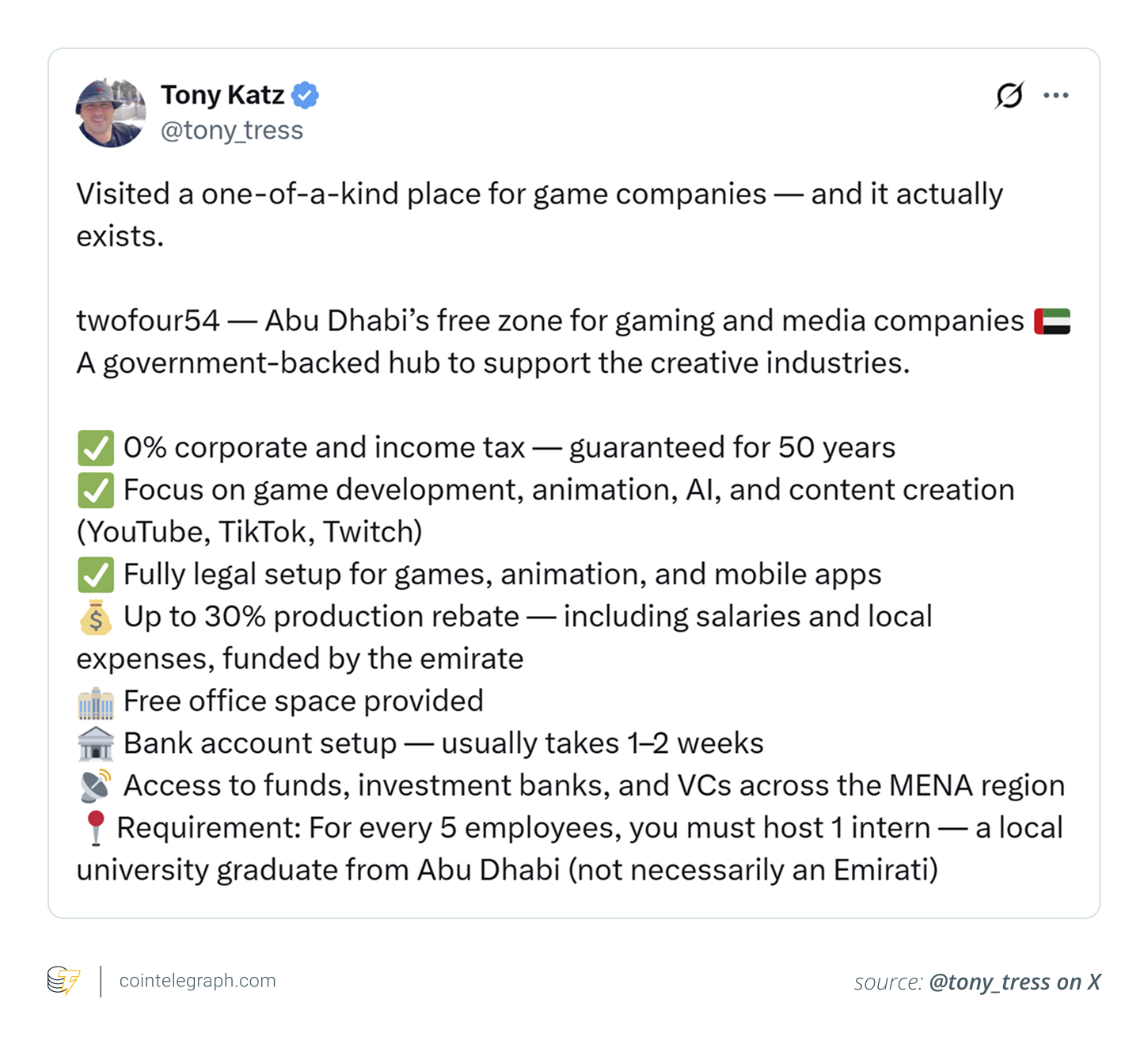
In Abu Dhabi, the ADGM on Al Maryah Island has become a crypto and blockchain innovation hub. ADGM operates under English common law and has a robust fintech ecosystem (Hub71) that, in 2023, launched a $2-billion+ initiative to fund Web3 and blockchain startups.
-
Over 5,000 Special Purpose Vehicles (SPVs) for wealth and business structuring have been set up in ADGM, rising from 46 SPVs in 2016. This indicates how many family offices, investment funds, and crypto project founders are choosing Abu Dhabi’s infrastructure to store assets and build new ventures.
-
Binance’s ex-CEO, Changpeng “CZ” Zhao, and other global billionaires have established holding companies in ADGM, leveraging its legal framework and crypto-friendly regulations.
Sharjah and Beyond
-
Sharjah is contributing to infrastructure by nurturing human capital and innovation. The emirate hosts the Sharjah Research, Technology and Innovation Park and recently launched a blockchain academy in partnership with layer-1 blockchain Sui at the American University of Sharjah. Through such initiatives, Sharjah is building a pipeline of blockchain talent and startups, complementing the physical infrastructure with intellectual resources.
-
Fujairah is developing tech-friendly free zones (like Fujairah Creative City) and exploring blockchain use cases in sectors such as supply chain and finance, aiming to diversify its economy with digital ventures.
-
Ajman and Umm Al Quwain offer cost-effective free zone licenses and supportive business environments for crypto-related startups, ensuring that entrepreneurs have options beyond the main cities.
The UAE’s digital infrastructure, high-speed internet, 5G networks, and cloud data centers provide the backbone for crypto or blockchain operations. Whether in Dubai’s crypto co-working spaces or RAK’s digital assets zone, crypto investors find a ready-to-use infrastructure.
4. National Blockchain and Metaverse Ambitions of Visionary Government
The UAE’s rise as a crypto hub is the result of government vision, incorporating blockchain and digital assets into broader national innovation strategies.
Strategic National Goals
-
In 2018, the UAE unveiled Blockchain Strategy 2021, aiming to transfer 50% of government transactions onto blockchain platforms by 2021. This streamlined public services and signaled the UAE’s serious adoption of crypto technology.
-
Dubai launched an ambitious Dubai Metaverse Strategy in 2022, aiming to make the emirate a top 10 metaverse economy, adding 4 billion UAE dirhams ($1.1 billion) to the economy and creating 40,000 virtual jobs by 2030.
-
This plan includes attracting 1,000 blockchain and metaverse companies (Dubai had this many by 2022) and integrating metaverse tech into tourism, education, and government services. Dubai’s government is experimenting with NFTs, virtual real estate, and immersive digital services, welcoming crypto-related ideas.
Federal Support
-
The UAE has a National AI Strategy and a Digital Economy Strategy, where blockchain and crypto are key for diversifying beyond oil.
-
High-level ministers champion crypto and metaverse projects, ensuring policy support.
Regional Alignment
Each emirate is finding its niche under this vision.
-
Abu Dhabi focuses on Web3 investments and institutional adoption through Hub71 and ADGM.
-
Dubai focuses on retail crypto adoption, blockchain in everyday services, and emerging tech like tokenized assets and AI in finance.
-
Ras Al Khaimah’s creation of the RAK Digital Assets Oasis aligns with the national vision to become a “global crypto capital,” enabling RAK to specialize in nurturing early-stage Web3 innovators.
-
Sharjah’s emphasis on education (like the American University of Sharjah Blockchain Academy) echoes the strategic goal of building human infrastructure for a blockchain-based economy.
The government’s pro-crypto vision is also evident in international partnerships. Dubai’s leadership has agreements with global crypto firms (like a deal with Crypto.com to develop blockchain solutions for real estate transactions) to pilot new use cases.
These efforts, including blockchain strategies and tech parks, create a clear message: The UAE sees crypto and digital assets as integral to its future. This vision reassures crypto entrepreneurs that relocating to the UAE aligns with a country that wants their industry to thrive.
Did you know? The TON Foundation’s offer of UAE golden visas to Toncoin stakers was denied by regulators, exposing a legal misstep. Despite support, the plan clashed with UAE crypto marketing laws, highlighting the need for legal reviews.
5. Residency Opportunities: Golden Visas and an Elite Global Lifestyle
The UAE offers an appealing lifestyle and residency benefits that attract wealthy individuals, including crypto millionaires.
Key highlights include:
-
The UAE’s Golden Visa program, a 10-year residency visa, has changed the game for investors, entrepreneurs, and professionals.
-
Crypto founders who qualify can obtain a Golden Visa, securing a decade of residency for themselves and their families with no local sponsor required.
-
The Golden Visa’s appeal is its stability and simplicity, letting expatriates base themselves in the UAE, open bank accounts, buy property, and sponsor family members easily. In 2024, the government expanded the visa categories, introducing sponsor-free residency tracks for digital content creators and luxury yacht owners.
-
This inclusive approach signals that innovators are welcome. A crypto hedge fund manager or blockchain developer can move to Dubai or Abu Dhabi, securing long-term residency easily.
The lifestyle advantages of the UAE are compelling. Dubai and Abu Dhabi are safe cities with low crime and stability, valued by wealthy families. Modern infrastructure abounds: hospitals, schools, malls, and cultural scenes.
For international travelers, the UAE’s location is a boon: Dubai and Abu Dhabi are aviation hubs with direct flights connecting continents within eight hours. This connectivity allows investors to manage businesses and enjoy a home base in the emirates.
Moreover, the quality of life is bolstered by smart city initiatives. UAE cities are investing in smart governance, digital amenities, and high-speed 5G. The lifestyle, from weather to real estate, is often compared to a vacation. Many crypto conferences and networking events now take place in Dubai annually.
The UAE offers strong banking, private banking services, and new family-friendly legal reforms that provide expatriate families more certainty.
The Crypto Future is Being Built in the Emirates
The UAE presents crypto millionaires a place to do business, an upscale lifestyle, and a secure home. It is a combination of tax-free profits and luxury living that is hard to match.
From Dubai’s metaverse ambitions to Abu Dhabi’s infrastructure and Ras Al Khaimah’s Web3 regulatory sandbox, each emirate shapes the UAE as a crypto haven. With visionary governance and a welcoming environment, the UAE is shaping crypto’s future.
In 2025 and beyond, the UAE’s message is clear: Bring your ideas and build your future here. It’s a call that is drawing the blockchain community to this crypto-friendly oasis.
This article does not provide investment advice. Investment involves risk, and readers should conduct their own research.