

Bitcoin (BTC) is often touted as “digital gold,” a store of value similar to precious metals, offering a shield against economic uncertainty and rising inflation. Its appeal lies in its limited supply and lack of correlation with traditional assets, making it a potential diversification tool for portfolios. In contrast, Ether (ETH), the cryptocurrency of the Ethereum network, is considered a technological investment, granting exposure to the burgeoning fields of tokenization, Non-Fungible Tokens (NFTs), and Decentralized Finance (DeFi). For investors aiming to capitalize on the growth of tokenized assets, ETH may represent a compelling option.
This in-depth study investigates the effects of integrating Bitcoin and Ether into conventional investment portfolios. It examines the advantages and disadvantages of including these digital assets, demonstrating how a carefully considered allocation can improve portfolio results, marking a progression in how assets are strategically distributed.
Analysis Overview
Our research explored the impact of adding Bitcoin (BTC) and Ether (ETH) to a standard portfolio consisting of 60% stocks and 40% bonds. The study spanned from September 1, 2015, to April 30, 2024, and was divided into five key areas:
-
Optimizing Crypto Allocation within a Traditional Portfolio: We sought to identify the ideal allocation of Bitcoin and Ether within a portfolio holding 60% equities and 40% fixed-income investments. Cryptocurrency holdings were capped at a combined 6%. This involved analyzing 169 different portfolio scenarios, gradually increasing the proportion of crypto assets.
Benchmarks Used:
- S&P 500 Index: Representing 60% of the equity portion. This index tracks the performance of 500 of the largest publicly listed companies in the United States, weighted by market capitalization.
- Bloomberg Barclays US Aggregate Bond Index: Representing 40% of the bond portion. This is a broad index measuring the performance of investment-grade, US dollar-denominated, fixed-rate taxable bonds. It encompasses U.S. Treasuries, government-related and corporate securities, and asset-backed securities.
- MarketVector Bitcoin Index: Tracks the performance of a portfolio invested in Bitcoin.
- MarketVector Ethereum Index: Tracks the performance of a portfolio invested in Ether.
These benchmarks provide a general sense of market performance. Actual results from investing directly in Bitcoin and Ethereum might vary due to things like transaction costs, how easy it is to buy or sell (liquidity), and price swings (volatility). To stick to our desired investment mix, we adjusted (rebalanced) all portfolios every month. This ensured that each portfolio stayed in line with our intended strategy.
- Risk and Reward Assessment: We looked at the biggest drops in value (drawdowns) and Sharpe ratios for a selection of 16 portfolios to understand the trade-offs between risk and potential profit. Our findings suggest that even a small investment in cryptocurrencies (up to 6%) in a traditional portfolio can greatly improve the Sharpe ratio, without drastically affecting drawdowns. Monthly portfolio adjustments were done to handle price fluctuations and ensure that the portfolio maintained its risk and return profile over time. For those who can handle more risk (around 20% volatility each year), an allocation of up to 20% can still improve the risk-reward balance of the overall portfolio. The optimal allocation between bitcoin and ether was roughly 70/30, offering the best return for the amount of risk taken.
- Ideal Bitcoin and Ether Mix in a Crypto-Focused Portfolio: We explored different combinations of Bitcoin and Ether within a portfolio containing only these two cryptocurrencies, with the aim of maximizing the Sharpe ratio and identifying the best BTC/ETH ratio.
- Mapping the Efficient Frontier with Crypto: We charted how to weight the best BTC/ETH portfolio to get the most return for different levels of risk. This showed a portion of the efficient frontier when cryptocurrencies are included in the standard 60/40 portfolio, focusing on reasonable levels of price fluctuation. The routine of monthly rebalancing helped the portfolios adapt to market movements while preserving the original asset allocation strategy.
- How Timing Affects Results: We examined whether starting at different times changed the conclusions from point 4. Our investigation confirmed that a larger allocation to crypto consistently boosted portfolio returns when adjusted for risk, irrespective of the period analyzed.
1. Optimal Allocation in a Traditional 60/40 Portfolio
Our main goal was to find the best mix of Bitcoin (BTC) and Ether (ETH) in a traditional 60/40 portfolio, while keeping the total cryptocurrency weight at 6% or less. To do this, we built 169 different portfolio models, each with a slightly different amount of crypto exposure, up to 3% each for BTC and ETH.
The results showed that a portfolio containing 3% BTC and 3% ETH, combined with 57% S&P 500 and 37% U.S. Bonds, provided the highest return for the level of risk (standard deviation). Essentially, keeping the overall crypto allocation conservative at 6%, the maximum allowed, led to the most favorable risk-adjusted returns. Monthly adjustments (rebalancing) were implemented to keep these allocations in check, which aided in managing volatility and ensuring the portfolio remained true to its strategic aims.
Optimal BTC/ETH Allocation in a Traditional 60/40 Portfolio (9/1/2015 – 4/30/2024)
Source: VanEck Research as of 5/28/2024. Past performance is no guarantee of future results. The information, valuation scenarios, and price targets in this blog are not intended as financial advice or any call to action, a recommendation to buy or sell, or as a projection of how ETH and BTC will perform in the future. Actual future performance of ETH and BTC is unknown, and may differ significantly from the hypothetical results depicted here. There may be risks or other factors not accounted for in the scenarios presented that may impede the performance. These are solely the results of a simulation based on our research, and are for illustrative purposes only. Please conduct your own research and draw your own conclusions.
The findings suggest that thoughtfully adding Bitcoin and Ether to a traditional portfolio can significantly boost returns relative to the level of risk taken, even with a modest allocation.
2. Drawdown and Sharpe Ratio Analysis
To gauge the balance between risk and reward, we assessed 16 different 60/40 portfolios, each with an incrementally larger allocation to cryptocurrencies, up to a maximum of 6%. The main takeaways were:
- Sharpe Ratio Enhancement: As the cryptocurrency allocation increased, the portfolio’s Sharpe ratio improved considerably.
- Minimal Drawdown Impact: The maximum drawdown saw only a slight increase, making the higher crypto allocation a worthwhile trade-off for many investors.
The maximum drawdown and Sharpe ratio data showed that a 6% cryptocurrency allocation nearly doubled the Sharpe ratio of the traditional 60/40 portfolio, while only slightly increasing the drawdown. This highlights the favorable risk-reward profile when adding BTC and ETH to a standard portfolio.
| 60% 40% Portfolio | -21.54 | 0.78 |
| 59% 39% Portfolio, 1% Bitcoin and 1% Ethereum | -22.18 | 1.04 |
| 58.5% 38.5% Portfolio, 3% Bitcoin | -22.21 | 1.04 |
| 58.5% 38.5% Portfolio, 3% Ethereum | -22.85 | 1.24 |
| 57% 37% Portfolio, 3% Bitcoin and 3% Ethereum | -23.60 | 1.44 |
Source: VanEck Research as of 5/28/2024. Past performance is no guarantee of future results. Sharpe ratio is a measure used in finance to evaluate the performance of an investment compared to a risk-free asset, after adjusting for its risk. It is calculated by subtracting the risk-free rate of return (such as the return on U.S. Treasury Bonds) from the rate of return for a portfolio and then dividing the result by the standard deviation of the portfolio returns. This ratio helps investors understand how much excess return they are receiving for the extra volatility that they endure for holding a riskier asset. A higher Sharpe ratio indicates a more attractive risk-adjusted return. The information, valuation scenarios, and price targets in this blog are not intended as financial advice or any call to action, a recommendation to buy or sell, or as a projection of how ETH and BTC will perform in the future. Actual future performance of ETH and BTC is unknown, and may differ significantly from the hypothetical results depicted here. There may be risks or other factors not accounted for in the scenarios presented that may impede the performance. These are solely the results of a simulation based on our research, and are for illustrative purposes only. Please conduct your own research and draw your own conclusions.
These findings illustrate the potential advantages of incorporating cryptocurrencies into traditional investment strategies, offering better risk-adjusted returns with only a slight increase in risk.
3. Optimal Bitcoin and Ether Allocation in a Crypto-Only Portfolio
Looking specifically at portfolios that only include Bitcoin and Ether, we experimented with different allocation percentages to discover the ideal mix for the highest Sharpe ratio. Our findings revealed that an allocation of 71.4% Bitcoin and 28.6% Ether was optimal. This mix resulted in the best risk-adjusted return for a crypto-only portfolio. The study highlights the importance of holding both cryptocurrencies to get the maximum benefit. Moreover, simply allocating 50% to BTC and 50% to ETH also showed considerable advantages, highlighting the value of diversification within the crypto asset class.
Comparative Metrics of Various Bitcoin-Ether Portfolio Allocations (9/1/2015 – 4/30/2024)

| Ideal Portfolio (71.4% BTC – 28.6% ETH) | 0.89 | 1.32 | 1.43 |
| 100% Bitcoin | 0.81 | 0.98 | 1.16 |
| 100% Ether | 1.58 | 1.35 | 0.83 |
| 50% Bitcoin 50% Ether | 1.04 | 1.44 | 1.33 |
| 60% S&P, 40% Bonds | 0.10 | 0.09 | 0.37 |
Source: VanEck Research as of 5/28/2024. Past performance is no guarantee of future results. Volatility refers to the fluctuation in the returns of an asset or portfolio as measured by the standard deviation of returns. Higher volatility indicates greater risk and potentially higher returns, affecting the risk-adjusted returns measured by the Sharpe Ratio. Compound Annual Growth Rate (CAGR) represents the rate at which the value of ether (ETH) has grown annually over a specified time period. This metric is used to provide a smoothed annual growth rate, eliminating fluctuations and giving a clearer picture of long-term investment performance. Sharpe ratio is a measure used in finance to evaluate the performance of an investment compared to a risk-free asset after adjusting for its risk. It is calculated by subtracting the risk-free rate of return (such as the return on U.S. Treasury Bonds) from the rate of return for a portfolio and then dividing the result by the standard deviation of the portfolio returns. This ratio helps investors understand how much excess return they are receiving for the extra volatility that they endure for holding a riskier asset. A higher Sharpe ratio indicates a more attractive risk-adjusted return. The information, valuation scenarios, and price targets in this blog are not intended as financial advice or any call to action, a recommendation to buy or sell, or as a projection of how ETH and BTC will perform in the future. Actual future performance of ETH and BTC is unknown, and may differ significantly from the hypothetical results depicted here. There may be risks or other factors not accounted for in the scenarios presented that may impede the performance. These are solely the results of a simulation based on our research, and are for illustrative purposes only. Please conduct your own research and draw your own conclusions.
These results underline the significant benefits of diversifying within the crypto asset class to optimize risk-adjusted returns.
4. The Efficient Frontier When Including Cryptocurrencies
To pinpoint the optimal amount of crypto assets to hold in a 60/40 portfolio while managing volatility, we looked at how to best weight a crypto portfolio consisting of 71.4% Bitcoin and 28.6% Ether. The goal was to maximize returns while keeping volatility within acceptable ranges (13%-25%), thereby charting the efficient frontier using these assets. These volatility levels are commonly seen in investor portfolios. The resulting analysis showed that incorporating the ideal crypto portfolio into a 60/40 portfolio can greatly enhance returns for different levels of risk.
Additional Volatility from Cryptocurrencies Help Overall Returns (9/1/2015 – 4/30/2024)

Source: VanEck Research as of 5/28/2024. Past performance is no guarantee of future results. Volatility refers to the fluctuation in the returns of an asset or portfolio as measured by the standard deviation of returns. Higher volatility indicates greater risk and potentially higher returns, affecting the risk-adjusted returns measured by the Sharpe Ratio. Compound Annual Growth Rate (CAGR) represents the rate at which the value of ether (ETH) has grown annually over a specified time period. This metric is used to provide a smoothed annual growth rate, eliminating fluctuations and giving a clearer picture of long-term investment performance. The information, valuation scenarios, and price targets in this blog are not intended as financial advice or any call to action, a recommendation to buy or sell, or as a projection of how ETH and BTC will perform in the future. Actual future performance of ETH and BTC is unknown, and may differ significantly from the hypothetical results depicted here. There may be risks or other factors not accounted for in the scenarios presented that may impede the performance. These are solely the results of a simulation based on our research, and are for illustrative purposes only. Please conduct your own research and draw your own conclusions.
This analysis highlighted a nearly straight-line connection—rare in efficient frontier studies—between risk and return as volatility increased. The core finding is that more exposure to cryptocurrencies resulted in highly attractive trade-offs between risk and reward.
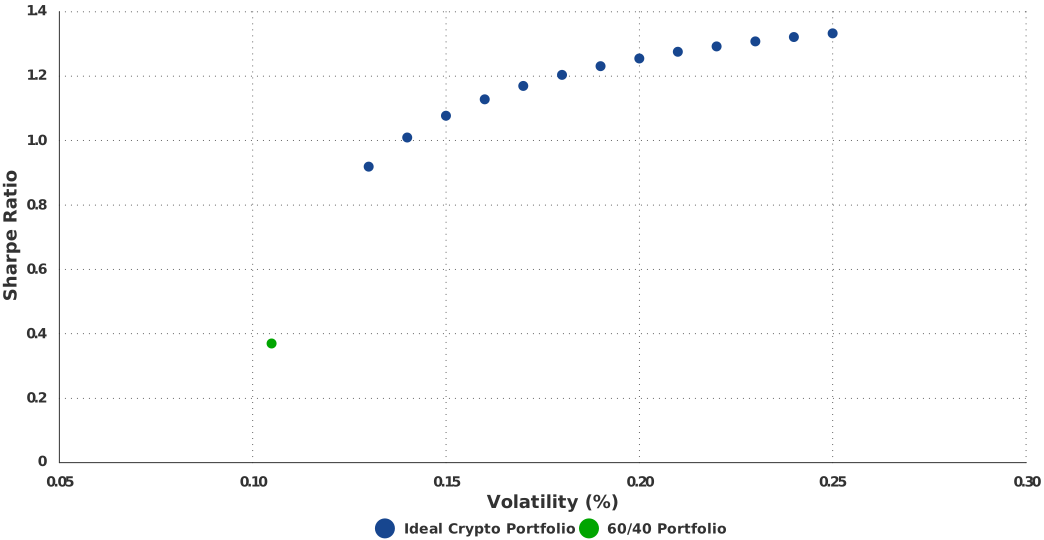
Sharpe Ratio for Blended Portfolio Levels Off at 22% Volatility (9/1/2015 – 4/30/2024)
Source: VanEck Research as of 5/28/2024. Past performance is no guarantee of future results. The information, valuation scenarios, and price targets in this blog are not intended as financial advice or any call to action, a recommendation to buy or sell, or as a projection of how ETH and BTC will perform in the future. Actual future performance of ETH and BTC is unknown, and may differ significantly from the hypothetical results depicted here. There may be risks or other factors not accounted for in the scenarios presented that may impede the performance. These are solely the results of a simulation based on our research, and are for illustrative purposes only. Please conduct your own research and draw your own conclusions.
The chart reveals that the Sharpe ratio for the blended portfolio rises with volatility, eventually plateauing around 22% volatility.
5. Time Dependence of Efficient Frontier Results
We tested the impact of different starting dates on the risk/reward profiles of the blended crypto and 60/40 portfolios by rerunning the analysis from point 4, each time moving the start date forward by one quarter. We required at least three years of return data, which yielded 23 sets of results. This was done to isolate the impact of timing as a variable.
Our findings indicated:
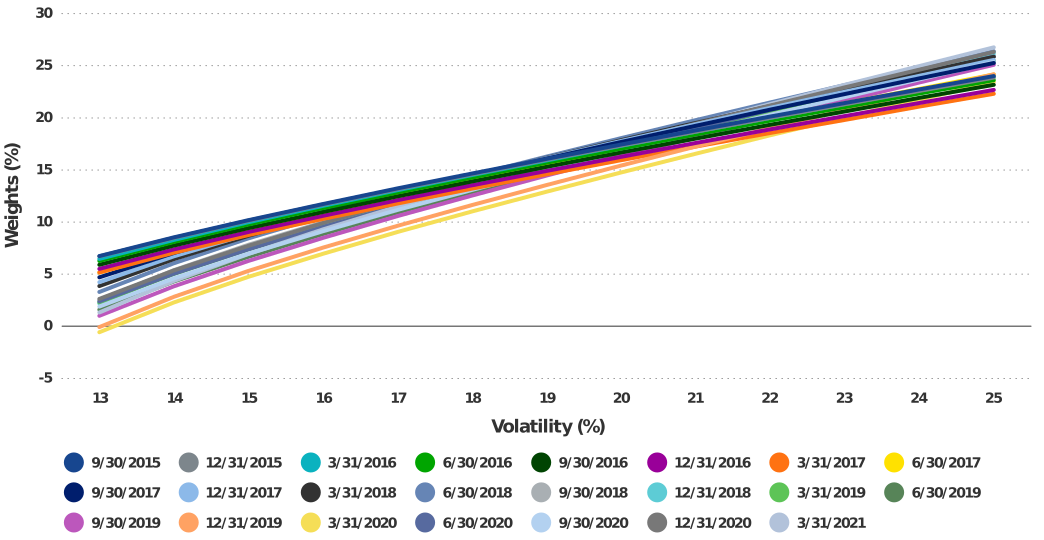
- Across all time periods analyzed, the optimal allocation to the ideal cryptocurrency portfolio increased in proportion to the level of risk being undertaken.
Optimal Weights Across Volatility for Time-Independent Portfolios
Source: VanEck Research as of 5/28/2024. Past performance is no guarantee of future results. The information, valuation scenarios, and price targets in this blog are not intended as financial advice or any call to action, a recommendation to buy or sell, or as a projection of how ETH and BTC will perform in the future. Actual future performance of ETH and BTC is unknown, and may differ significantly from the hypothetical results depicted here. There may be risks or other factors not accounted for in the scenarios presented that may impede the performance. These are solely the results of a simulation based on our research, and are for illustrative purposes only. Please conduct your own research and draw your own conclusions.
The chart shows that greater allocations to cryptocurrencies consistently matched with higher optimal weights as volatility increased across all the tested time frames.
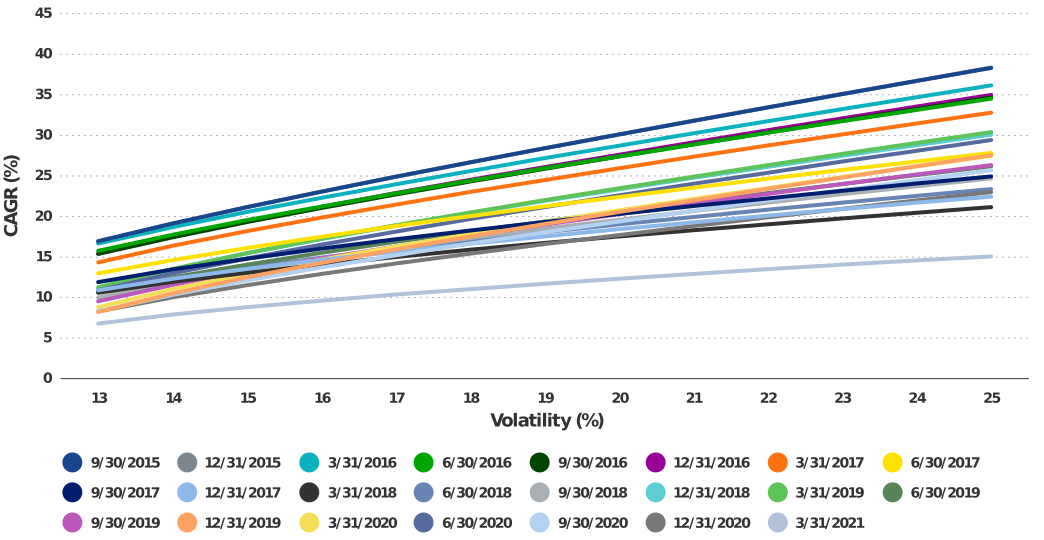
CAGR Across Volatility for Time-Independent Portfolios
Source: VanEck Research as of 5/28/2024. Past performance is no guarantee of future results. The information, valuation scenarios, and price targets in this blog are not intended as financial advice or any call to action, a recommendation to buy or sell, or as a projection of how ETH and BTC will perform in the future. Actual future performance of ETH and BTC is unknown, and may differ significantly from the hypothetical results depicted here. There may be risks or other factors not accounted for in the scenarios presented that may impede the performance. These are solely the results of a simulation based on our research, and are for illustrative purposes only. Please conduct your own research and draw your own conclusions.
Consistently, over all examined time periods, increased allocations to cryptocurrencies were associated with higher Compound Annual Growth Rates (CAGRs).
Sharpe Across Volatility for Time-Independent Portfolios

Source: VanEck Research as of 5/28/2024. Past performance is no guarantee of future results. The information, valuation scenarios, and price targets in this blog are not intended as financial advice or any call to action, a recommendation to buy or sell, or as a projection of how ETH and BTC will perform in the future. Actual future performance of ETH and BTC is unknown, and may differ significantly from the hypothetical results depicted here. There may be risks or other factors not accounted for in the scenarios presented that may impede the performance. These are solely the results of a simulation based on our research, and are for illustrative purposes only. Please conduct your own research and draw your own conclusions.
The research indicated that Sharpe ratios generally trended upwards with greater volatility and more substantial allocations to cryptocurrencies.
Conclusion
Our analysis strongly suggests that adding a small amount of cryptocurrencies (up to 6%) to a standard portfolio that is 60% stocks and 40% bonds can significantly improve the portfolio’s Sharpe ratio without greatly affecting the size of potential losses (drawdown). For a portfolio consisting solely of cryptocurrencies, splitting the allocation approximately 70/30 between Bitcoin and Ether provides the optimal risk-adjusted returns.
While individual risk appetite should guide investment choices, the data implies that a balanced inclusion of Bitcoin and Ether can offer significant advantages in terms of boosting returns relative to the additional risk incurred. These results underscore the potential of cryptocurrencies to improve portfolio performance in a measured and quantifiable way.