

The integration of cryptocurrency into investment portfolios is gaining traction among U.S. investors. Digital asset ownership has seen an uptick, climbing from approximately 21% in 2024 to 24%. On a global scale, over 560 million individuals, representing around 6.8% of the planet’s population, now hold crypto assets. Across diverse sectors, from nascent tech ventures to established wealth management firms, including digital currencies in investment strategies is seen as a calculated move, rather than simply speculation. Discover how this evolution is impacting financial choices on a worldwide scale.
Editor’s Choice
- Approximately 28% of adults in America, which translates to about 65 million people, possess cryptocurrency in 2025, almost twice the number compared to 2021.
- The total number of crypto holders worldwide has reached 562 million, accounting for 6.8% of the global population.
- Crypto adoption in the U.S. increased from 21% in 2024 to 24% in 2025.
- Interest from institutional players is on the rise; a significant 59% of investors are planning to commit more than 5% of their Assets Under Management (AUM) to crypto in 2025.
- Institutional investments in crypto during the first quarter of 2025 reached a total of $21.6 billion.
- While some hedge funds opted to scale back their Bitcoin ETF holdings in early 2025, overall institutional demand displays a range of approaches across various firms and investment styles.
- The total value of the global crypto market experienced a surge, reaching $4 trillion by the middle of 2025.
Recent Developments
- The aggregate value of the cryptocurrency market worldwide peaked at $4 trillion by July 2025.
- Funds managed by BlackRock, which include Bitcoin ETFs, reportedly exceeded $100 billion in total assets related to crypto investments by mid-2025, primarily driven by inflows into Bitcoin ETFs.
- Crypto-focused hedge funds, such as Tephra Digital, reported year-to-date (YTD) gains as high as 23%, spurred by a market rally of $700 billion and $30 billion flowing into crypto products.
- Well-known crypto businesses such as Circle (valued at $35B) and Bullish finalized prominent IPOs, supported by enhanced regulatory clarity.
- Surveys suggest that roughly 30–35% of U.S. individual crypto investors made their initial purchases with meme-based cryptocurrencies, such as Dogecoin or Shiba Inu, which served as introductory assets.
- Proposed regulatory frameworks for stablecoins, like the Genius Act, coupled with other reform initiatives, are fostering heightened interest from institutional investors.
Global Crypto Ownership and Market Size
- Across several major countries, there was growth in crypto ownership from 2024 to 2025: In the U.S., it grew from 20% → 22%, in the UK from 18% → 24%, in France from 18% → 21%, and in Singapore from 26% → 28%.
- An estimated 562 million people around the world own cryptocurrency, which represents 6.8% of the entire global population.
- The total number of cryptocurrency owners has jumped by 33% since 2023.
- During 2025, 28% of adults within the U.S. (roughly 65 million people) hold crypto assets, an increase from 27% in 2024.
- Memecoins often serve as initial investments: 30–35% of cryptocurrency owners in the U.S. started their investment journey by acquiring memecoins.
- Crypto ETFs are becoming increasingly attractive; 39% of individuals in the U.S. who own crypto also hold ETFs, up from 37%.
- Ownership is predominantly male (67%), compared to female (33%), with an average owner age of 45 years old.
Cryptocurrency Allocation in Investment Portfolios
- Throughout 2025, 59% of entities with institutional investment mandates intend to allocate greater than 5% of their AUM to digital currencies.
- Currently, 35% of institutional investors allocate 1–5% of their portfolio assets to digital currencies, 60% allocate over 1%, and a limited 3% allocate above 20%.
- Institutional crypto investments for Q1 2025 totaled $21.6 billion.
- Approximately 40–45% of private equity companies maintain some involvement with blockchain or digital currencies as of 2025.
- It is estimated that around 15–20% of real estate investment firms are engaging with cryptocurrencies using tokenized property or accepting cryptocurrencies as a form of payment, particularly in specialized markets.
- Registered investment advisors and wealth managers possess a noteworthy share, nearing 50%, of the total assets of Bitcoin ETFs, according to reports from early 2025.
- Retail investors mainly drive spot Bitcoin ETF inflows, while institutional allocations remain below 10%, as indicated by 13F filings and platforms specializing in ETF analytics.
Volatility and Risk Metrics of Crypto Portfolios
- Cryptocurrency markets continue to exhibit high volatility, illustrated by significant price swings in Bitcoin, like rallies to approximately $112,000, followed by subsequent variations.
- Evolving institutional approaches and the scaling back of exposure by hedge funds indicates a response to short-term volatility.
- Deliberate allocations by financial advisors suggest a more risk-conscious, long-term investment view when it comes to crypto assets.
- Increased regulatory clarity through the introduction of ETFs and stablecoin frameworks is contributing to diminished perceived risk and boosting confidence among institutional participants.
- Generally, while the crypto space experiences significant volatility, progressive institutional frameworks endeavor to alleviate risk through structured asset allocation.
Public Perception of Cryptocurrency as an Investment
- 42.6% of respondents express moderate agreement with the notion that cryptocurrency constitutes a legitimate form of investment.
- 23.8% register strong agreement, signaling robust confidence regarding the validity of crypto.
- 16.8% neither agree nor disagree, which reflects existing market uncertainties.
- 9.9% register slight disagreement, exhibiting moderate skepticism.
- 6.9% strongly disagree, rejecting cryptocurrency as a valid investment option.

Risk-Adjusted Returns of Crypto-Integrated Portfolios
- Adding just 1% Bitcoin to a standard portfolio leads to noticeable improvements in Sharpe and Sortino ratios, highlighting that even limited exposure may enhance risk-adjusted returns.
- A model portfolio including 5% Bitcoin produced a cumulative return of 26.33% and a Sharpe ratio of 0.30, in contrast to 18.38% return and 0.17 ratio when crypto is not included.
- Bitcoin’s annualized return across 10 years achieved a rate of 77.65% with a corresponding volatility of 70.43%.
- Over the previous 12-month period, Bitcoin’s Sharpe ratio reached 2.42, ranking it among the top 100 assets worldwide, substantially above the average for large-cap tech companies (approximately 1.0).
- Certain models display Sharpe ratios exceeding 4.0 during periods of robust market growth, emphasizing exceptional performance with respect to risk.
- Dynamic rebalancing strategies produce better results than fixed strategies, enhancing both returns and control over volatility.
- Institutional adoption of Bitcoin improves overall metrics of portfolio risk-adjusted performance, particularly when reallocating assets previously held in equities.
Correlation Between Cryptocurrencies and Equity Markets
- Bitcoin’s average correlation with the S&P 500 over five years is approximately 0.38, increasing to 0.70 during periods of market instability, such as in early 2025.
- Daily correlation measures from 2014 to April 2025 are around 0.20, but increased to approximately 0.50 throughout 2020–2022, and recently is around 0.48.
- Studies show that corporate Bitcoin adoption is more closely correlated with equity markets, with peaks reaching up to 0.87 in 2024.
- Rolling correlation often spikes during periods of market stress, such as the COVID-19 sell-off during early 2020, the war in Ukraine in 2022, and the drawdowns in early-2025.
- Bitcoin’s standard deviation remains 2–4 times that of equities, yet correlations tend to increase during periods of instability, reducing the potential for diversification benefits.
- Coinbase’s inclusion within the S&P 500 (at about 0.11% weight) strengthens its ties to equity markets and may slightly increase the cryptocurrency market’s exposure within index funds.
- While cryptocurrency began as a hedging asset, the increasing correlation suggests its role as a diversifier has diminished over time.
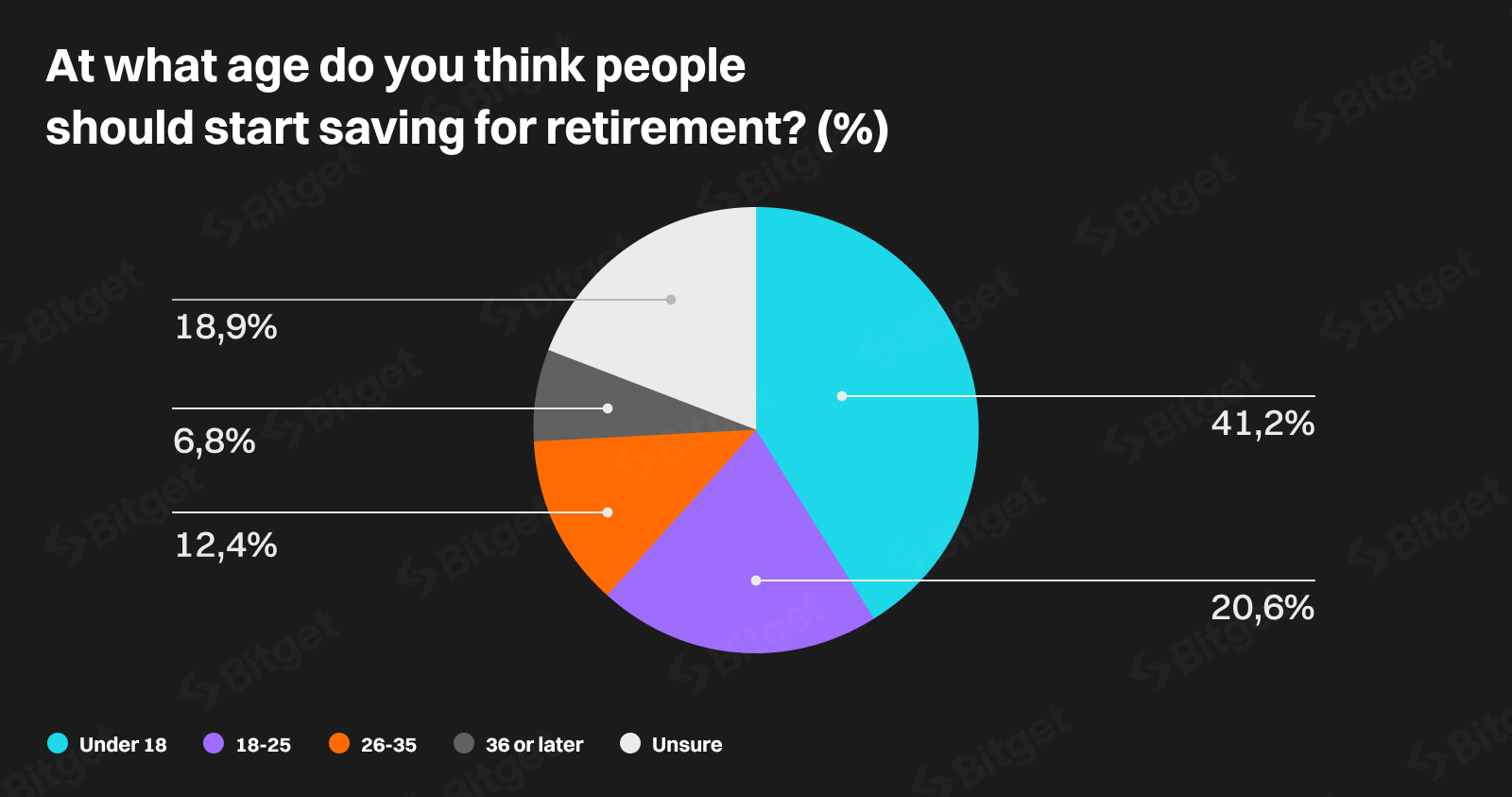
Ideal Age to Start Saving for Retirement
- 41.2% of respondents believe individuals should commence retirement savings before the age of 18.
- 20.6% consider the ideal age for starting savings to be between 18–25.
- 12.4% suggest starting between the ages of 26–35.
- Only 6.8% recommend beginning savings at 36 or later.
- 18.9% expressed uncertainty regarding the optimal time to initiate savings.
Portfolio Performance Statistics with Cryptocurrency
- A portfolio heavily weighted towards cryptocurrency generated a year-to-date (YTD) return of 26.46%, and a 76.25% annualized return over 10 years, as of August 17th, 2025.
- Comparatively, the S&P 500 registered 9.66% YTD and an annualized return of 11.89% over a 10-year span, underscoring the superior growth exhibited by cryptocurrencies.
- Portfolios focusing on digital assets significantly outperformed balanced allocations, although these returns come with increased volatility, necessitating careful risk alignment.
- Hedge funds such as Tephra Digital reported 10% YTD gains, while Edge Capital recorded 7.3% YTD, amidst volatile market conditions.
- Even during spikes in volatility, certain quantitative strategies, like long/short approaches, achieved 6% YTD gains, demonstrating tactical resilience.
- Models that incorporate hierarchical risk parity or GARCH‑Copula portfolio optimization yield higher performance compared to traditional allocations.
- Dynamic agent-based allocation strategies deliver superior Sharpe and Sortino ratios (measures of risk-adjusted return) when assessed out-of-sample, as compared to static weighting approaches.
Contribution of Bitcoin and Ethereum to Portfolio Performance
- Bitcoin often contributes more significantly to risk-adjusted returns, because of its higher liquidity and robust markets, particularly when it comprises 1–5% of a portfolio’s total weight.
- Ethereum (along with other alternative cryptocurrencies) can enhance possible gains but also contributes to increased volatility and other structural risks; as a result, allocations are commonly smaller.
- During periods of strong market growth, Ethereum may produce higher raw returns; however, it often lags behind Bitcoin with regards to the Sharpe ratio due to increased drawdown risk.
- Whenever Bitcoin and Ethereum move in a similar pattern, combined exposure can raise the total correlation of a portfolio, leading managers to allocate diversely to minimize overlap.
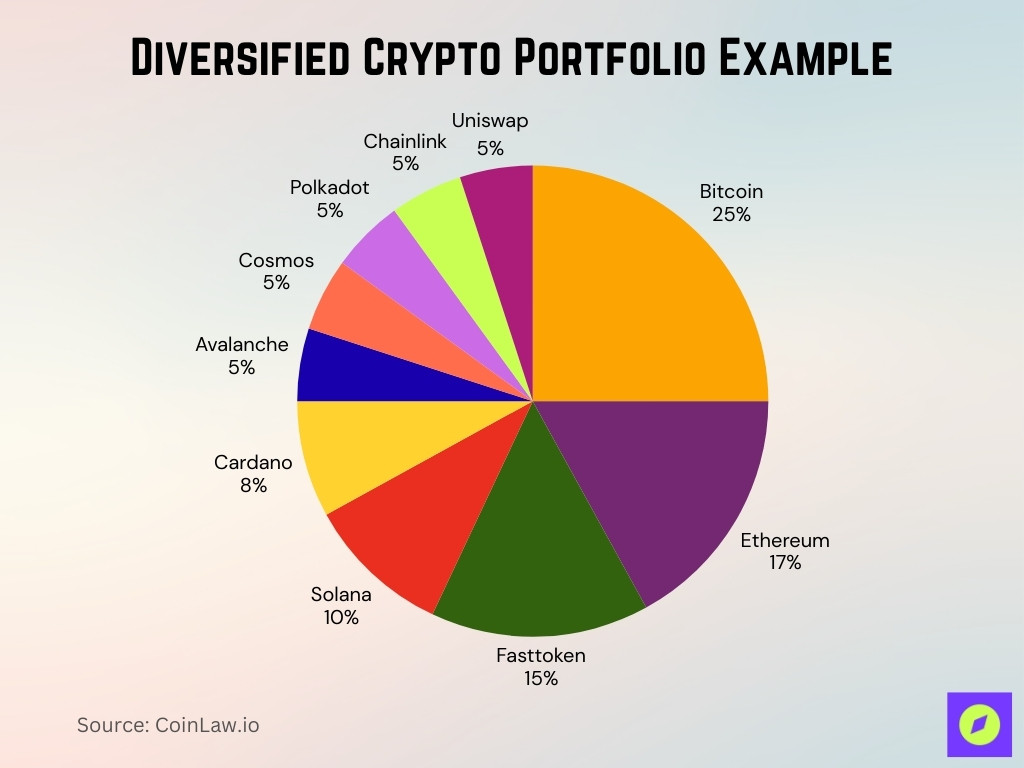
Diversified Crypto Portfolio Example
- Bitcoin (BTC) accounts for the largest proportion, set at 25% of the entire portfolio.
- Ethereum (ETH) makes up 17%, strengthening its standing as a reliable secondary asset.
- Fasttoken (FTN) is allocated 15%, establishing a notable presence.
- Solana (SOL) represents 10%, projecting confidence regarding high-performance blockchain technologies.
- Cardano (ADA) makes up 8%, delivering balance through its focus on long-term growth.
- Avalanche (AVAX), Cosmos (ATOM), Polkadot (DOT), Chainlink (LINK), and Uniswap (UNI) each hold 5% of the total portfolio assets, achieving diversification across multiple projects.
Stablecoins’ Role in Portfolio Structure
- The total value of the global stablecoin market reached about $255 billion by June 2025, nearly 99% of which is pegged to the U.S. dollar.
- Leading fiat-backed stablecoins include USDT, USDC, and BUSD, which predominantly shape the stablecoin market landscape.
- Stablecoins streamline cryptocurrency trading, allowing investors to transition smoothly into a stable form of assets during volatile market conditions.
- Frequently utilized for cross-border payment purposes, especially in emerging economies, stablecoins deliver advantages related to speed and lower costs.
- Legislation in the U.S. known as the GENIUS Act mandates that stablecoins are backed 1:1 by high-quality assets.
- In the EU, MiCA provides a legislative framework for stablecoins; Hong Kong and the UAE have also instituted formal regulatory measures.
- The CEO of DWS has described stablecoins as a “gigantic market” unfolding within institutional workflows.
Altcoins’ Share in Portfolio Allocations
- Bitcoin dominance decreased from 65% in May 2025 to 59% in August, when altcoin capitalization went beyond $1.4 trillion.
- Retail asset allocators display an evolving interest landscape; while the altcoin season index continues to be low (at around 40s), broader capital rotation is taking place.
- Institutional portfolios typically allocate approximately 67% to a combined BTC and ETH mix, compared to only 37% by retail investors.
- The pursuit of yield and diversification is pushing interest toward alternative cryptocurrencies that provide practical utility, such as assets related to AI and infrastructure.
- Ethereum recently appreciated by almost 42% year-to-date, closing in on record highs and highlighting investor interest in these alternative coins.
- Interest in ETFs for Ether is growing alongside Bitcoin, enhancing its importance within institutions’ altcoin exposure strategies.
Institutional vs. Retail Allocation to Crypto Assets
- 75% of institutional investors plan to increase cryptocurrency allocations during 2025, marking a transition away from speculative trading to more strategic investment use.
- A survey of 352 participants from the institutional investment space reveals that 83% plan to increase cryptocurrency exposure in 2025, and 59% are already aiming to allocate over 5% of their AUM to digital currencies.
- Institutions frequently concentrate portfolio holdings within BTC and ETH (67%), whereas retail investors hold a lesser share (37%).
- 35% of institutions currently allocate 1–5% to digital assets, and 60% allocate more than 1%.
- A marginal 3% of investors allocate more than 20% of their portfolios to digital currencies.
- Smaller institutions (with AUM less than $1B) tend to allocate a higher proportion (over 1%) than larger institutions (with assets greater than $500B).
Dynamic Allocation Strategies Involving Cryptocurrencies
- Including a 10% allocation to crypto (BTC + ETH) within a combined portfolio considerably enhances both the return and Sharpe ratio, while marginally impacting volatility or increases in drawdown risk.
- Dynamic dilution (DD90/10) portfolios deploying EWMA or GARCH models achieved returns of approximately 10.1–10.4%, alongside Sharpe ratios around 1.04–1.06 compared to a baseline Sharpe of 1.00.
- Multi-agent AI-driven strategies (using static versus rolling-window optimization) lead to improved risk-adjusted returns, specifically under volatile market conditions.
- Applying Markowitz + GARCH-Copula optimization that combines crypto with traditional assets yields portfolios exhibiting higher Sharpe ratios alongside more stable performance.
- Optimization using network analysis, as well as price forecasting and portfolio theory, assists in identifying potentially profitable crypto portfolios even with uncertainties.
Sharpe Ratio Analysis Including Crypto Assets
- Adding Bitcoin to a 60/40 portfolio steadily increases the Sharpe Ratio up to a 5% asset weight, beyond which the improvements level off.
- An ideal 71.4% BTC and 28.6% ETH crypto-only mix produces a Sharpe ratio of 1.43, surpassing allocations of 100% Bitcoin (1.16) or 100% Ether (0.83).
- A 10–20% BTC allocation for individual investors consistently improves returns and Sharpe Ratios across both lump-sum and rolling portfolios.
Standard Deviation and Value-at-Risk in Crypto Portfolios
- Cryptocurrency portfolios generally exhibit a standard deviation 2–4 times greater than that of equity portfolios, reflecting significant levels of volatility.
- Within DD90/10 dynamic portfolios, volatility remained approximately similar (around 9.7–9.8%) when compared with the conventional 8.2% baseline, while both returns and Sharpe ratio exhibited improvements.
- GARCH‑Copula optimized portfolios commonly display reduced tail risk (VaR) and more consistent performance when compared against portfolios consisting solely of crypto assets, or traditional portfolios.
Strategic Approaches to Crypto Risk Management
- Fixed upper limits (such as a maximum of 10% allocation to crypto) present a simple yet effective method for controlling risk.
- Dynamic rebalancing that leverages instruments such as EWMA or GARCH models enables adjustments that are controlled for volatility.
- AI-based strategies involving intelligent agents provide allocation methods that are scalable, auditable, and adaptive, especially useful in fast-changing cryptocurrency markets.
- Incorporating cryptocurrencies focused on environmental sustainability or ESG principles could enhance the robustness of a portfolio while adhering to environmental requirements and regulatory expectations.
- Specialized models, like GARCH-Copula or network analysis, assist in managing tail risk and shifts in correlation effectively.
Long-Term vs. Short-Term Portfolio Statistics with Crypto
- Long-term allocations (spanning 5–10 years) demonstrate cryptocurrency outperforming traditional benchmarks in terms of raw returns (~76% annualized) as well as risk-adjusted performance (Sharpe ratio exceeding 1).
- Short-term dynamic strategies and rebalancing practices assist in navigating volatility, enhancing performance during turbulent periods.
- Strategic allocations below 10% using long-term investing can lead to better returns while preserving manageable risk profiles.
Regulatory Trends Affecting Portfolio Crypto Allocations
- The U.S. officially enacted the GENIUS Act in July 2025, solidifying the regulatory foundations for stablecoins.
- MiCA continues to function as the foundational crypto regulation framework for the EU, while Hong Kong and the UAE advance similar licensing and oversight measures for stablecoins.
- Major financial institutions, such as Citigroup, are venturing into custody and payment services for stablecoins, expanding the infrastructure for institutional investment.
- Regulatory clarity supports the surging institutional flows as well as ETF growth within Bitcoin and Ethereum markets.
Conclusion
Cryptocurrency continues to reshape the financial landscape and the world of investment portfolios. A moderate allocation to digital currencies (1–10%), specifically targeting BTC and ETH, often yields superior risk-adjusted returns, enhanced portfolio performance, and increased diversification. Dynamic optimization models, strategies powered by AI, and carefully crafted frameworks for managing risk further refine these potential benefits, specifically in unstable markets. Stablecoins offer strategic liquidity alongside regulatory appeal, whereas alternative coins present opportunities for portfolio growth through shifting market cycles. Growing adoption by institutional investors, strengthened by evolving regulatory clarity, solidifies crypto’s position within investment portfolios. For investors in the U.S. and participants in global markets, incorporating crypto demands a balance between strategic planning and prudent risk management.
Disclaimer: The information provided within this article on CoinLaw is purely intended for general informational and educational purposes only. It does not represent financial, legal, or investment advice, nor do any statements reflect the views or recommendations of CoinLaw concerning the purchase, sale, or ownership of specific assets. All investments carry varying degrees of risk, and it’s recommended that you carry out independent research or consult with a certified advisor prior to making any financial decisions. Your use of any information found on this website is entirely at your own discretion and risk.