
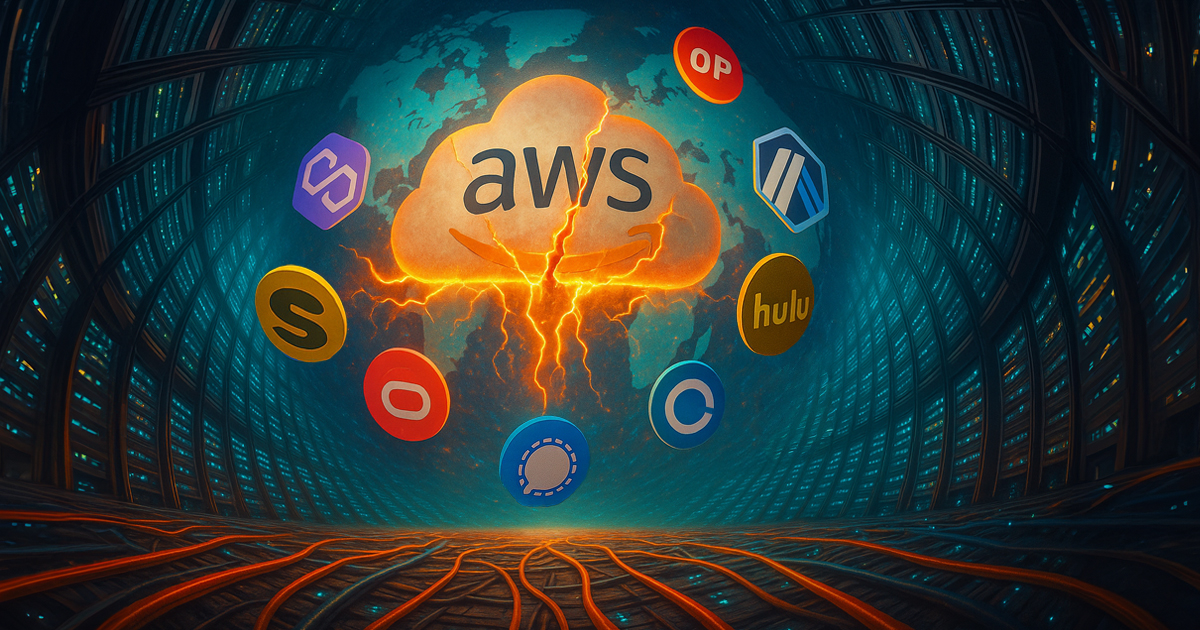

A widespread disruption impacted the internet community earlier today as Amazon Web Services (AWS) experienced technical difficulties. The ripple effects reached the cryptocurrency space, affecting several platforms.
Prominent cryptocurrency exchanges like Coinbase and Robinhood, along with some Ethereum-based layer-2 solutions, reported service interruptions. These issues stemmed from an operational problem within AWS’s DynamoDB database service.
According to the official Amazon status page, the problem originated in the US-EAST-1 region. It subsequently triggered a chain reaction, resulting in slowdowns across a significant number of AWS services – totaling 58 globally.
Amazon stated:
“Our investigation indicates the root cause is related to DNS resolution concerning the DynamoDB API endpoint within the US-EAST-1 region. We are actively pursuing multiple solutions concurrently to expedite the recovery process. This issue also extends to other AWS services operating within the US-EAST-1 region. Global services or functionalities reliant on US-EAST-1 endpoints, such as IAM updates and DynamoDB Global tables, may also encounter difficulties.”
As a direct consequence, Down Detector recorded numerous outages across a diverse range of online services. Over 50 platforms were impacted, spanning airlines, streaming entertainment sites, and popular social media applications like Snapchat and Signal.
Notably, this recent event represents Amazon’s second major disruption in the current year, following a similar incident in April.
Centralized Cloud, Decentralized Repercussions
AWS constitutes a cornerstone of global internet infrastructure. It provides crucial cloud storage and processing capabilities to a vast number of businesses. The reliance on its reliable uptime is now being scrutinized within the crypto community.
Coinbase acknowledged that the outage temporarily restricted user access but indicated that its systems are in the process of recovery. Robinhood also confirmed a similar restoration of service to its users.
In parallel, Base, the Ethereum layer-2 network developed by Coinbase, announced that the AWS outage had affected its own underlying infrastructure, resulting in reduced operational capacity.
Of particular note, infrastructure providers specializing in blockchain technology were also affected.
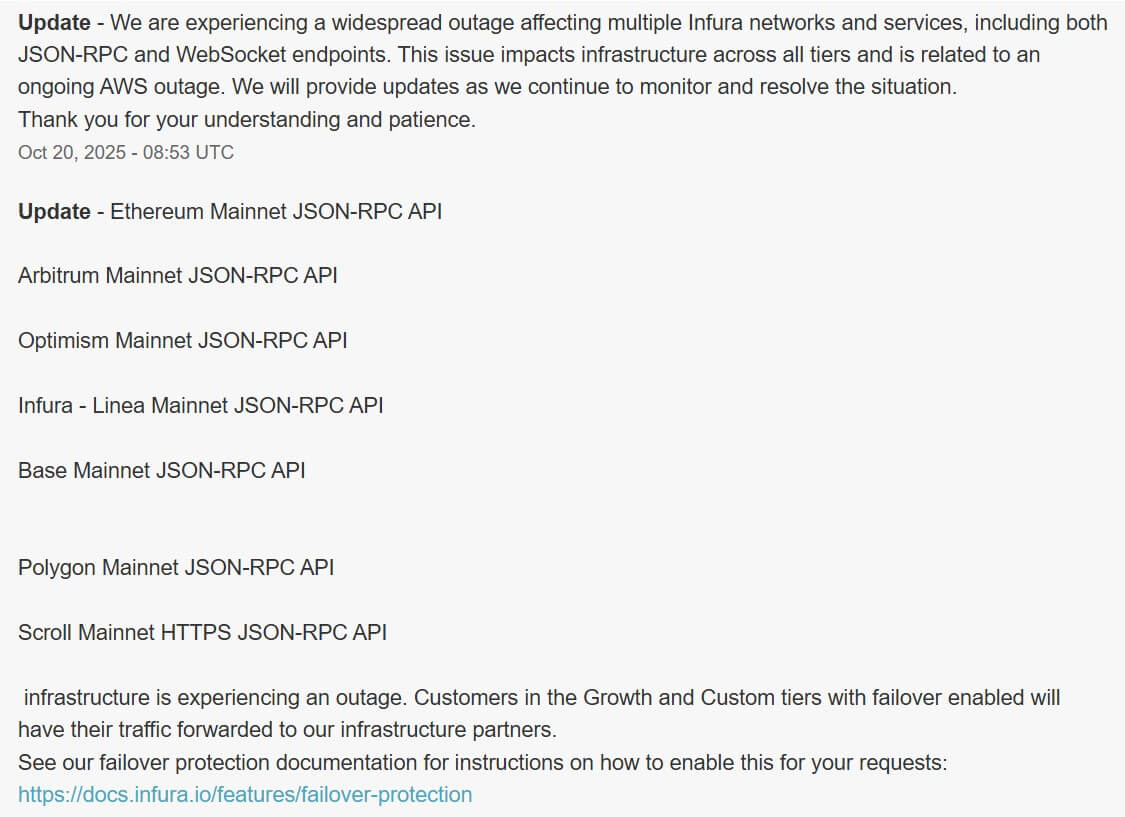
Infura, a service backed by Consensys that connects cryptocurrency wallets, such as MetaMask, to various blockchain networks, confirmed disruptions. User connectivity to networks including Polygon, Optimism, Arbitrum, Linea, Base, and Scroll, was impacted.
The Persistent Question: Why Does AWS Outages Keep Affecting Crypto?
Given the widespread nature of these disruptions, Lefteris Karapetsas, the founder of Rotkiapp, a privacy-focused portfolio tracking tool, commented:
“The fundamental vision underpinning blockchain technology centered around decentralized infrastructure, a goal we have largely failed to achieve.”
The reality is that a considerable portion of blockchain network infrastructure continues to rely on centralized server systems.
To illustrate, data sourced from Ethernodes indicates that AWS hosts approximately 2,368 Ethereum execution layer nodes. This figure represents about 37% of the entire network’s node count.
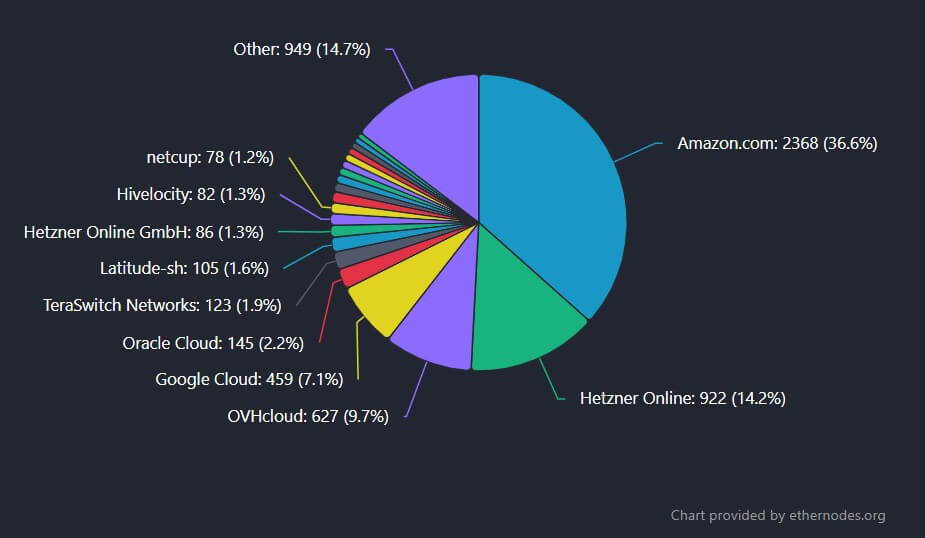
This dependence means that a technical problem impacting the provider, or even one of its data centers, has the potential to slow down entire ecosystems built upon the blockchain.
It’s important to note that an AWS outage will not completely halt Ethereum, as other nodes, hosted on competing cloud platforms or on independent hardware, will continue processing transactions.
Nevertheless, this level of concentration highlights the degree to which so-called “decentralized” crypto relies on centralized infrastructure.
Despite the philosophical implications of this reliance, cloud hosting is often the most convenient option for smaller cryptocurrency projects.
Operating nodes internally requires significant investment in hardware, reliable power sources, and high bandwidth connections, resources that large data centers provide at scale.
This makes AWS a cheaper, seemingly reliable, and faster deployment option for startups.
However, this convenience trades long-term resilience for short-term efficiency because an over-reliance on a limited number of cloud providers creates inherent structural risks for the emerging cryptocurrency sector.
Decentralized Alternatives: A Path Forward?
The recent outage reignited the conversation surrounding the development and adoption of decentralized cloud computing systems. These systems would ideally replicate the functionality of AWS but with distributed storage and processing managed by independent participants.
Ahmad Shadid, the CEO of O.XYZ, provided insights to CryptoSlate, suggesting that this transition will not be easily achieved.
He noted:
“AWS has an incredibly vast network of data centers. For decentralized cloud compute providers to effectively compete, they would need a comparable, or even larger, infrastructure. Is that even a feasible undertaking? Where would that electricity come from?”
While he acknowledged the potential for these decentralized solutions to leverage consumer-grade GPUs and other existing resources,
he questioned the platforms’ ability to “find enough consumer GPUs and other such resources that offer the same processing power that AWS provides to all of its clients.”
Nevertheless, advocates for decentralization in the cryptocurrency community believe that projects such as Filecoin and Arweave hold promise. Their censorship-resistant and cost-effective approach aligns more closely with the core values of the cryptocurrency ecosystem.
Notably, market data within the cryptocurrency space appears to support this narrative. Tokens associated with decentralized storage protocols have demonstrated strong performance over the last 24 hours, according to data compiled by CryptoSlate data.