
Last September, Hurricane Helene’s unprecedented flooding caused widespread destruction in Mountain City, Tennessee. The storm damaged buildings, crippled infrastructure, and left many residents without homes.
The town’s largest employer, a yarn manufacturing facility, sustained significant damage and announced its closure earlier this year, resulting in the loss of over 100 jobs and millions in local investment for Mountain City.
“It was a real blow to both the city and the county, with people losing their livelihoods,” stated Mayor Jerry Jordan, emphasizing the devastating impact.
Now, this close-knit community of approximately 2,500 residents nestled in the Doe Valley is actively seeking a new industrial partner to revitalize its economy, with local leaders exploring all available options.
Since February, Mountain City officials have been engaged in private discussions with CleanSpark, a company specializing in bitcoin mining, while simultaneously advancing planning proposals without adequate public awareness.
Like many tech companies, CleanSpark seeks locations in rural areas, such as Mountain City, to construct the necessary infrastructure for server operations. They are drawn to the availability of affordable land, ample space, and abundant electricity often found in these smaller towns.
While such developments can bring economic benefits, they can also create excessive noise pollution, negatively affecting neighbors and diminishing property values.
Residents of Mountain City only became aware of the proposal to construct a 30-megawatt bitcoin mining facility on 50 acres in the heart of their neighborhood in April.
Upon discovering the plan, community members expressed strong disapproval, with Mayor Jerry Jordan acknowledging that he was “bombarded” with calls, texts, and emails. However, Mayor Jordan admitted to WUOT News that he selectively responded only to communications from individuals he knew personally.
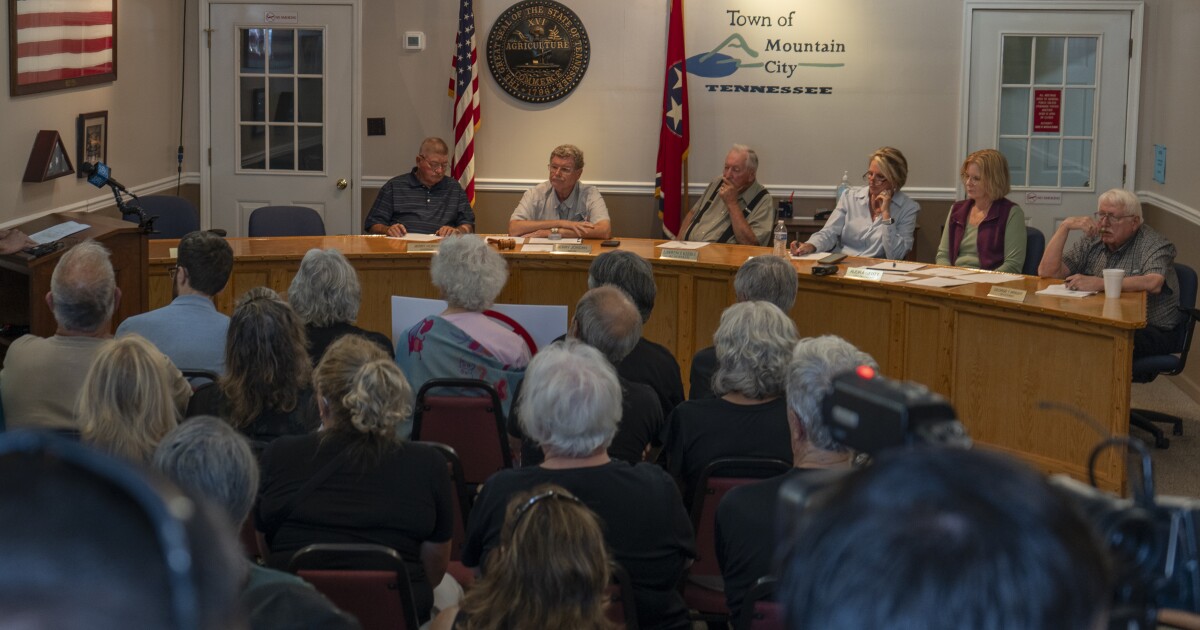
Despite widespread community opposition, a widely circulated petition, and hours of public comment against the project, the voices of Mountain City residents and the surrounding county were largely disregarded by the local government.
In an interview with WUOT, Mayor Jordan questioned his responsibility to the public versus making decisions he felt were in the best interest of Mountain City.
“[I’m] trying my best to make the best decision for this town,” Jordan explained. “It might not be the most popular decision, but I wanna try and make it the best decision for this town.”
Despite assurances from the electric company that the investment would maintain low power rates and generate an additional $170,000 in annual tax revenue, many residents remained unconvinced, expressing concerns about potential noise pollution. Several locals are reporting that pending real estate transactions have been put on hold, and asking prices for nearby properties have dropped due to this proposal. Emerging conflicts of interest within the local government remained unaddressed.
Pierce Gentry
/
WUOT News
Residents showed out to voice criticism of plans to bring a 30 megawatt bitcoin mine to town.
Facing potential legal action, city leaders are now reconsidering their position.
“I guess we made a mistake,” conceded Mayor Jordan. “But are we going to go to jail for making a mistake? I mean, what’s the consequences?”
Rural Areas: The New Frontier for Big Tech
CleanSpark has experienced rapid growth by targeting energy-rich rural communities across the United States. Over the past eleven years, it has either acquired or constructed over 20 bitcoin mining facilities in four states, with nearly half located in rural Tennessee.
CleanSpark’s Senior Vice President Harry Sudock stated that a partnership with Mountain City “made perfect sense.”
“When we learned about the closure of the manufacturing plant in Mountain City… we thought it made perfect sense,” Sudock said. “How could we bring someone into the system to make sure they don’t lose the revenue – the tax base – and the benefit to the community that that plant brought.”
While CleanSpark asserts its commitment to community support, not everyone is satisfied with the results.
Noise Concerns Arise at Wyoming Bitcoin Mine
Earlier this year, CleanSpark launched a new bitcoin mine in Cheyenne, Wyoming. Utilizing advanced oil immersion technology for cooling processors, the system circulates oil through large, industrial coolers mounted on the building.
These coolers continuously force air over radiators where the hot oil flows, facilitating cooling before releasing heated air. The cooler’s fans operate around the clock to maintain optimal oil temperatures for the facility’s processors.
Caryl Simpson and her husband, residing less than a mile from the mine, were unaware of the facility’s construction until it became operational and the noise began.
“It was like being on the tarmac of an airport,” Simpson described. “It was so loud.”
Neighbors report that the noise generated by the coolers extends beyond CleanSpark’s property. The continuous nature of the noise is particularly bothersome, according to Simpson.
“When it’s persistent, you begin noticing it more and more,” Simpson explained. “It’s sort of like Chinese water torture, where one drop of water is okay, but when it’s perpetual, it becomes an annoyance or dangerous.”
The Mayor of Cheyenne has been in communication with CleanSpark to seek solutions. Temporary noise barriers, similar to those used on highways, have been erected around the facility, and power has been reduced to mitigate fan noise. However, Simpson notes that the noise sometimes returns.
“CleanSpark is not just annoying, it’s a real problem in terms of our peace and quiet out here,” Simpson stated. “Especially for those that are closer to it.”
Procedural Lapses
Two days prior to a February meeting of the Mountain City Planning Commission, the general manager of the local utility, Mountain Electric Cooperative, notified the city office that he would be presenting a business matter to the commission – the town was gaining a new industry.
After weeks of meetings with CleanSpark representatives and inquiries about their bitcoin mining technology, Metcalf expressed his support, believing the facility would be an unobtrusive and beneficial addition to the town.
“I’m very optimistic that it’s the best thing for Mountain Electric and the members,” Metcalf stated. “I think that they are a stand up company.”
However, due to insufficient notice to the city recorder, the CleanSpark proposal was not included on the published meeting agenda. The agenda instead listed “no new business,” and according to meeting minutes, no public comments were received.
Pierce Gentry
/
WUOT News
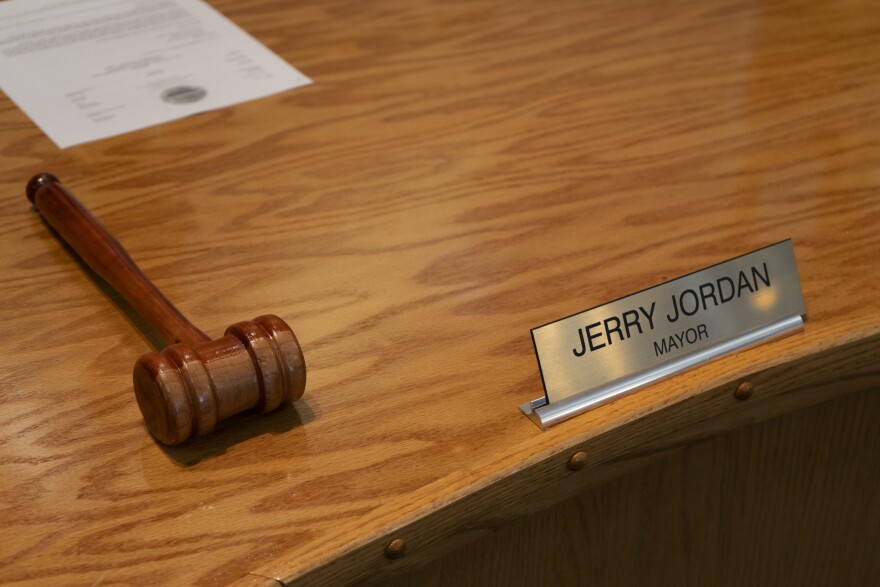
company – to the small town of Mountain City in northeast Tennessee. Despite concerns expressed by
people who live in the city and county, Jordan says he thought it was what would be best for Mountain
City.
Mayor Jordan shared with the planning commission that he had attended meetings with CleanSpark and believed the company to be “very, very nice.”
He proposed granting preliminary approval to the CleanSpark project, even without a final site plan or contract. The motion passed unanimously, remaining largely unknown to the Mountain City community for two months.
CleanSpark’s ‘Sudden’ Arrival
In late April, the planning commission invited CleanSpark representatives to present new information about the bitcoin mine. The proposal was added to the agenda. Residents and local media were in attendance. People were shocked to learn the proposal had already been given preliminary approval.
“It just seemed to come out of nowhere,” remarked city resident David Thompson. “And thanks to social media, people became more aware and alerted, and people were asking, ‘what’s going on?’”
Residents began quickly researching bitcoin mining and its potential impact on their community. They held discussions and sought insights from former residents of areas near bitcoin mines, like Graham and Judy Marshall, who relocated from Texas a few years prior.
“Up the road from us was Granberry, Texas,” Judy shared. “They’re having health problems, just all kinds of things. And when you start to hear that, it’s like, what good is it for the people that live around it?”
Her husband, Graham, worries about CleanSpark’s long-term presence if the project receives approval.
“They can do what they want,” he expressed. “They can run us over with a bus, and we just have to say thank you.”
Pierce Gentry
/
WUOT News
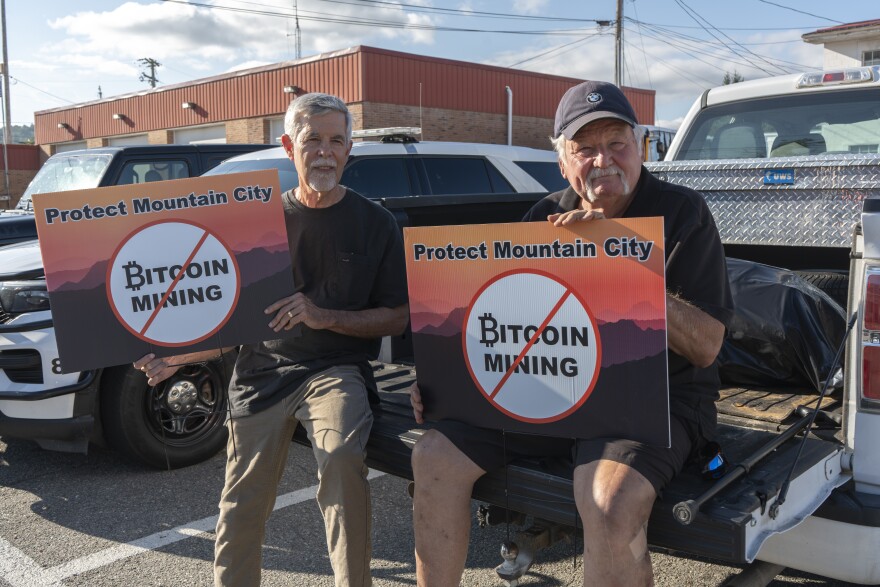
2025. The two showed up at a town hall meeting called by the Mountain City Board of Mayor and
Aldermen on Thursday to voice their opposition to a bitcoin mine planned for a 50 acre parcel in
the middle of a residential part of town.
City leaders moved to alleviate community concerns by emphasizing CleanSpark’s promises of minimal noise and the use of oil immersion cooling technology.
Residents Report Feeling ‘Ignored’
Despite the residents’ concerns and a petition gaining 1,700 signatures, city leaders remained unmoved.
Mayor Jordan believes that the majority of residents support the project, even though public feedback suggests otherwise.
“The people that are against it are very, very, very vocal,” Jordan said. “Now, there’s a lot of people that’s for it that’s not going to speak up … I guess they don’t want to be criticized.”
Many people have grown frustrated with the mayor for failing to respond to their emails, letters and phone calls.
“Every time I send them a letter, I never get a response,” said Lori Blevins, a county resident. “And I think that’s been a consistent thing.”
Ginger Johnson, a city resident, echoes Blevins’ sentiments regarding unanswered emails.
“He will not respond to any emails,” she said.
In an interview with WUOT News, Mayor Jordan admitted to not opening emails from people he does not personally recognize.
“A lot of these correspondence I don’t open, because I don’t know if it’s from a trusted source,” Jordan said. “Do you open up everything that you get on your computer? Could that be a threat to get a virus on your computer or your phone?”
Pierce Gentry
/
WUOT News
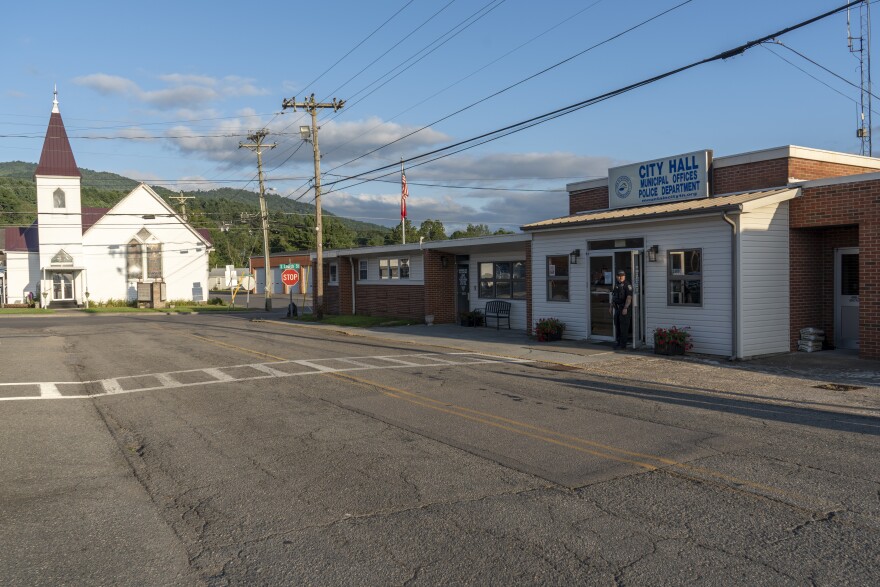
leaders have tried for months to bring a bitcoin mine to the small town of around 2,500 people,
but have come up against severe opposition expressed by many who live nearby.
WUOT News has uncovered several unreported conflicts of interest on the boards and commissions that voted on the bitcoin mine proposal. Alderman Jason Bryan accepted employment with CleanSpark in June but only disclosed it weeks later, upon his resignation from the board.
Additionally, Planning Commissioner Richard Walsh failed to disclose his wife’s position as Chief Financial Officer of Mountain Electric during the voting process. Similarly, the town’s general counsel, George Wright, also serves as Mountain Electric’s attorney.
Despite potential violations of the town’s ethical code, city leaders did not address these conflicts. When questioned about these issues, Mayor Jordan suggested that they existed in a “gray area.”
“I’d say, looking back, [Bryan] probably should have resigned as soon as he accepted [the job],” Jordan said. “But, I mean, that’s their private right, whatever they wanna do.”
The proposal would necessitate rezoning of the 50-acre parcel, which is yet to be sold to CleanSpark. A resolution to reclassify the land passed its first reading at a July Board of Mayor and Aldermen meeting, despite strong opposition from attending residents. A public hearing was held last week to gather input from area residents, with all eleven speakers opposing the project.
The situation came to a head on Tuesday, when the Board convened again to vote on the resolution. The Mayor asked if any members wanted to vote on the plan. All members abstained and the onlookers erupted in applause.
“Bitcoin is dead in the city limits,” Mayor Jordan declared.
Looking Ahead
Mayor Jordan revealed that the board’s reversal on the CleanSpark issue stemmed from several legal threats received in the days leading up to the vote.
Local residents have grown frustrated, and started contacting law groups to stop the plan.
On August 5, the Southern Environmental Law Coalition submitted a letter to Mountain City and Mountain Electric Cooperative requesting all communications and documents related to CleanSpark.
Additionally, county resident Randy Dandurand claims that he consulted attorneys prepared to file an injunction against the city for its swift advancement of the CleanSpark proposal.
“This is bigger than all of us,” Dandurand said. “But if we get together as a group like this, you can see that we can take down a goliath.”
Mayor Jordan shared that it was more than the town could handle.
“We don’t need to spend revenue on fighting a lawsuit,” he admitted.