


The economic future of the United States faces significant challenges. As of September 2025, the country’s total debt has exceeded $37.43 trillion, presenting a serious financial situation. A considerable portion of government revenue, approximately 25 cents of every tax dollar, is allocated to covering interest payments on this substantial debt.
America’s Growing Debt Burden
Recent reports from the U.S. Treasury and the Joint Economic Committee reveal that the national debt has climbed to a staggering $37.43 trillion. This represents an increase of $2.09 trillion within a single year.
CNBC reports that the interest payments for the fiscal year 2025 have already surpassed $478 billion year-to-date, showing a 17% rise compared to the same period last year.
This expenditure is projected to consume about 23 cents of each dollar collected by the IRS. This significant percentage has increased considerably as global interest rates return to normal levels after years of quantitative easing policies.
Tariffs: A Drop in the Bucket?
The U.S. government has collected record-breaking tariff revenues in recent years, especially after the implementation of new import duties under the previous administration.
These tariffs are projected to boost government revenue and potentially reduce the national deficit by as much as $4 trillion over the next decade.
However, even with these gains, the growing national debt remains a monumental problem, as increasing interest costs are outpacing the revenue generated by tariffs. The IMF has indicated that “the scale of the increase in tariff revenue is highly uncertain.” Eliant Capital noted:
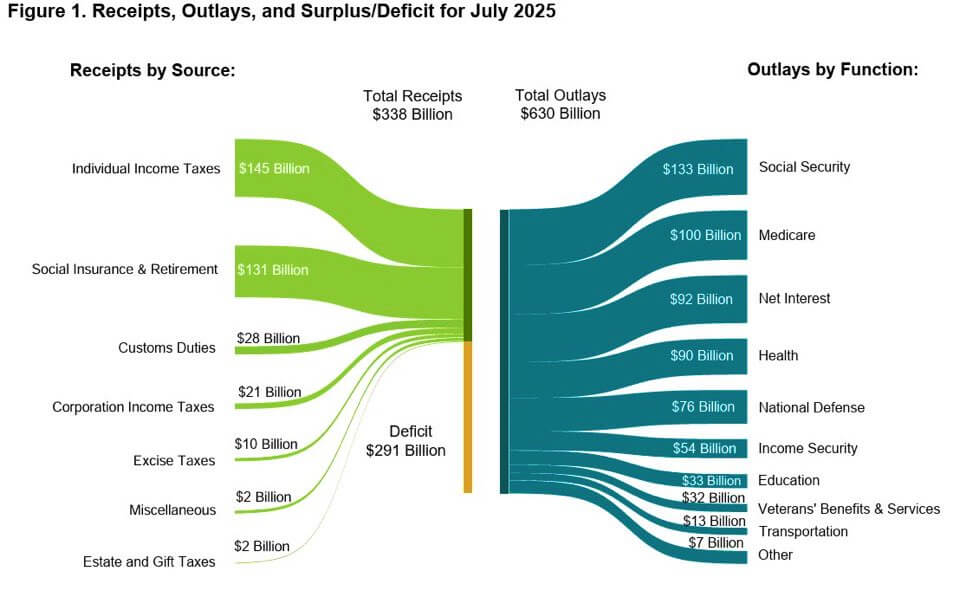
“Despite tariff revenues, the deficit for July reached $291B, with the U.S. spending $630B and collecting $338B, indicating that 46¢ was borrowed for every $1 spent.”
An Unstoppable Trend?
Macroeconomic analyst Lyn Alden uses the phrase “nothing stops this train,” originally from pop culture, to describe the U.S. debt situation.
Alden suggests that consistent deficits and continuous spending are creating an era of fiscal dominance, making meaningful fiscal reform politically unachievable. She believes the ongoing accumulation of debt is fundamentally built into the system, and only a major shift, such as a return to hard money, can reverse the trend. Alden commented in a Slate Sundays interview:
“Structurally, U.S. debt is increasing faster than its target, and there seems to be almost no way to stop it.”
The Peterson Foundation reports that interest payments are now the third largest expenditure for the federal government, exceeding almost all other programs except Social Security and Medicare.
By the end of the year, federal interest payments will account for 18.4% of revenues, a level not seen since the early 1990s.


Don’t Get Left Holding the Bag
Join The Crypto Investor Blueprint — 5 days of pro-level strategies to turbocharge your portfolio.
Brought to you by CryptoSlate
As interest payments consume a larger share of federal revenue, and conventional solutions such as tariffs and spending reductions prove inadequate, the discussion surrounding “hard money” gains traction.
Bitcoin and other cryptocurrencies are increasingly viewed as alternative stores of value in an era characterized by continuous monetary expansion.
Echoing Alden’s concerns, the perception of an unstoppable trend towards greater debt is driving renewed attention toward hard money options such as Bitcoin and gold.
Investors Seek Alternative Investments
Both gold and Bitcoin have experienced increased demand as investors seek alternative stores of value amid fiscal uncertainties and rising inflation.
As of mid-September 2025, gold prices have hit record highs, trading above $3,600 per ounce, which is an increase of over 41% from the previous year.
Some analysts believe gold prices will continue to rise, potentially reaching $3,800 by the end of the year, as global liquidity concerns drive investors towards safe-haven assets.
Bitcoin, often referred to as “digital gold,” is trading between $115,000 and $118,000 after recovering from lows near $108,000 in September.
Despite Bitcoin’s price volatility, many analysts, including Lyn Alden, expect its value to reach at least $150,000 by the end of the current market cycle.
As fiscal pressures intensify, these alternative assets are increasingly seen as crucial components of diversified investment portfolios, particularly given concerns about the escalating U.S. debt.