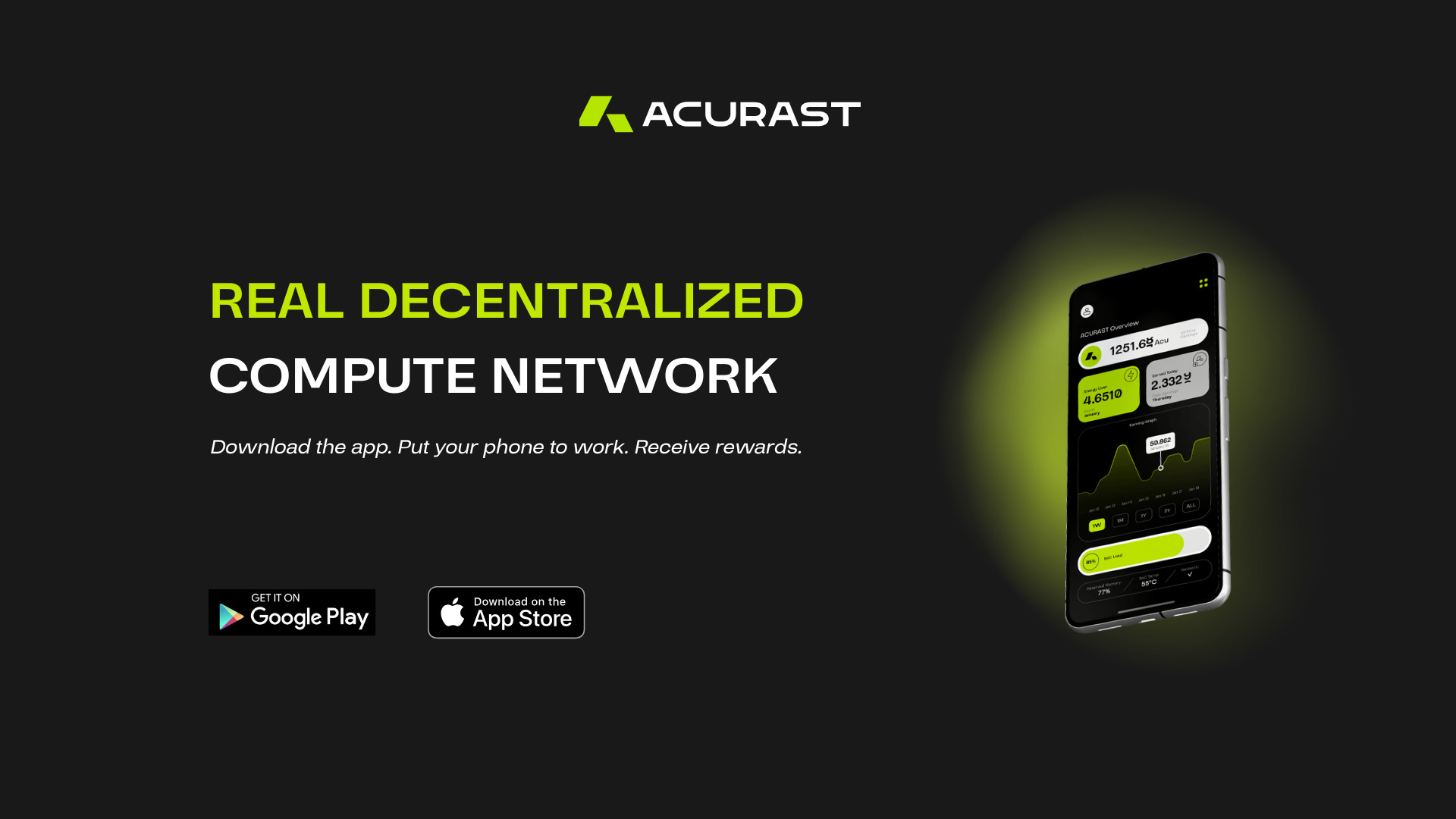
Leveraging a network of over 119,000 devices and facilitating 360 million+ transactions, Acurast introduces Staked Compute, harnessing the widespread availability of smartphones for decentralized computing with enterprise-level reliability.
Acurast, a decentralized network utilizing the processing power of smartphones, has unveiled Staked Compute, a significant protocol upgrade transforming crowdsourced device capabilities into a robust, enterprise-grade computing infrastructure. Acurast aligns economic incentives with proven uptime, achieving reliable and secure computing without the need for centralized control, by combining hardware-verified processing on both iOS and Android platforms with stake-backed commitments to availability.
Decentralized computing and Decentralized Physical Infrastructure Networks (DePINs) have historically faced challenges related to reliability and genuine hardware verification. The lack of verifiable assurances at the device level has led to networks susceptible to virtualized or misrepresented hardware, ultimately resulting in failed deployments and unavailable resources.
Acurast directly confronts these issues by integrating smartphone Trusted Execution Environments (TEEs) with a comprehensive global benchmarking protocol and innovative stake-based commitments, ensuring the continuous operation of workloads.
The graphic above illustrates Acurast’s allocation of 70% of inflation towards the Staked Compute Pool, directly linking rewards to system dependability.
“The secure hardware available in today’s smartphones is truly world-class, and these devices are ubiquitous,” stated Alessandro De Carli, Founder of Acurast. “Staked Compute leverages this widespread availability to create a reliable network. Providers commit to specific uptime promises, back those promises with staked tokens, and are rewarded based on consistent performance. This eliminates the need for traditional data centers or intermediaries, creating a protocol where performance is directly incentivized.”
The new framework requires each participating smartphone to prove its integrity through its TEE, undergo performance benchmarking, and then dedicate a portion of its capacity for designated periods. Providers receive rewards for meeting their commitments, while penalties are applied proportionally for failures. This results in a service-level agreement approach for decentralized computing, driven by economic principles rather than centralized management.
“Businesses prioritize cost-effectiveness and data confidentiality above all else,” said Alessandro De Carli, Founder of Acurast. “When workloads are executed within a secure TEE on a consumer device, sensitive information remains protected. The competitive pricing of smartphone-based computing compared to traditional service-class options allows Acurast to offer attractive rates without compromising security.”
Different applications require different resources. For example, AI inference might prioritize sustained computing power, while simpler data retrieval or automation tasks might emphasize availability or unique residential IP addresses. Acurast’s benchmarking system ensures optimal job allocation to appropriate devices, while Staked Compute guarantees that providers are compensated for dependability, not simply processing speed.
The network’s inherent diversity mitigates concerns about relying solely on high-end devices, as many workloads do not demand flagship-level performance. The global smartphone market is vast, encompassing all price ranges and manufacturers. This heterogeneity enables Acurast to distribute tasks across a broad spectrum of devices, enhancing resilience and minimizing reliance on a single hardware type.
This model differs significantly from ‘mobile mining.’ Instead of consuming resources on artificial tasks, Acurast directs computing power toward productive activities, encompassing AI, secure data processing, automation, and proof generation. Stake-backed guarantees ensure service quality for developers and businesses.
Staked Compute is being introduced with Acurast’s recent protocol update, allowing providers to participate through the Acurast Processor applications. Developers can also interact with the network via the Acurast Hub, with detailed information, parameters, and benchmarking methodologies available in the Acurast documentation.
About Acurast
Acurast is revolutionizing computing by harnessing the potential of billions of smartphones, eliminating the need for data centers. The verifiable, scalable, and private compute network allows users to securely run applications at scale on a decentralized infrastructure without compromising speed or data protection.
Acurast has already integrated more than 119,000 smartphones worldwide into its incentivized testnet, making it the most decentralized verifiable compute network currently available. With over 35,000 compute deployments powering critical workloads and more than 360 million on-chain transactions processed to date, Acurast is establishing a new standard for decentralized computing. This scale enables high-security and AI-powered applications to function seamlessly within a global, community-driven network.
Website | Twitter/X | Discord | Telegram
Disclaimer: TheNewsCrypto is not responsible for the content on this page. The information contained within this press release does not constitute financial advice. Readers are advised to conduct thorough research before making any decisions. TheNewsCrypto is not liable for any losses or damages resulting from the use of any content, products, or services mentioned in this press release.