

Welcome to Slate Sundays, CryptoSlate’s refreshed weekly spotlight. We’re diving deep with exclusive interviews, sharp expert insights, and opinion pieces that peek beyond the surface, exploring the ideas and personalities shaping the crypto revolution.
Lyn Alden stands out as a truly exceptional individual.
Widely considered a leading authority in macroeconomics, engaging with Lyn feels like absorbing some of her remarkable intellect. You might just feel a little bit smarter after a conversation with her.
She navigates complex subjects like government debt and the rise of artificial intelligence with remarkable grace and articulate precision, like an Olympic gymnast sticking a perfect landing.
As the founder of Lyn Alden Investment Strategy and a general partner at Ego Death Capital (alongside other prominent figures such as Jeff Booth and Preston Pysh), Lyn has cemented her reputation over the years as a highly respected macroeconomic analyst within the industry.
Her sought-after insights and extensive market knowledge make her a frequently requested interview guest.
Lyn is a prolific creator of content. She shares a free investment newsletter and actively participates on Crypto Twitter, where she has garnered nearly 750,000 followers who value her up-to-date observations and sharp humor. Beyond her insightful advice, Lyn is also quite skilled at creating memes.
The Unstoppable Force
Lyn is perhaps best known for her book, “Broken Money,” which offers a detailed analysis of the history of currency and a critical examination of the existing global monetary system. She is also a strong advocate for her perspective on the U.S. government’s fiscal imbalances, often referred to as ‘The Unstoppable Force.’
The U.S.’s significant expenditure levels are accelerating faster than its capacity to fund them. This situation is what Lyn describes as a “slow-motion runaway train.” She elaborates:
“Substantial U.S. government deficits are set to persist for the foreseeable future – across a five or ten-year investment outlook. This is driven by various factors, largely linked to political divisions. Achieving major tax increases or significant spending cuts becomes extremely challenging in such a polarized environment, complicated further by the current debt situation.”
The total owed by the U.S. to its creditors is currently a staggering $36.9 trillion, exceeding 120% of the nation’s economic output and rising by approximately $1 trillion each quarter.
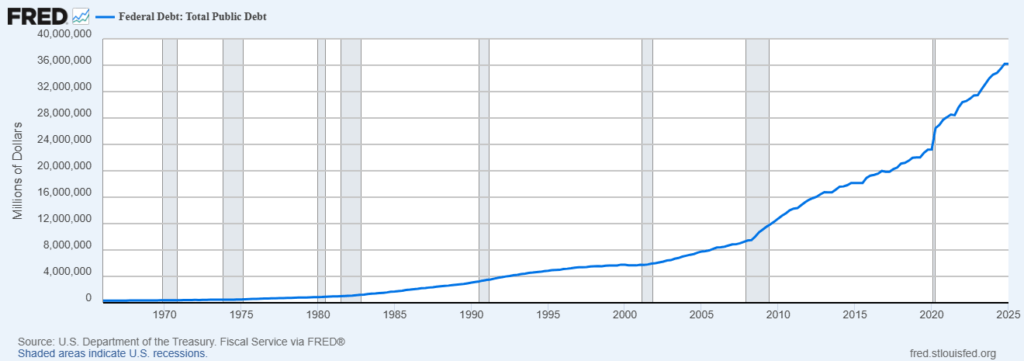
Even the most skilled illusionist would struggle to conceal such a significant level of government debt. With a decreasing capability to manage the repayments, if nothing can stop it, can anything slow it down? She responds:
“Numerous factors can offer some mitigation. Import taxes are one such measure, bypassing some of the political resistance. They function as substantial tax increases, circumventing Congress via executive orders enacted during emergencies, which tempers pushback, at least for a while.”
While tariffs may slightly enhance government income, Lyn emphasizes that the figures are insufficient to significantly affect the deficit: currently around $2 trillion, with tariff income generating around $500 billion per year, around one-fourth of the needed amount. Additionally, “we are already witnessing exemptions.” She continues:
“The ultimate factor influencing the ‘unstoppable force’ is the high degree of financialization within the U.S. economy, where tax revenue is closely linked to asset valuations. Efforts at fiscal restraint tend to backfire, impacting either the stock market or the broader economy. This, in turn, reduces other tax revenues, hindering long-term, sustained deficit reduction.”
I listen, contemplating the scale of the predicament and the impending economic path. She adds:
“Its very structure results in it growing beyond the target, with little prospect of control.”
The Landscape for Bitcoin and Cryptocurrency Markets
We then shift our focus to the recent market dip following a weaker-than-expected employment report, which prompted former BitMEX CEO Arthur Hayes to reduce his cryptocurrency holdings. I ask Lyn how significant this jobs report is and whether she shares Hayes’ cautious short-term views on liquidity globally.
She cautions that Hayes is more active as a short-term trader than herself. However:
“The jobs data was certainly significant, showing the most substantial downward revision in some time, supported by other indicators. The ISM Purchasing Managers’ Index also points to similar weaknesses.”
The ISM Manufacturing PMI serves as an important gauge of the economic health of the U.S., indicating the strength of demand by measuring the quantity of orders received by U.S. factories. Lyn continues:
“Whether this affects Bitcoin and the broader crypto market is less clear. While it could weaken earnings and the economy, it also suggests a more accommodating stance from the Federal Reserve, which typically benefits Bitcoin and the crypto sector.”
Though she doesn’t make short-term trading decisions like Hayes, Lyn does find some validity in his short-term views, based on several factors:
Tariffs could reduce the government debt somewhat, impacting the momentum of crypto (“slightly slowing the force over a couple of quarters”), and the Treasury is working to increase its General Account balance (the TGA) after the debt ceiling was lifted. This means removing liquidity from the market, which could negatively affect riskier asset classes. Lyn explains:
“Ironically, debt limits are generally beneficial to liquidity, as they compel these stores of value to be returned to the economy. However, the subsequent replenishment of these stores drains the system of cash.
This activity [by the treasury] is expected to continue through the end of this quarter, which, in line with Arthur’s predictions, typically isn’t ideal for asset prices across the board.”
In contrast, Lyn isn’t overly worried about tighter liquidity across the globe. She states:
“Liquidity is in an intermediate state, given that the dollar has ceased its previous decline. The dollar’s direction heavily influences liquidity. Generally, a decreasing dollar is advantageous to global liquidity. Conversely, China’s rising credit impulse is favorable for global liquidity. Overall, it is neutral at the present time.”
Bitcoin Cycles Will Lengthen and Moderate
While it’s not perfect for Bitcoin to reach a million dollars, it could be worse. Lyn affirms:

“I do not believe that this cycle has concluded. I anticipate that Bitcoin will reach higher peaks during this cycle, potentially later this year or in early 2026. While various factors may influence this, current indicators do not signal a peak for the next several years.”
Indeed, Lyn suggests that we are “nowhere near multi-year peaks,” looking at metrics that assess market value relative to on-chain cost basis, which serves as an indicator of exuberance.
“The liquidity situation seems stable, perhaps not excellent for the immediate quarter, but also not a major obstacle. Entering the upcoming year, I anticipate higher Bitcoin prices.”
How high might it go?
Lyn pauses, stating she lacks a firm projection. Unlike others in the field, she doesn’t seek to boost her following with outrageous predictions. Instead, she says:
“I expect it to surpass $150,000 this cycle. It may reach considerably higher than that. However, I always start with a conservative estimate, considering prevailing conditions at the time.”
Lyn believes that Bitcoin cycles are evolving. We should expect cycles to be longer, and “perhaps less extreme” than previous ones. Be prepared to witness significant upward moves followed by consolidation periods, “rather than shooting to the moon and collapsing.”
“Looking back at what were once known as FANG stocks, now the Mag7, or major U.S. technology companies, they consistently grew for longer periods than many anticipated. Value investors often expressed disbelief in their sustained growth.

Periodically, these stocks become overextended, experiencing a 30% decline, or worse. Other times, they remain relatively flat, experiencing volatile periods, but continue rising after consolidating. Bitcoin may follow a similar pattern to some degree. While still volatile, we should anticipate longer, less drastic cycles on average.
Bitcoin Treasury Companies: Bear Market Trigger?
For individuals shaken out by Mt. Gox, restrictions in China, or FTX-style black swan instances that instantly reversed Bitcoin’s advances, Lyn’s forecast may be soothing. But are there lurking events which could lead to the close of the cycle?
Lyn points out that now that Bitcoin is a multi-trillion dollar asset, institutions will want to participate. She says:
“It is unrealistic to think that Bitcoin would be held only by individual investors and not by larger investment groups. This scenario might be conceivable only when Bitcoin remains a very small market.”
She is unconcerned about the concentration risks to Bitcoin posed by companies like MicroStrategy accumulating BTC like it’s going out of fashion (MicroStrategy currently holds more than 628,791 coins, almost 3% of the entire supply). She adds that this is similar to previous cycles:
“Mt. Gox previously held more than 800,000 coins, representing a larger proportion of the total coins at that time than BlackRock or MicroStrategy hold now. While centralization issues are always worth noting, it isn’t significantly worse now than it was in past periods. So, no, I’m not particularly worried about centralization.”
More important to watch for, Lyn says, is the level of leverage within the sector, since, “extreme optimism and high debt lead to downturns.” Bitcoin needs volatility to increase from zero to a value of trillions of dollars to become globally relevant; however, Lyn warns that volatility breeds optimism and leverage.
“This can cause imbalances and corrections. The liquidations occasionally occurring could contribute to the downturn, although this doesn’t differ fundamentally from previous instances. The current leverage in the treasury sector isn’t particularly high.
MicroStrategy has rather moderate leverage related to their Bitcoin, as does Metaplanet. We will see about other Bitcoin treasury companies over time. I anticipate a major cleansing event, wiping out many alternative cryptocurrency firms. Some Bitcoin firms which are badly run will also be at risk in the coming downturn.”
The Roaring Twenties and the Decade of Inflation
Around the time of the COVID lockdowns, Lyn spoke about the ongoing inflation caused by shutting down the globe and increasing the money supply. She would eventually characterize the 2020s as a decade of inflation, with governments challenged to curb rising costs. Does Lyn expect this trend to continue?
“To some extent, yes, as we are in 2025. We remain above the level that the Federal Reserve is measuring, and above their official objective, despite a recent reduction. The potential for another significant spike depends largely on whether energy supplies are restricted. It’s difficult to have considerable inflation without energy pressure. Thus, maximizing the energy supply can moderate inflation.”
In contrast to previous decades, when gains in productivity from manufacturing automation offset the printing of money, she thinks the 2020s will have “stickier” inflation. Unless we see major productivity gains, such as through AI, it won’t bring down the value of store-of-value assets. She says:
“Things that are genuinely scarce, such as waterfront properties, gold, fine art, high-quality stock, etc., go up dramatically because it’s hard to increase those things. Going forward, AI potentially cheapening white-collar services might alleviate pressures on CPI and people’s expenditures.
Ongoing printing of money could offset this, however, with higher gold, higher Bitcoin, higher value properties, and scarce items. I think we’re still in a sticky inflation environment, but it’s difficult to generate dramatic inflation without energy shortages.”
AI and the Economics of White-Collar Work
Since she referenced AI for its potential productivity gains, I ask whether she’s worried about job losses, being something of an AI skeptic myself. Lyn’s considerably more positive. She says AI is inevitable, just like the government debt.
“Banning it in one country won’t stop it, since other countries will support its development. It will be open-sourced, as with any technology. When it arrives, it can disrupt the status quo, as it will cause some job losses quickly.”
She compares AI to social media and its disruption of social interaction, and warns that it should be used carefully to avoid harmful impacts. I remember reading an MIT study which made the point that AI is a great learning tool, so long as people don’t become so dependent on it that their own intelligence suffers.
Lyn continues:
“It’s beneficial to find ways to make repetitive white-collar jobs cheaper and more accessible, so that people can do different kinds of work. This has happened previously when we automated textiles or farming with tractors. It’s the same, only quicker.”
She points out that portable AI differs from data center AI, marveling at the workings of the human brain, which can process thoughts and emotions, has “high bandwidth senses,” and can “self-heal” all while using only 20 watts of power. She continues:
“It’s astonishing, since it’s less than an incandescent light bulb. Comparable processing in a data center requires megawatts of power, or millions of watts…
I don’t think we’re near the point where people can no longer add value over silicon. It will cause some disruption, which will then make people focus on other things.”
I agree, wondering if my thought process requires as much power as Lyn Alden’s very intelligent brain.
Inflation, Disruption, Broken Money… Oh My!
Given the inflation, disruption, and broken money, this era has the hallmarks of what is known as a fourth turning, so I’m unsure about the eventual outcome. I wonder about Lyn’s view. Is this a good time to be alive? She ponders:
“I think so. There are fewer deaths from avoidable causes than nearly ever before globally, which is why the population bubble is happening now… Technology is increasing connections. I see it positively, but technology is polarizing, becoming ‘winner-take-most’. We have to use technology in a natural way, avoiding so much reliance on it. I think that will be the case eventually.”
Lyn also thinks that AI won’t continue improving forever, but will eventually plateau, like aviation, where progress has stagnated for years, after explosive growth in the 20th century. She says:
“We went from the Wright brothers to landing on the moon in a lifetime. However, after the 70s, growth slowed. We still don’t have faster planes than the Blackbird or commercial aviation faster than the Concorde. We no longer even have the Concorde…
I think eventually electronics will reach certain limits that will be hard to exceed dramatically. This will allow us more time to absorb what we already have.”
Keep up with Lyn Alden on X or visit lynalden.com for in-depth insights and research.