

A significant trend is emerging in the cryptocurrency sphere: traders are increasingly opting for decentralized exchanges (DEXs) over their centralized counterparts (CEXs). This shift has resulted in an unprecedented CEX-to-DEX trading volume ratio.
According to a recent industry analysis by CoinGecko, a well-known crypto data aggregator, spot trading volumes on DEX platforms experienced a substantial surge of at least 25% in the second quarter of 2025, when compared to the preceding quarter. In stark contrast, trading volumes on CEX platforms witnessed a sharp decline of nearly 28%. Find more details in
CoinGecko’s Quarterly Report.
This growing preference for DEXs has propelled the DEX-to-CEX ratio to a new height during Q2, escalating from 0.13 in the first quarter to 0.23, as highlighted in the report.
Despite this increasing ratio, it’s important to note that the spot DEX market is still considerably smaller than the CEX market. The top 10 decentralized exchanges collectively recorded a trading volume of $877 billion in Q2, while CEXs processed a much larger volume of $3.9 trillion.
PancakeSwap and BSC Driving DEX Growth
PancakeSwap, a decentralized exchange operating on the Binance Smart Chain (BSC), emerged as the frontrunner in this surge. Its trading volume skyrocketed by an impressive 539%, climbing from $61.4 billion in Q1 to $392.6 billion in Q2.
This substantial growth has positioned PancakeSwap as the leading DEX globally, accounting for a significant 45% of all DEX trades executed in Q2, as reported by CoinGecko.
CoinGecko suggests that the remarkable growth of DEXs in Q2 can be partially attributed to the launch of Binance Alpha in May, which directs trades through the PancakeSwap platform.
“Consequently, BSC has risen to become the most favored blockchain for DEX trading activities, surpassing prominent platforms like Ethereum, Base, and Solana,” the report highlighted.
Perpetual Trading Reaches New Peaks on DEXs
In addition to the rise in spot trading volumes, decentralized crypto platforms have achieved significant progress in the realm of
perpetual futures (perp) trading, where traders engage in price speculation without actually owning the underlying assets.
CoinGecko’s data reveals that perp trading volumes on DEXs reached an all-time high in Q2, crossing the $898 billion threshold for the first time.
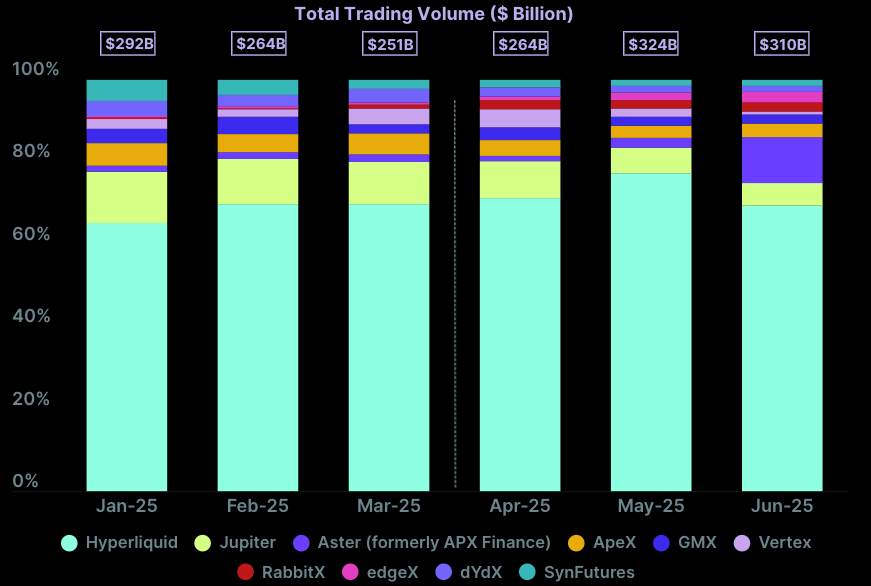
Within the perp trading landscape, Hyperliquid — a
decentralized perpetual exchange (perp DEX) operating on its own layer 1 blockchain — has solidified its dominance. The platform reported a trading volume of $653 billion, capturing a substantial 73% market share.
Related:
BNB Chain targets 5,000 DEX swaps per second in 2025
Among the top 10 perp DEXs, only Hyperliquid, Aster (formerly APX Finance), RabbitX, and EdgeX demonstrated growth in trading volumes.
Conversely, dYdX, once a leading perp DEX, experienced a continued decline in its trading volume, registering an average monthly volume of $5.3 billion, a decrease from the over $10 billion recorded in January 2025.
While derivatives trading reached new peaks on DEXs during Q2, centralized alternatives exhibited a slight downturn. CEX platforms saw a modest 3.6% decline in derivatives trading compared to the previous quarter, according to data from TokenInsight.
Magazine:
Will Robinhood’s tokenized stocks REALLY take over the world? Pros and cons