


Decentralized perpetual exchanges, or perp DEXes, achieved a significant milestone in October, recording a monthly trading volume of $1.049 trillion as of October 24th. This marks the first time that on-chain derivatives markets have surpassed the $1 trillion mark, setting a new standard for decentralized trading platforms.
Data from DefiLlama indicates a 30-day volume of roughly $1.241 trillion as of the same date. However, the open interest across these platforms is approximately $15.83 billion, showing about a 12% decrease over the preceding month. This contraction is likely linked to the market downturn that occurred around October 10th.
The events of October 10th and 11th acted as a major catalyst. A significant sell-off, fueled by tariff concerns, led to what CoinGlass described as “the largest liquidation event in crypto history.” This event resulted in an estimated $19 billion to $30 billion being wiped out across both centralized and decentralized trading venues.
DefiLlama data captured a record single-day peak around October 10th, with perp DEX volume reaching approximately $78 billion. This figure significantly exceeds the typical volume observed earlier in October.
The increased volatility was triggered by President Donald Trump’s announcement regarding a potential 100% tariff on goods imported from China. This announcement led to substantial liquidations of leveraged positions within a 24-hour timeframe.
The resulting two-day period of market activity maintained elevated funding rates and spurred ongoing activity on derivatives platforms throughout the following week. This mechanically increased perp turnover and resets across the decentralized exchange infrastructure.
Incentives Drive Perpetual Trading Activity
Points programs, airdrop farming, and trading competitions played a significant role in encouraging users to continue trading both during and after the October 10th market event.
As CoinGecko reported, the practice of airdrop farming for perpetual DEXs without native tokens gained traction in late 2025. Users recognized the potentially lucrative airdrop allocations from these platforms.
This likely contributed to Lighter reporting $193.1 billion in monthly volume and Aster recording $187.9 billion. Both platforms benefited from the heightened interest in perp DEXs. Despite having its own token, Aster continues to offer an active rewards campaign as of this writing.
Initiatives such as Arbitrum’s DRIP program and Synthetix’s late-October trading competition exemplify the types of protocol-level incentives that promote repeated on-chain engagement, especially among users aiming to maximize point accumulation on platforms lacking tokens or those recently launched.
The design of these programs, which involve milestone-based unlocks, fee-sharing arrangements, and yield-generating collateral options, altered the decision-making process for both market makers and individual traders.
Despite the increased volume from newer platforms, Hyperliquid accounted for approximately $316.4 billion in 30-day perp volume and maintains over $7.5 billion in open interest on its layer-1 blockchain.
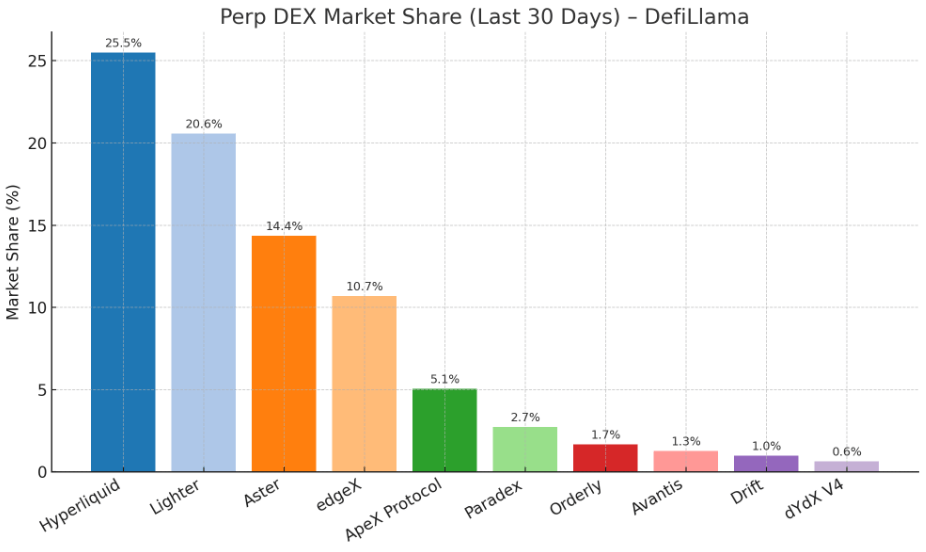
Platforms built on Solana also significantly contributed to the October surge. Drift, along with other perp platforms native to the Solana blockchain, demonstrated increased daily throughput. Data from Messari shows that Solana-based perpetual contracts averaged approximately $1.8 billion in daily volume during the month.
Impact on Decentralized Derivatives
On-chain derivatives have now reached a scale that rivals certain segments of centralized exchange activity. This brings greater liquidity, distribution of fee revenue to token holders, and direct market maker participation onto public blockchains.
This shift has systemic implications. Failures in oracle feeds, risk management engines, or blockchain functionality can now affect billions in open interest and daily trading volume measured in the tens of billions.
The events of October 10th served as a real-world stress test for many platforms. Centralized exchanges, including Kraken, Coinbase, and Binance, reported service disruptions during the event.
However, with the exception of a brief pause on dYdX, perp DEXes operated as intended, processing liquidations without experiencing downtime. This demonstrated the ability of decentralized infrastructures to withstand extreme volatility while maintaining operational capability.
Regulatory scrutiny of leverage ratios and user safeguards will likely increase as perp DEXs capture a larger share of the market.
Aster’s offering of up to 1,001x leverage on certain trading pairs, combined with the absence of Know Your Customer (KYC) requirements on most platforms, is likely to create friction with jurisdictions that are tightening regulations on retail access to high-leverage products.
Purpose-built application chains and rollups specifically optimized for derivatives trading are expected to proliferate as teams pursue the potential fee revenue and network effects demonstrated by October’s trading volumes.
The long-term sustainability of this surge depends on whether market volatility persists and whether incentive programs can effectively support ongoing user acquisition without devaluing tokens or depleting reserve funds.
October demonstrated that decentralized derivatives can operate at an institutional scale. However, it also highlighted the potential for increased impact from both technical failures and regulatory intervention as the sector continues its expansion.