

The financial world is abuzz as the first U.S. Dogecoin (DOGE) exchange-traded fund (ETF)
prepares for its launch this Thursday. Opinions are sharply divided, with some celebrating it as a landmark
moment for the crypto community’s validation and others dismissing it as simply a new vehicle for speculative
investments.
In a departure from Bitcoin ETFs, which were approved under the Securities Act of 1933, the Rex-Osprey Dogecoin
ETF (DOJE) secured regulatory clearance under the Investment Company Act of 1940. This
legislation, typically applied to mutual funds and diversified ETFs, sets it apart from its Bitcoin
counterparts.
For instance, BlackRock’s spot crypto fund directly holds Bitcoin (BTC) in Coinbase’s custody.
However, DOJE gains exposure through a subsidiary based in the Cayman Islands and via derivatives. This is
because the 1940 act mandates diversification, preventing excessive concentration in a single asset.
While the introduction of crypto ETFs is usually met with
enthusiasm within the industry, critics argue that offering an ETF based on a memecoin elevates
speculation to an institutional level. They also question the value proposition, given the associated fees that
investors could avoid by purchasing Dogecoin directly. The irony of Dogecoin, initially conceived as a joke,
surpassing projects with more practical applications to reach the ETF stage is not lost on some observers.
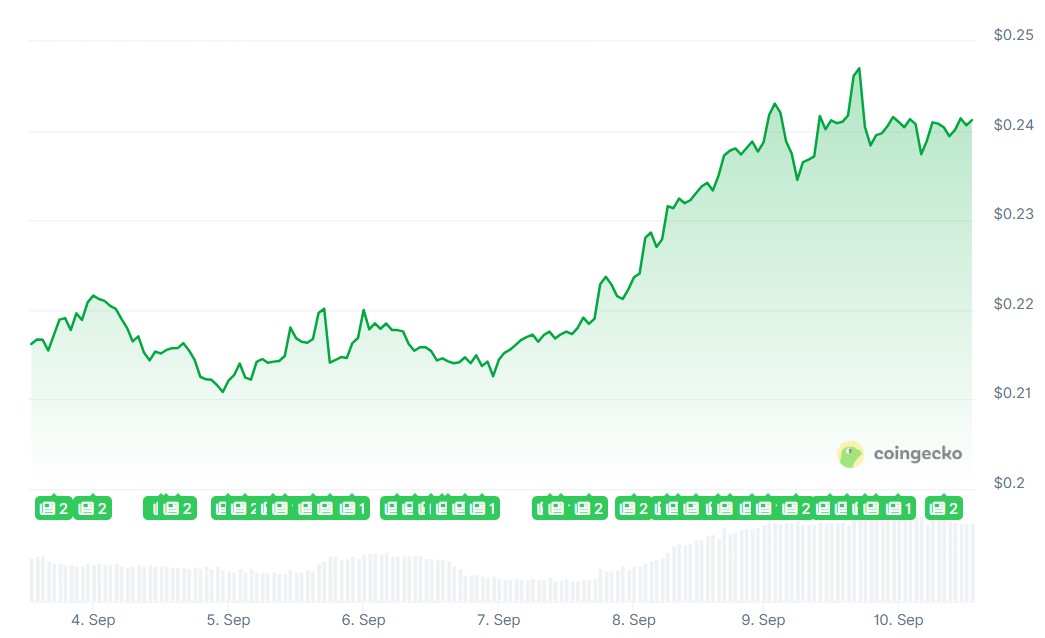
Is a Dogecoin ETF Necessary?
Dogecoin, a cryptocurrency originating from the Bitcoin lineage, emerged in 2013. It began as a fork of
Luckycoin, which itself was a fork of Litecoin, a derivative of Bitcoin. Despite its humorous beginnings, it
has evolved into a prominent cryptocurrency, securing a position among the top 10 based on market
capitalization.
Widely popular among retail investors, Dogecoin has been the genesis of the broader memecoin phenomenon, an asset
category often criticized for resembling a casino. Therefore, the approval of a Dogecoin ETF sparks significant
debate.
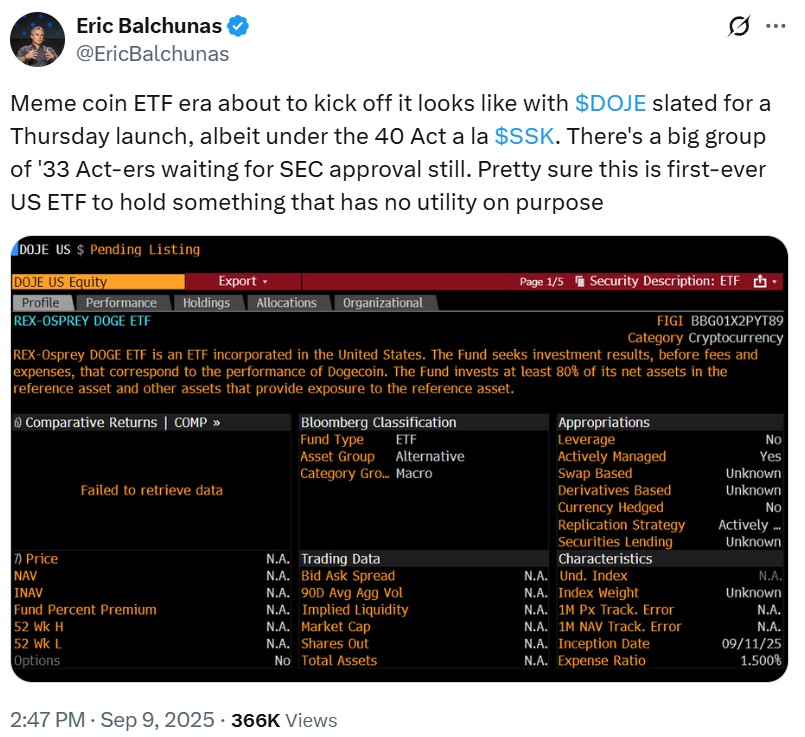
Source: Eric Balchunas
An ETF provides investors with access to Dogecoin through conventional stock market channels. However, the
rationale for such a product is questioned by certain experts.
“These ETFs levy exceedingly high fees when individuals could easily establish a Coinbase account in a matter of
minutes, acquire the token, and avoid any expense ratio,” stated Brian Huang, co-founder and CEO of Glider, a
crypto management platform, in a discussion with Cointelegraph.
He further suggested that institutional investors are more inclined to prioritize tokens with established
legitimacy and revenue generation.
Related: How plushies saved Pudgy Penguins from
bankruptcy
Dogecoin has propelled several crypto investors to millionaire status throughout its history.
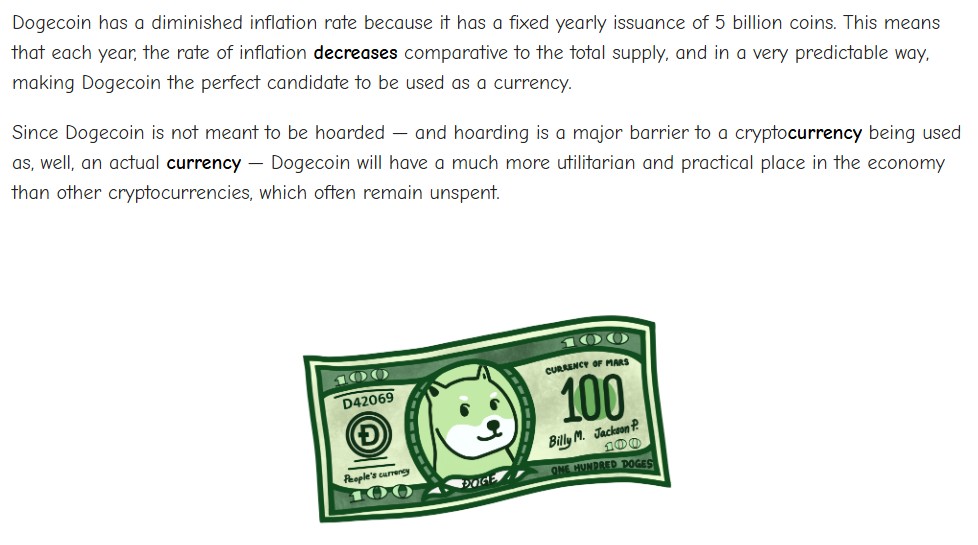
Nonetheless, its price continuously grapples with inflation. Dogecoin’s tokenomics were conceived as a
parody of Bitcoin’s scarcity. In contrast to Bitcoin’s capped supply of 21 million coins, Dogecoin has an
unlimited supply and issues a block reward of 10,000 DOGE every minute. This translates to approximately 5
billion new coins entering circulation annually.
During previous memecoin surges, analysts cautioned that such assets diverted capital and focus from more robust
blockchain endeavors. Certain individuals perceive the ETF as reinforcing this issue.
“It seems unusual to see a memecoin jumping ahead of more serious projects in the ETF race,” commented Douglas
Colkitt, a founding contributor at Fogo, a layer-1 blockchain, in an interview with Cointelegraph.
“An ETF wrapper does not fundamentally alter the underlying asset; it merely provides a platform for
Wall Street to promote DOGE with apparent legitimacy.”
A Dogecoin ETF Doesn’t Guarantee a Crypto ETF Free-For-All
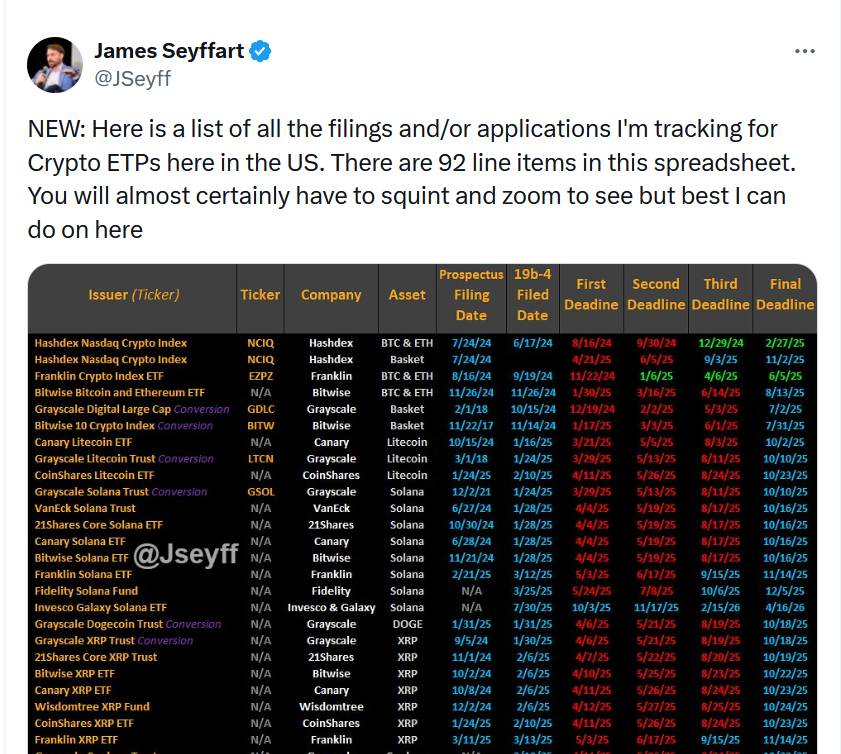
As of the end of August, the Securities and Exchange Commission (SEC) had 92 pending crypto ETP applications awaiting review. These included Dogecoin offerings, alongside other
memecoin
applications like Pengu, associated with the Pudgy Penguins NFT brand.
“While Dogecoin may have started as a lighthearted project, it has evolved into a legitimate altcoin, drawing in
genuine investors and developers,” stated Mike Maloney, CEO and founder of Incyt. “Community engagement is just
as significant for a coin as it is for a stock.”
While critics like Colkitt voiced concerns about a memecoin being prioritized over more serious ventures, others
contend that its success mirrors the dynamics of the crypto community. Maja Vujinovic, CEO of Digital Assets at
FG Nexus, communicated to Cointelegraph that Dogecoin’s advance over other altcoins demonstrates the capacity of
communities to steer assets into regulated frameworks.
“The precedence of DOGE signifies that communities, not solely technical roadmaps, possess the ability to push
assets into regulated structures. Regulators are acknowledging social momentum alongside market capitalization,”
she explained.
Related: Retail traders lose when OTC token deals win:
Here’s why
In contrast to many altcoins, Dogecoin has often been featured in mainstream media. Tesla CEO Elon Musk’s tweets
in 2021 resulted in a dramatic price surge, and a US government department he
once oversaw was even nicknamed the Department of
Government Efficiency, or DOGE. The token has also weathered several bear markets, resulting in a degree
of resilience and maturity absent in other memecoins.

“The ETF landscape will not be a free-for-all; liquidity, oversight, and custody readiness will remain critical.
Nevertheless, more tokens will find their way into regulated frameworks, expanding overall adoption,” Vujinovic
added.
On Tuesday, the SEC postponed its decision on the Bitwise Dogecoin ETF, extending
the review period to November 12.
Dogecoin ETF: Blurring the Lines Between Meme and Market
The advent of a Dogecoin ETF prompts the industry to evaluate whether the incorporation of speculative elements
and cultural trends is an inherent part of the crypto ecosystem.
Skeptics suggest the new fund overly embraces the latter. Huang deems the concept of packaging a single token
within an ETF as “absurd,” equating it to presenting a single stock as a diversified product. He contends that
the Wall Street wrapper primarily institutionalizes a meme while imposing fees on investors, who could effortlessly
acquire DOGE directly.
Conversely, others assert that the form is as significant as the function. Vujinovic emphasizes that an ETF
does not modify Dogecoin’s underlying code or intent. However, it integrates custody, audits, and disclosure
requirements, thereby enhancing legitimacy for mainstream investors.
Colkitt perceives the development as both promising and satirical. If a memecoin can navigate its way into a
regulated ETF, then “anything is possible.” While this could stimulate wider adoption, it also underscores the
ongoing convergence of innovative financial technology and pure entertainment within the crypto space.
As such, DOJE does not definitively address whether memes belong in established markets. Instead, it reveals that
regulators and investors are increasingly willing to engage with them as if they do.
Rex-Osprey has additional memecoin ETFs in development, with SEC filings detailing offerings
linked to Official Trump (TRUMP) and Bonk (BONK), as well as altcoins XRP (XRP) and Solana (SOL).
Magazine: Can Robinhood or Kraken’s tokenized stocks ever be
truly decentralized?