


A sharp turnaround occurred last week within the United States concerning its dozen Bitcoin ETFs. These investment vehicles experienced significant net outflows, totaling $1.2 billion.
Data provided by SoSoValue indicates this negative flow marks the second most substantial weekly loss observed since their initial market introduction in January of 2024.
This downturn brought an end to a positive two-week influx where over $5 billion entered, a period widely interpreted as growing confirmation of institutional belief.
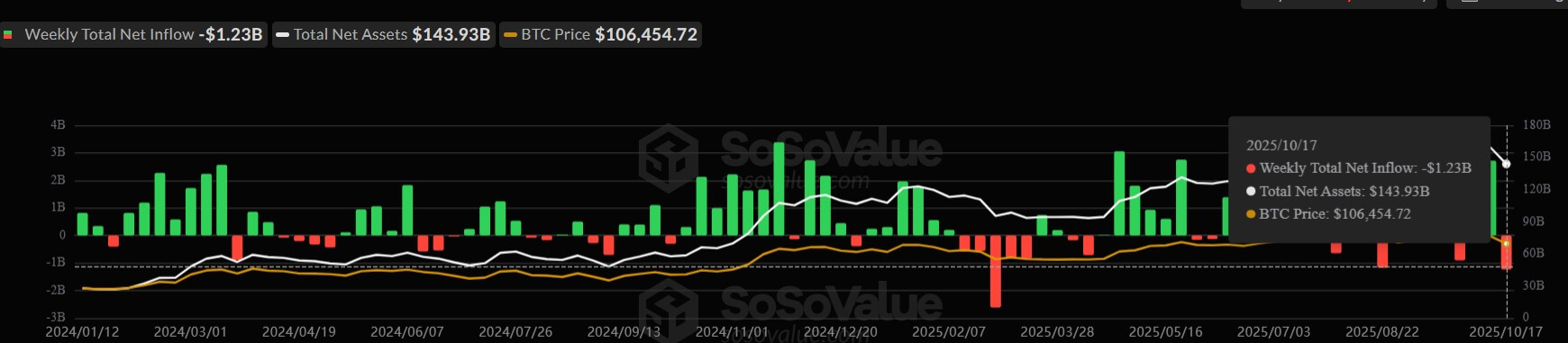
SoSoValue’s figures reveal that capital withdrawals affected nearly every major ETF provider. BlackRock’s IBIT experienced an outflow of $276 million, while Fidelity’s FBTC saw $169 million exiting its holdings.
Other significant issuers also faced losses. ARK Invest’s ARKB lost $290 million, Bitwise’s BITB saw $128 million depart, and Grayscale’s two funds together experienced a $321 million reduction.
This reversal followed a turbulent period for Bitcoin, its value briefly slipping below $104,000 during the tracked week. It’s important to note that this was its lowest price point since June.
Industry analysts have attributed this pullback to broader economic conditions, notably the anxieties generated by trade tensions between the U.S. and China, which impacted the appeal of riskier assets like Bitcoin.
However, the leading cryptocurrency has shown resilience, rebounding above $110,000 as of this writing, supported by recent developments within the cryptocurrency market.
London’s Alternative
In contrast to the U.S. outflows, the landscape was shifting across the Atlantic, promising to reshape retail access to Bitcoin.
October 20th marked the commencement of trading for Bitcoin exchange-traded notes (ETNs) on the London Stock Exchange. This action effectively ends the UK’s three-year-long prohibition against retail access to cryptocurrency investment products.
BlackRock spearheaded the launch with its iShares Bitcoin ETP, accompanied by other significant issuers like Bitwise.
Initial reactions to these products have been mixed, yet they demonstrate encouraging indications.
Charlie Morris, the founder of ByteTree, noted that early trading performance highlighted “success with platforms such as Interactive Investor, Swissquote, and Trading 212,” while some brokers, such as AJ Bell, were slower to integrate support.
Bradley Duke, head of Europe at Bitwise, expressed the view that the launch signifies a “big week” for individual investors, pointing to the clear upward trend for cryptocurrencies.
Potential $600 Billion Inflow?
Fueled by this new wave of adoption originating in Europe and the renewed institutional focus on Bitcoin, Galaxy Research anticipates that cryptocurrency investment instruments could attract up to $600 billion in new capital, driven by the broadening distribution efforts of traditional financial institutions.
The firm suggests the U.S. advisory market represents a substantial, largely unexploited prospect that could generate significant inflows into BTC. They asserted:
“Approximately 300,000 financial advisors oversee around $30 trillion in client assets. A modest 2% allocation to Bitcoin ETFs through this channel alone would equate to approximately $600 billion in potential inflows.”
Such influx could rival the entire global gold ETF market, currently valued at approximately $472 billion, and quadruple the $146 billion in assets under management (AUM) across all U.S. spot Bitcoin funds.
The asset management company emphasized that recent strategic moves by prominent traditional financial institutions, including Morgan Stanley and Vanguard, support this prediction.
Morgan Stanley recently recommended an allocation of up to 4% to digital assets, while Vanguard is reportedly considering offering select third-party crypto ETFs to its brokerage customers.
These developments are anticipated to inject fresh capital into the emerging industry and further propel Bitcoin’s broader adoption.
Galaxy Research contends that full access to these large advisory platforms could signify a structural shift in how digital assets are integrated into the mainstream financial system.
Once this accessibility is fully implemented, financial advisors will be capable of incorporating cryptocurrency directly within standard balanced portfolios, shifting its character from one of retail-driven speculation to advisor-led portfolio construction.
They noted:
“The impact could be substantial. New inflows may follow as wealth managers begin allocating to the asset class, potentially pushing total Bitcoin ETF AUM to $500 billion within a few years, assuming just a 1% average allocation across managed portfolios. Such flows would reshape market dynamics and reinforce Bitcoin’s position as a mainstream, investable asset.”
Galaxy’s analysis also suggested that this transformation could introduce a more mature form of liquidity.
According to their research, advisory-driven allocations tend to have longer holding periods and more rigorous compliance frameworks, leading to a decrease in the short-term turnover characteristic of retail crypto trading.
Over time, this increased discipline could improve price stability, strengthen liquidity, and align Bitcoin more closely with conventional asset classes such as stocks, bonds, and gold.