

Key Points
The Ethereum network secures the lion’s share (70%) of the tokenized Treasury market. Fidelity Digital Interest Token (FDIT) quickly made its way into the top 10, attracting $203 million, while BlackRock’s BUIDL experienced a $150 million decrease.
Ethereum’s blockchain network commands significant influence in the realm of tokenized U.S. Treasuries.
Specifically, Ethereum facilitates over $5.3 billion of tokenized instruments, including U.S. Treasuries, bonds, and cash equivalents. This represents a substantial 70% plus of the total $7.46 billion tokenized Treasury market.
Fidelity recently entered this space, presenting nearly 50 different tokenized U.S. Treasury options via its Fidelity Digital Interest Token (FDIT).
The central question revolves around FDIT’s potential to introduce further utility and liquidity to Ethereum’s decentralized finance (DeFi) ecosystem.
Fidelity Joins the Tokenized Asset Arena
Fidelity’s entrance is noteworthy, but the firm isn’t the pioneer in the real-world asset (RWA) sector.
The current dominant player is BlackRock’s BlackRock USD Institutional Digital Liquidity Fund (BUIDL), maintaining a robust $2.2 billion market capitalization within the tokenized Treasury landscape across multiple blockchain networks.
Fidelity’s FDIT, in contrast, is exclusively on Ethereum. In a short span, it accumulated $203.7 million in assets, rapidly ascending into the top ten Treasury offerings.
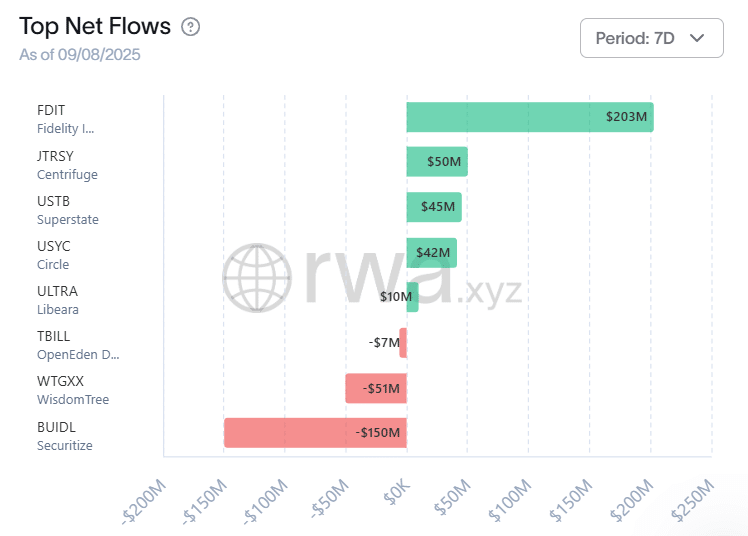
Source: Rwa.xyz/treasuries
Examining the seven-day performance, BUIDL experienced a decline of approximately $150 million, while FDIT effectively attracted fresh capital. This on-chain shift reinforces FDIT’s positioning within the competitive landscape of tokenized Treasuries.
The launch of FDIT has displayed robust on-chain demand. Each FDIT token corresponds to a share in FYOXX, backed by U.S. Treasury securities.
More broadly, Ethereum remains a leading platform for institutional RWAs in the DeFi sector.
Ethereum’s Strength in Institutional DeFi
Tokenized U.S. Treasuries comprise nearly 27% of the total RWA market.
In essence, more than a quarter of all on-chain RWAs are allocated to low-risk, yield-generating Treasury assets. This underscores the considerable impact of U.S. government-backed tokens within DeFi’s real-world asset strategies.
Consequently, FDIT’s entry into the top 20 RWA assets is no accident.
It signals strong on-chain interest in tokenized Treasury products, with Ethereum developers positioning themselves advantageously regarding institutional RWA adoption.
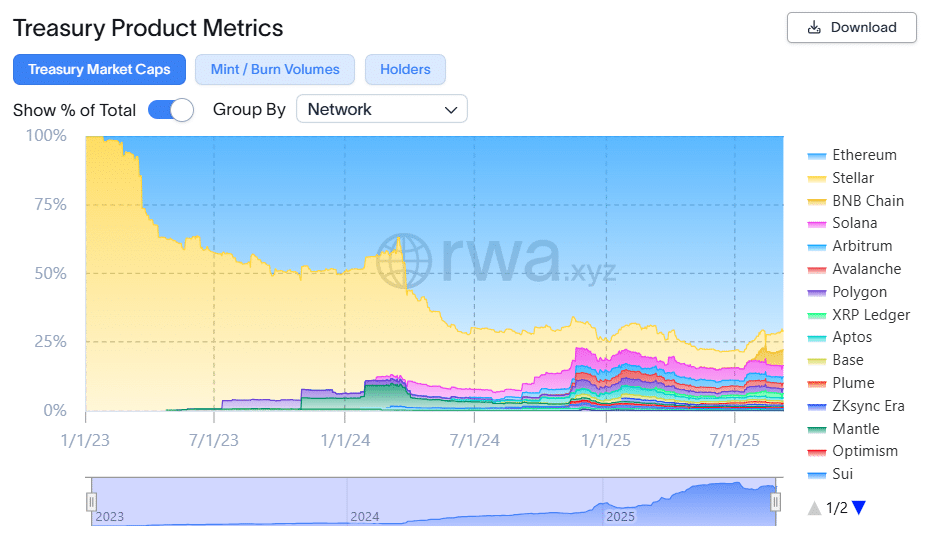
Source: Rwa.xyz/networks/ethereum
Currently, no blockchain network can match Ethereum’s Treasury assets volume. Ethereum boasts a 70% market share, while Stellar lags behind at 6%, highlighting Ethereum’s dominance in the space.
Even accounting for the significant stablecoin presence (95%), Treasuries still capture 3.15% of Ethereum’s market, showcasing the considerable potential of on-chain RWAs.
Fidelity’s deployment of FDIT on Ethereum further solidifies this trend. Selecting Ethereum leverages the network’s abundant liquidity and robust developer community.
Consequently, this strategic decision positions Fidelity to increase its market presence and enhance its standing in the DeFi sector.