

The market for Ethereum-based financial instruments is exhibiting indications of potential excess speculation, as shown by increasing leverage metrics, open interest figures, and funding rates. Over the past month, ETH has appreciated by over 24%, which has spurred a notable rise in derivatives activity, with open interest now exceeding $24.5 billion, reaching its highest point ever.
This surge has brought the estimated leverage ratio (ELR) near its historical highs, and the funding rates associated with perpetual futures contracts are at levels not observed since the early part of 2022.
The current configuration of the derivatives landscape reveals traders are positioning themselves aggressively, betting on further price increases. However, this also creates a level of instability that could quickly reverse should the price of Ethereum stall or decline. With traders increasingly dependent on borrowed funds to maintain their positions, the risk of substantial liquidations is growing.
The total open interest for Ethereum derivatives across various exchanges has reached $24.5 billion, representing a 37% surge over the last month. Approximately $2.9 billion of this increase has occurred within the past week alone. This jump in open interest occurred alongside a price rally in ETH, which moved from below $2,600 to over $3,160, suggesting a significant influx of speculative capital into the market.
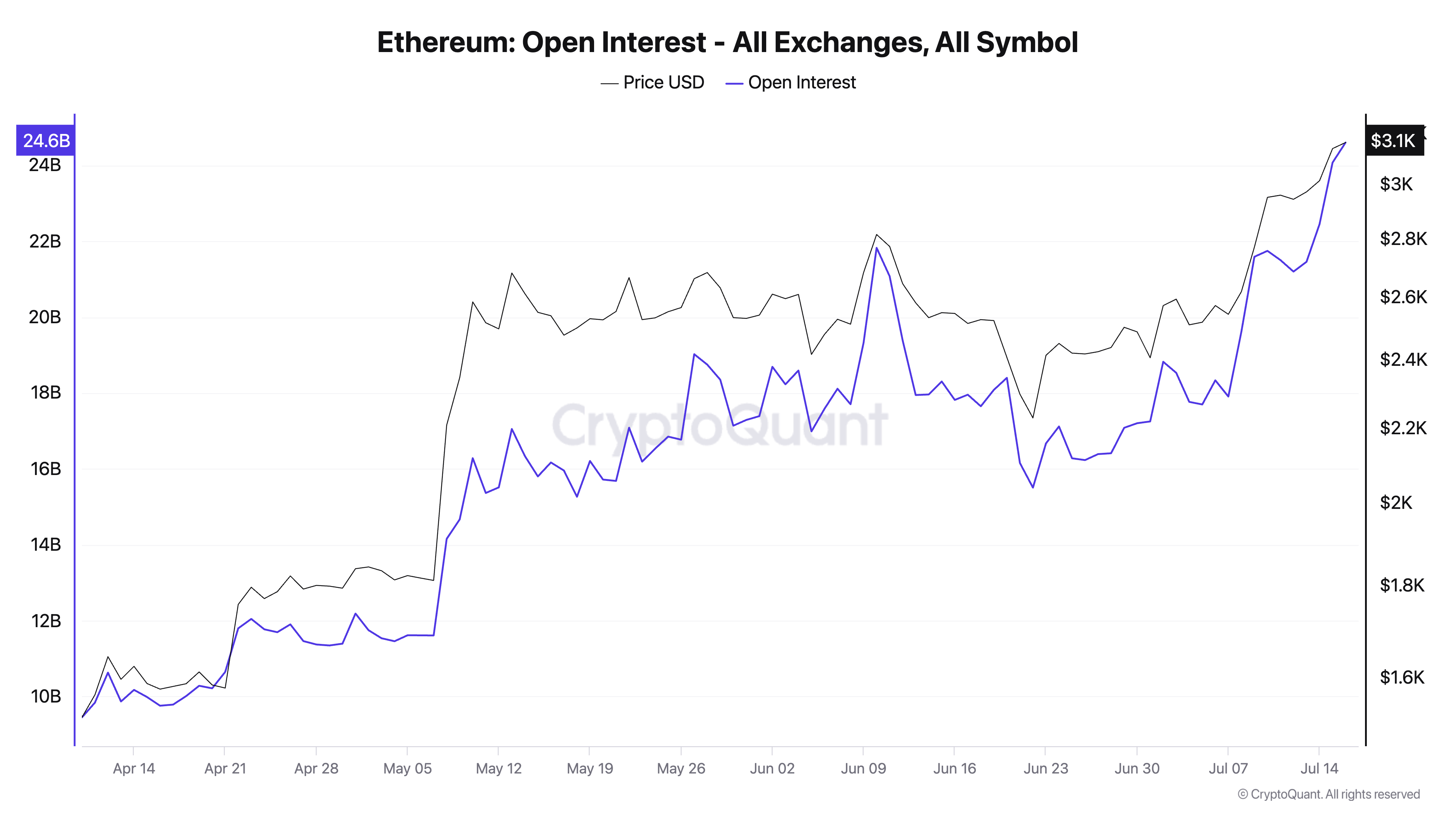
Data from CryptoQuant indicates that Ethereum’s open interest now represents about 7.7 million ETH, which equates to roughly 6.4% of the total ETH in circulation. This percentage offers insights into the extent of the market’s exposure to leverage relative to the available supply of tokens. Historically, periods where notional open interest exceeded 6% have often preceded sharp price corrections, suggesting an over-reliance on derivatives to drive price movements.
The correlation between Ethereum’s price and its open interest, measured over a 90-day period, currently stands at 0.96. This high degree of correlation typically signifies a feedback loop where rising prices encourage traders to open more positions, further boosting prices until margin requirements or profit-taking disrupt the cycle.
The estimated leverage ratio, reflecting the proportion of open interest relative to the amount of ETH held on exchanges, has risen back to elevated levels. At 0.90, it is nearing its record high of 0.916, which was observed in early June.
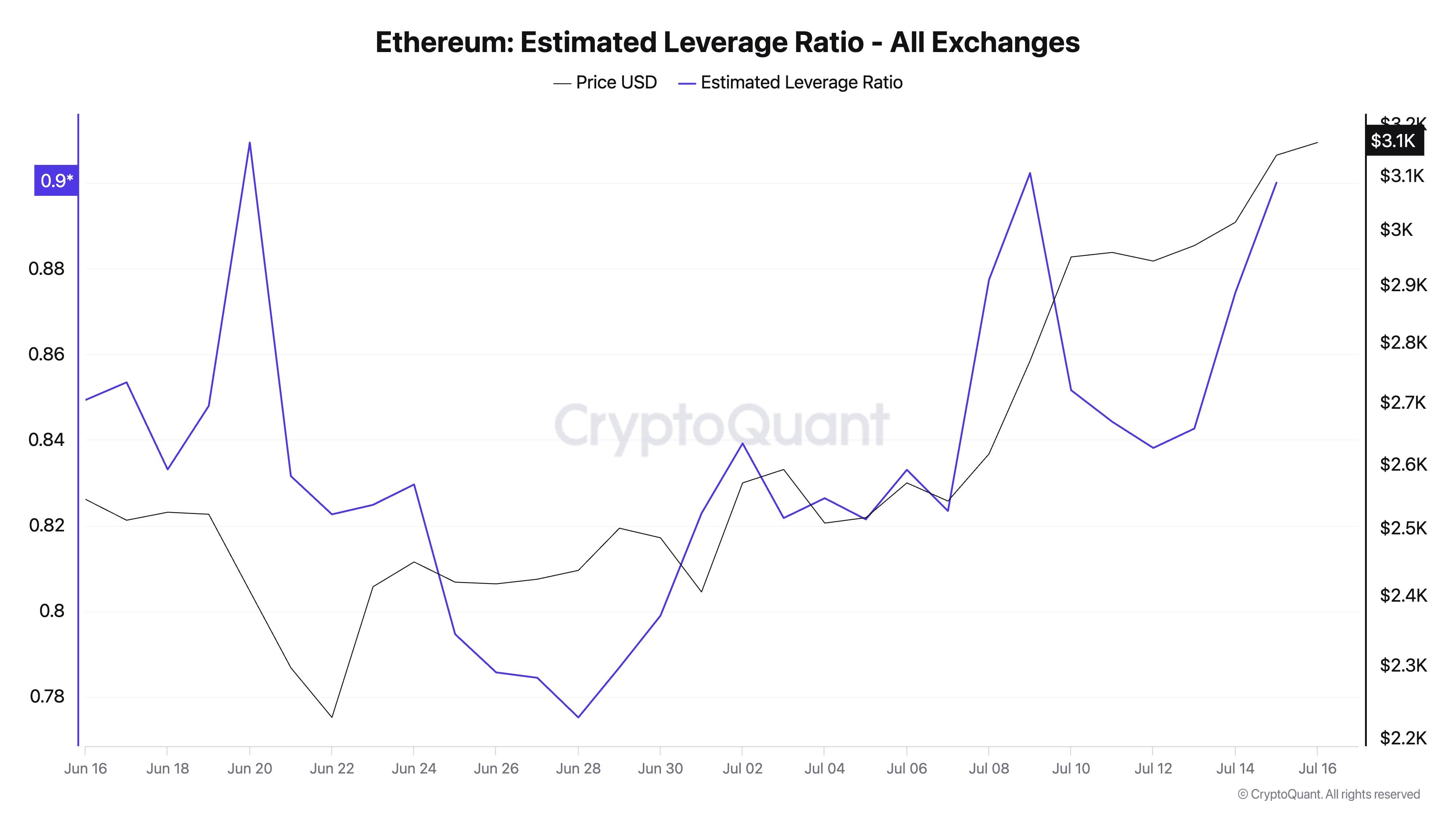
This implies that traders are increasingly utilizing margin or borrowed funds to maintain their market positions. It also suggests that a larger portion of the ETH held on exchanges is committed to derivatives contracts, rather than being available for spot trading or withdrawals. A rising ELR typically reduces the market’s ability to withstand price volatility. In highly leveraged markets, even modest price declines can initiate a series of liquidations as collateral requirements are breached.
Funding rates for Ethereum perpetual futures contracts have also increased. On July 16, the average daily funding rate across major exchanges reached 0.018%, which translates to an annualized cost of around 6.7% for those holding long positions. This is a significant increase from the previous week’s average of 0.0075% and is well above the 30-day average of 0.0073%.
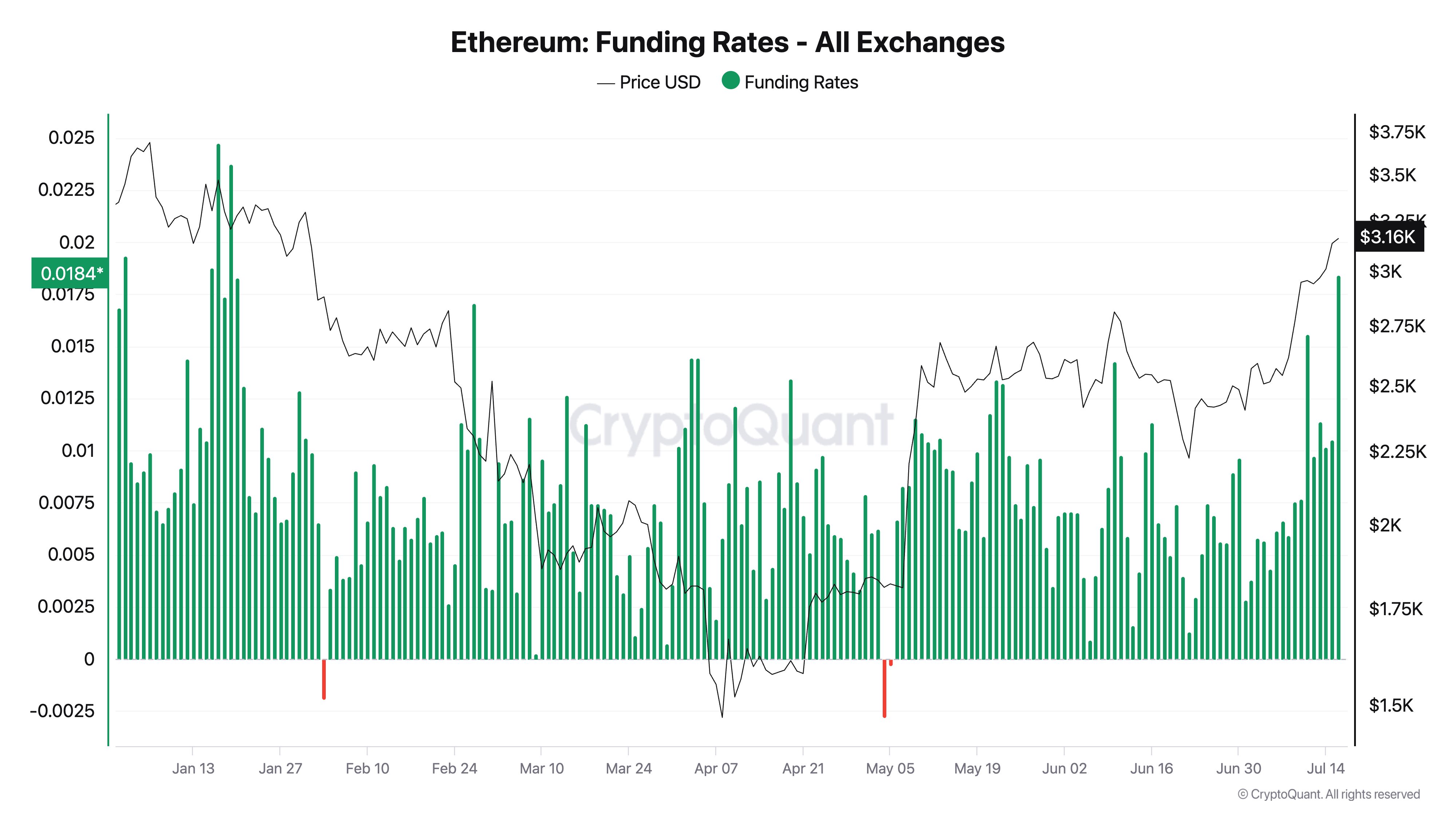
Funding rates have only been negative for two days since the start of the year, indicating a consistent bias towards long positions among traders. The pressure on funding rates seems largely concentrated on short-term perpetual swaps, especially on platforms popular with retail traders such as Binance, Bybit, and OKX.
In contrast, longer-dated ETH futures on CME and other institutional platforms are trading at a more conservative premium compared to spot prices. This difference suggests that the current rally is being driven more by short-term traders than by traditional asset managers or macro-focused investment firms.
The ongoing expansion within the derivatives market is not an isolated event. Ethereum’s spot trading volume has also risen considerably, lending credibility to the price increase. Average daily spot volumes over the past week have been 874,000 ETH, exceeding the 30-day average by 25%.
This increase in spot trading volume supports the idea that new capital is entering the market, rather than simply being cycled through perpetual contracts. However, the scale and speed of the derivatives build-up are still disproportionately large relative to spot flows, which increases the likelihood that much of the recent price appreciation has been amplified by leverage.
Derivatives are now significantly influencing Ethereum’s price dynamics. While this signals a growing market maturity, it also introduces more risk. Elevated leverage, stretched funding rates, and substantial notional exposure suggest that ETH is currently trading within a delicate balance. Should spot prices continue to rise, the derivatives market could sustain itself for a while, attracting additional capital and further increasing leverage.
However, any sudden downward movement could rapidly destabilize this structure. High ELR levels mean many positions have limited collateral buffers, and a sharp downturn could trigger liquidations, which could further depress prices, creating a cascading effect.
The post Ethereum open interest tops $24.5 B as traders chase rally appeared first on CryptoSlate.