


The world of Pokémon trading cards could be the next sector to embrace blockchain technology, bringing these physical assets onto digital ledgers as real-world assets (RWAs). This move would broaden the application of blockchain beyond its established financial uses.
Over the last year, tokenization has streamlined access to more conventional markets, such as gold and U.S. Treasury bonds. These markets have seen improved efficiency through digital management.
However, the handling of collectibles like Pokémon cards still involves physical processes. Sellers worldwide are required to physically ship both graded and ungraded cards to their buyers, which introduces friction.
Despite these logistical challenges, the market size is significant. The social auction platform, Whatnot, reportedly facilitated $3 billion in sales last year, with a substantial portion attributable to Pokémon cards.
Tokenizing Pokémon Cards: A New Frontier
This energetic yet decentralized market has been compared to the rise of prediction markets championed by
Polymarket.
On September 3rd, Bitwise research analyst Danny Nelson
suggested
that tokenization could have the greatest impact in areas where robust financial infrastructure is lacking.
He argues that Pokémon cards, despite their multibillion-dollar market presence, are constrained by limited institutional support. While avenues like Pokémon ETFs or extensive investment funds are not yet readily available, blockchain platforms are beginning to address this gap.
Data
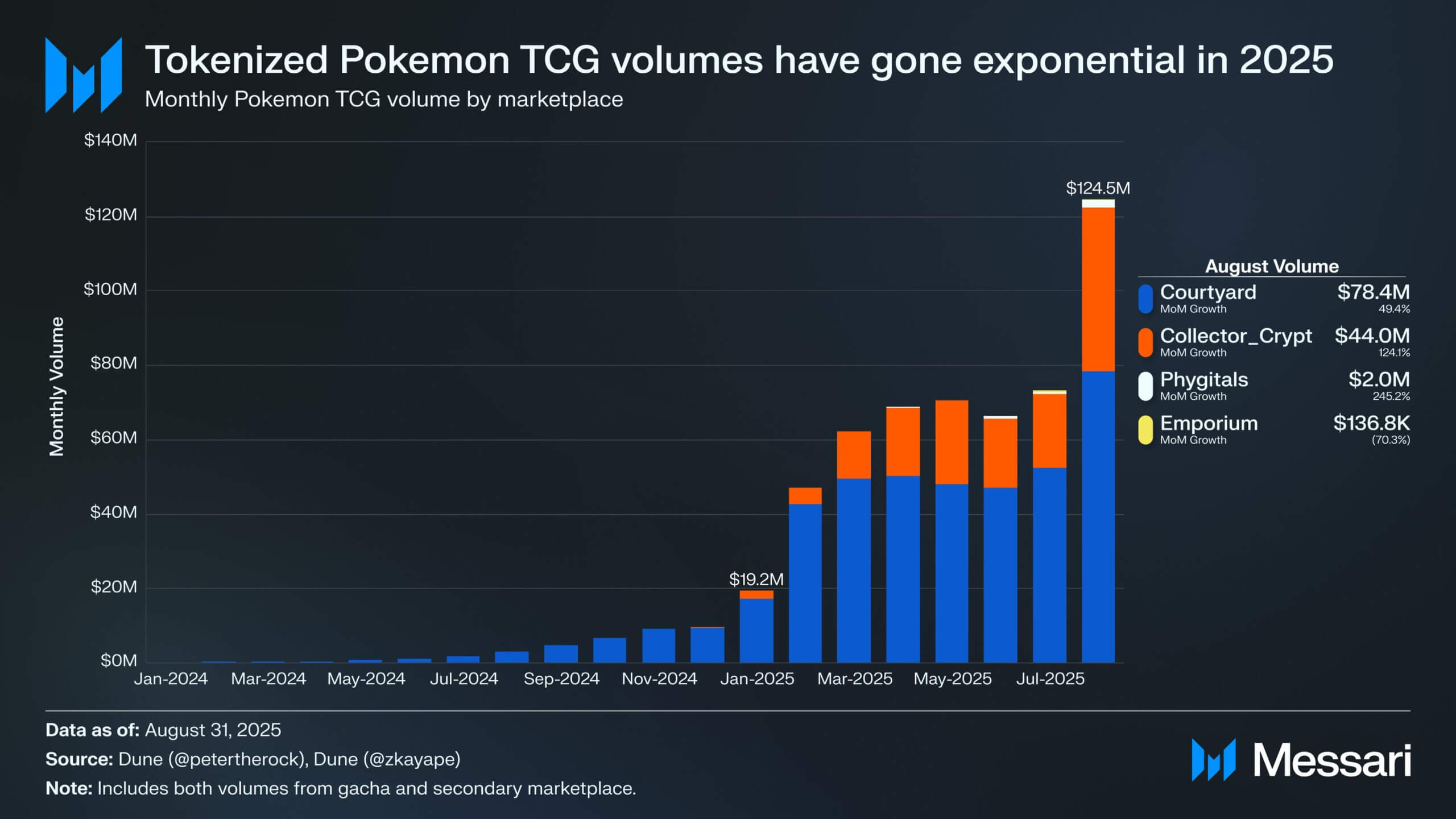
from Messari indicates that in August, the top four marketplaces for tokenized Pokémon cards processed $124.5 million in trades, showing a 5.5x increase since January.
Courtyard led the way with $78.4 million, followed by Collector Crypt at $44 million. Smaller platforms like Phygitals and Emporium also experienced significant growth rates, signaling increasing retail adoption.


The Crypto Investor Blueprint:
A 5-Day Course On Bagholding, Insider Front-Runs, and Missing Alpha
According to analysts, this approach blends the worlds of collectibles and gaming, similarly to how Polymarket revolutionized the prediction market by making it accessible worldwide.
Collector Crypt Gains Momentum
Collector Crypt, a marketplace built on the
Solana
blockchain, is playing a central role in this transformation. The platform enables collectors to tokenize their physical cards, effectively minting NFTs that can be traded instantly.
While comparable services exist for other asset types, Collector Crypt has gained significant traction because of its fresh and engaging approach. Simon Dedic, founder of Moonrock Capital, noted the platform’s appeal,
stating:
“It gave crypto degens the chance to collect real-world Pokémon RWAs in a gamified, randomized, and crypto-native way. Exactly what the market didn’t know it needed – and instantly got addicted to.”
Consequently, the platform’s native token, CARDS, saw a tenfold increase in value in under a week following its launch, bringing its fully diluted valuation to $450 million.
Nelson explained that the excitement is partly fueled by revenue expectations. He added that the marketplace projects annual revenue of $38 million, with traders anticipating potential buybacks that could return value to token holders.
He also highlighted the strong demand for the platform’s “Gacha machine,” a digital vending system that offers randomized card packs. This feature alone generated $16.6 million in the past week.
The high level of activity has challenged the Collector Crypt team to maintain adequate stock levels to meet user demand.