

The digital currency, Bitcoin, has often been associated with significant electricity consumption and resulting environmental problems. However, a growing number of companies are redefining this image by adopting renewable power sources, emphasizing open business practices, and adhering to rigorous standards of corporate governance. These innovative miners are demonstrating that it’s entirely feasible to increase profitability while at the same time lessening the impact on our planet.
Before diving into the list of leading environmentally conscious Bitcoin mining operations, let’s explore why sustainability is becoming increasingly vital in this sector.
Why Greener Mining Matters: Bitcoin’s ESG Future
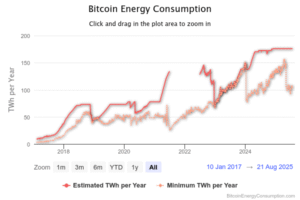
Bitcoin’s proof-of-work mechanism, which secures the network, demands a substantial amount of electricity. This demand has prompted criticism due to the heavy reliance on fossil fuels for mining activities. Thankfully, eco-conscious miners are working diligently to decouple Bitcoin’s expansion from carbon emissions.
As governments and investors increasingly favor cleaner energy sources, firms leveraging renewable technologies stand to gain significant advantages. These businesses can expect improved access to markets and fewer regulatory hurdles.
Environmentally friendly mining also benefits local communities and bolsters regional power grids. Some miners are strategically situating their facilities near renewable power sources, capitalizing on surplus energy and enhancing grid stability. Transparent and eco-friendly operations minimize both environmental and noise pollution, fostering strong relationships with local populations.
Furthermore, renewable energy typically results in lower operational costs, with prices sometimes dipping below one or two cents per kilowatt-hour. This cost reduction directly lowers the expense of mining each Bitcoin, shielding miners from the unpredictable price fluctuations of fossil fuels. As Bitcoin rewards gradually decrease, miners with access to affordable, sustainable energy are poised to remain profitable for longer.
In the competitive mining sector, companies that prioritize clean energy adoption can differentiate themselves. Certifications and carbon offsetting initiatives enhance their reputation, attracting investors who seek responsible and future-proof mining operations. Let’s take a look at five prominent Bitcoin mining firms that are pioneering the shift toward greener and more sustainable practices.
1. Gryphon Digital Mining: Carbon-Negative Mining Using Hydroelectric and Flare Gas Power
Gryphon Digital Mining is at the forefront as one of the first publicly traded Bitcoin mining companies focused on achieving carbon neutrality and, more recently, carbon negativity. In 2023, more than 98% of its power supply came from renewable sources, primarily hydroelectric, and the company achieved 100% renewable energy use early in 2024. These achievements have been validated by independent audits.
The company’s dedication to transparent environmental goals is further evidenced by its receipt of a sustainable Bitcoin certification. Gryphon publishes comprehensive emissions data regularly, providing transparency for its investors. Additionally, the company links executive compensation to the attainment of sustainability targets, which ensures accountability.
Gryphon’s mining equipment operates with impressive efficiency, consuming approximately 28.6 joules per terahash. This setup generates close to one exahash of computational power every second. The company produced Bitcoin worth millions of dollars each month in 2024, all while maintaining high operational uptime and low energy costs. The acquisition of flare gas-powered mining assets has further increased its operational capacity, with energy costs hovering around one cent per kilowatt-hour.
Gryphon has a pipeline of new clean energy projects totaling 500 megawatts, including flare gas sites. They recently purchased a substantial industrial property in Alberta to facilitate expansion. Under new leadership, the company is targeting multiple exahashes per second, with a continued focus on sourcing sustainable energy.
ESG, Growth, and Strategy
- In 2023, GP4BTC earned sustainable Bitcoin certification from Energy Web, an initiative to standardize energy measurement within the mining industry.
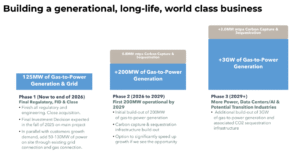
- The company has outlined plans for a 500 MW pipeline of cost-effective power projects, incorporating flare gas acquisition in Louisiana, adding 59 PH/s immediately at about 1¢/kWh.
- Recently, Gryphon acquired an 850-acre industrial site in Alberta to support future growth under its new CEO, Steve Gutterman, who previously grew TRADE Financial from $1B to $35B in assets.
- The company plans to scale its hash rate towards multiple EH/s by the mid‑2020s, supported by clean power sourcing and a carbon-negative approach.
2. CleanSpark: Multi-Source Renewable Energy and Community-Focused Mining
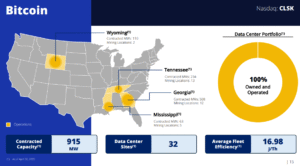
CleanSpark transitioned from energy services to Bitcoin mining, emphasizing a robust environmental commitment. Its data centers, situated in New York, Georgia, and Mississippi, obtain approximately 94% of their electricity from carbon-free sources like nuclear, hydro, wind, and solar energy.
A noteworthy partnership is with Coinmint, which operates a substantial hydro-powered facility in New York. This facility boasts almost full uptime and is progressing toward 100% renewable power. CleanSpark also prioritizes immersion cooling technology, prolonging equipment lifespan by minimizing heat and energy consumption, which reduces electronic waste and lowers overall power demand.
The company engages with local leaders before initiating new construction projects, addressing concerns and demonstrating potential community benefits to ensure social acceptance.
CleanSpark is focused on increasing its mining capabilities from one exahash per second to two, with a sustained dedication to clean power for this expansion.
Drawing on energy industry roots that extend back to 1987, CleanSpark effectively manages power costs and participates in grid programs that incentivize demand flexibility. The company is aiming for net-zero emissions from its direct and indirect operations by 2027.
Targets, Expansion, and Positioning
- CleanSpark benefits from energy infrastructure dating back to 1987, giving it an advantage in securing beneficial demand-response and grid service programs.
- Through ATL Data Centers and Coinmint, CleanSpark exceeded 470 PH/s earlier in 2022, mining 3,768 BTC (over time) and averaging approximately 4 BTC per day at its peak.
- The goal is to achieve net-zero Scope 1 and 2 emissions by 2027, while also increasing capacity from approximately 1 EH/s to 2 EH/s and beyond, maintaining a strong commitment to clean energy.
3. TeraWulf: Mining Powered by Nuclear and Hydroelectric Energy at Low Cost
TeraWulf operates two major Bitcoin mining facilities in the United States. The Lake Mariner facility in New York relies predominantly on electricity generated from hydro and nuclear power sources, resulting in a roughly 91% zero-carbon power supply. The company owns this extensive operation, which boasts approximately 110 megawatts of capacity and delivers over 3.6 exahashes per second of computing power.
The Nautilus Cryptomine site in Pennsylvania utilizes nuclear power sourced from the Susquehanna plant, co-owned and operated with partners. This arrangement lowers electricity costs to around two cents per kilowatt-hour, enhancing overall profitability.
Following the sale of its stake in the Nautilus project, TeraWulf reinvested capital into expanding the Lake Mariner facility. The company anticipates reaching a total capacity of approximately 238 megawatts by late 2024. They favor the most energy-efficient mining hardware and are committed to sourcing 100% clean energy to power all operations.
Performance Metrics and Strategic Growth
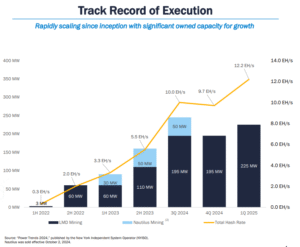
- By mid-2023, TeraWulf had expanded to about 5.5 exahashes per second and 160 megawatts of mining capacity, maintaining a lower cost per Bitcoin mined than industry averages.
- In Q2 2024, the company’s capacity rose to around 10 exahashes per second, which led to a 130% year-over-year revenue increase.
- TeraWulf intends to continue leveraging the most efficient mining hardware available, such as the Bitmain S19 XP Pro and S19 j Pro, which offer efficiency ratings between 21.5–29.5 J/TH. They also aim to achieve 100% zero-carbon power sourcing.
4. Iris Energy: Scaling 100% Renewable Bitcoin Mining and AI Compute Ventures
Based in Australia, Iris Energy, now known as IREN, operates mining sites located in Canada, Texas, and Australia. Its energy portfolio is primarily hydroelectric, supplemented by wind, solar, and renewable energy certificates, which amounts to about 97% renewable energy use.
Iris Energy strategically places its modular mining facilities in regions with abundant clean energy, converting excess renewable electricity into Bitcoin. This helps balance local energy grids and supports the surrounding communities.
The company owns its land, data centers, and grid connections, giving it full control over energy consumption and mining efficiency.
Despite reporting modest losses in fiscal 2025, positive earnings are predicted in the near future. Institutional investors have shown increasing interest, attributed in part to the company’s strong commitment to clean energy.
Iris Energy also develops AI computing services entirely powered by renewable energy. These high-performance GPU clusters create additional revenue streams that complement Bitcoin mining activities.
Metrics, Market Position, and Growth
- The stock is attracting considerable institutional interest, evidenced by A+/A‑ ratings from IBD and a top relative strength score of 98.
- By mid-2025, Iris Energy operated at an estimated 50 exahashes per second and reported impressive sales growth (172%).
- Iris offers AI-driven cloud services, powered by renewable-energy-fed GPU clusters (e.g. NVIDIA H100), adding a higher-margin revenue layer to its Bitcoin business.
- The company aims to reach 20 exahashes per second by 2026 and is also exploring green hydrogen and additional renewable energy projects.