<h1>Can "Green" Cryptocurrencies Provide a Safe Haven in Your Portfolio?</h1>

<p>A recent study investigated the potential benefits and drawbacks of incorporating environmentally conscious cryptocurrencies into investment portfolios that primarily hold mainstream digital assets.  The research focused on understanding if these "green" alternatives could offer risk mitigation in the volatile crypto market.</p>

<p>The study categorized cryptocurrencies into two groups: "dirty" and "clean".  The "dirty" cryptocurrencies, including popular names such as Bitcoin (BTC), Ethereum (ETH), Bitcoin Cash (BCH), Ethereum Classic (ETC), and Litecoin (LTC), are characterized by their reliance on Proof-of-Work (PoW) consensus mechanisms.  This method requires significant computational power, leading to high energy consumption during both the mining process and transaction verification.</p>

<p>Conversely, the "clean" cryptocurrencies analyzed—Cardano (ADA), Ripple (XRP), IOTA (MIOTA), Stellar (XLM), and Nano (NANO)—employ energy-efficient consensus mechanisms. These include Proof-of-Stake (PoS), the Ripple Protocol, and the Stellar Protocol, all designed to significantly reduce energy consumption compared to PoW.</p>

<p>The researchers analyzed daily price data from January 2, 2018, to May 8, 2023, obtained from Coincodex.  The data, all in US dollars, was transformed into daily log returns for detailed analysis.  A summary of the data revealed that, over the study period, most cryptocurrencies, with the exception of BTC and ETH, experienced negative average daily returns. Bitcoin showed the lowest volatility and tail risk, but had a more negative skew compared to other crypto assets. Stellar and Nano, on the other hand, showed the highest potential for single-day gains and a positive skew, while IOTA and Nano exhibited the highest tail risks. Statistical tests confirmed that the return data for all cryptocurrencies was stationary but exhibited volatility clustering and deviated from a normal distribution.</p>

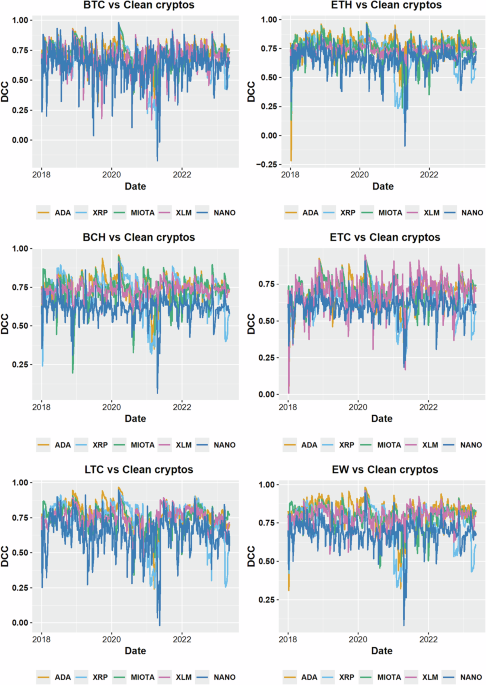
<p>The study also explored the relationship between "dirty" and "clean" cryptocurrencies.  Interestingly, these two categories showed a positive correlation of roughly 70%.  This indicates that, despite their differing consensus mechanisms, they tend to move together in the market to a substantial degree.</p>

<p>Analysis of the dynamic correlations over time revealed significant fluctuations, with correlations sometimes exceeding 0.9.  Notably, certain pairs, such as ETH & ADA in early 2018 and BTC & NANO during the first half of 2021, even experienced periods of negative correlation. The volatility of these correlations also differed between pairs, with ETH & XRP, LTC & XRP, and BTC & XRP showing the most significant fluctuations, while BCH & XLM exhibited a more stable relationship. This suggests that clean cryptocurrencies may, at times, offer a weak safe-haven status for "dirty" cryptocurrencies. The differing correlation volatilities emphasize the importance of considering the unique characteristics of each cryptocurrency when constructing diversified portfolios.</p>

<p>Reviewing annualized returns and risk levels, Bitcoin demonstrated the most attractive risk-reward profile.  However, the study's findings indicated that incorporating other cryptocurrencies could serve as a diversification strategy to potentially mitigate some of the risk associated with Bitcoin and Ethereum. Adding clean cryptocurrencies may or may not give additional benefits and this warrants additional research.</p>

<p>Safe-haven testing indicated that clean cryptocurrencies did not act as direct hedges against "dirty" cryptocurrencies during the tested time frame. However, under extreme market downturn conditions (analyzed at the 5% and 1% quantiles), some clean cryptocurrencies demonstrated potential as either weak or strong safe havens. Specifically, certain pairings with Ethereum Classic and Bitcoin Cash showed consistent safe-haven properties. The usefulness of clean cryptocurrencies as a safe haven appears to depend on the individual crypto assets being considered.</p>

<p>In times of market distress (at the 5% and 1% quantiles), results suggest that clean cryptocurrencies can be diversifiers and safe havens for dirty cryptocurrencies. Investors with portfolios holding primarily "dirty" cryptocurrencies might consider including "clean" cryptocurrencies to potentially benefit from safe-haven properties while supporting environmental responsibility. More portfolio construction research is needed to fully show diversification and safety benefits.</p>

<p>Further research using relative risk ratio analysis showed that as the allocation to clean cryptocurrencies increased, the overall tail risk was initially reduced. However, beyond a certain optimal weight, tail risk started to rise again.  Different clean cryptocurrencies offered varying degrees of tail risk mitigation, each having unique optimal allocation weights.  Nano appeared to have a less strong ability to mitigate extreme tail risk, while Cardano and IOTA showed the best risk reduction. Kurtosis, which represents the tail heaviness of the asset return distribution, affected the ability to mitigate tail risk.</p>

<p>Unconditional portfolio optimization revealed that adding clean cryptocurrencies had a limited impact on the weighting of a minimum variance portfolio or a tangency portfolio. BTC continued to dominate because of its low volatility and good risk-adjusted returns. With mean-variance portfolios, "dirty" assets like BTC and BCH held much of the weighting, but incorporating clean cryptocurrencies like XRP, MIOTA, XLM, and NANO provided some diversification.</p>

<p>Conditional optimization, using an out-of-sample evaluation, assessed the robustness of these allocations in changing market conditions. Across different strategies, BTC held a dominant portfolio weight. Mean-variance optimization strategies showed XRP and XLM having a high weighting when the portfolio included clean assets. Portfolios composed solely of "dirty" cryptocurrencies generally generated higher returns compared to mixed portfolios, and the diversification benefits of clean cryptocurrencies appeared limited during the COVID-19 pandemic.</p>

<p>During out-of-sample testing, portfolios containing only "dirty" cryptocurrencies showed greater cumulative returns overall. Including clean assets did not enhance return rates. Clean assets generally decreased returns while also increasing drawdown risks. In rolling performance, using 250 day windows, suggested a significant shift in the volatility dynamics of cryptocurrency portfolios around the COVID-19 outbreak. Including clean cryptocurrencies may increase volatility under times of heightened stress, like the COVID-19 pandemic.</p>

<p>Overall, these results suggest that including clean cryptocurrencies decreased returns while increasing volatility and turnover in portfolios with dirty assets. Additionally, incorporating clean assets did improve tail risk mitigation and potentially provided a weak safe haven.</p>

<p>Robustness tests using alternative conditional models and sub-period analysis confirmed that clean cryptocurrencies still contribute to a reduction of CVaR under all strategies. Additionally, excluding BTC and ADA led to more balanced weighting allocation with CVaRs of the combined portfolio being lower than those of the portfolio containing only dirty assets.</p>

<p>In conclusion, while clean cryptocurrencies may offer some benefits regarding tail risk mitigation, the benefits vary according to the assets included in the portfolio. As a result, further studies are necessary to determine more nuanced insights regarding risk dynamics.</p>