


Despite being in what’s considered a bull market, the feeling isn’t quite right. Bitcoin has achieved new highs, but the increases have been surprisingly subdued, and market corrections have been intense. Many alternative cryptocurrencies have dropped significantly, retail investors are scarce, and even experienced participants question if this bull cycle deserves the name.
Many believe this is the toughest crypto bull market ever seen. Bitcoin has increased twofold from its 2023 lowest points, yet the market feels devoid of true enthusiasm. What happened? Crypto analyst “Crypto Birb” explains it with three main reasons.
Institutional Dominance Dampened the Market
This time around, Wall Street didn’t just participate; they fully integrated and transformed the crypto landscape. Major players like BlackRock, Fidelity, and Goldman didn’t just come to speculate; they aimed to control infrastructure, custody solutions, and tokenized assets. While “institutional adoption” sounds positive, it mainly signifies large-scale resource extraction. They aren’t engaging with meme coins or seeking airdrops. They have acquired the essential framework, liquidity systems, and regulatory structures that everyone else must access through them.
As highlighted by both Telcoin Magazine and Fortune, institutional participation in early 2025 was “foundational, not speculative.” This benefits Bitcoin but harms the crypto community. As Crypto Birb notes:
“Smart money took what’s valuable – good on them.”
The Rise of Meme Coins and Meaning’s Decline
While institutional investment professionalized the sector, meme coins have, in many ways, distorted it. What started as satire became the dominant narrative in 2024 and 2025. Each week brought forth a new “community” token, based on animals, political humor, leading to a new series of losses for investors.
Meme coins transformed crypto into a high-risk gambling environment. Tokens would surge based on viral trends alone, then dramatically decrease in value. Even experienced industry figures were lured into pursuing hype over value. This was a combination of problems: retail investor greed combined with web3 irony, resulting in significant losses.
Trump’s Policies, Interest Rates, and Risk Aversion
Macroeconomic factors further complicated the environment. President Trump’s trade policies, while seen by some as protective, led to a 20% drop in stock values and reduced market liquidity. High interest rates made capital more expensive, which decreased speculative investments and caused riskier assets like crypto to stagnate.
Ironically, the supposedly “pro‑crypto administration” inadvertently hindered the retail market’s recovery. Higher interest rates reduced consumer spending, decreasing the average investor’s interest in high-risk tokens. This period, expected to be one of growth, turned into a test of endurance.
Bitcoin: The Bull Market’s Main Survivor
Despite the challenges, Bitcoin remains resilient. Institutional investment has strengthened its position, while other cryptocurrencies struggle. According to a16z’s State of Crypto report, Bitcoin’s strength is driven by macroeconomic conditions and regulatory acceptance.
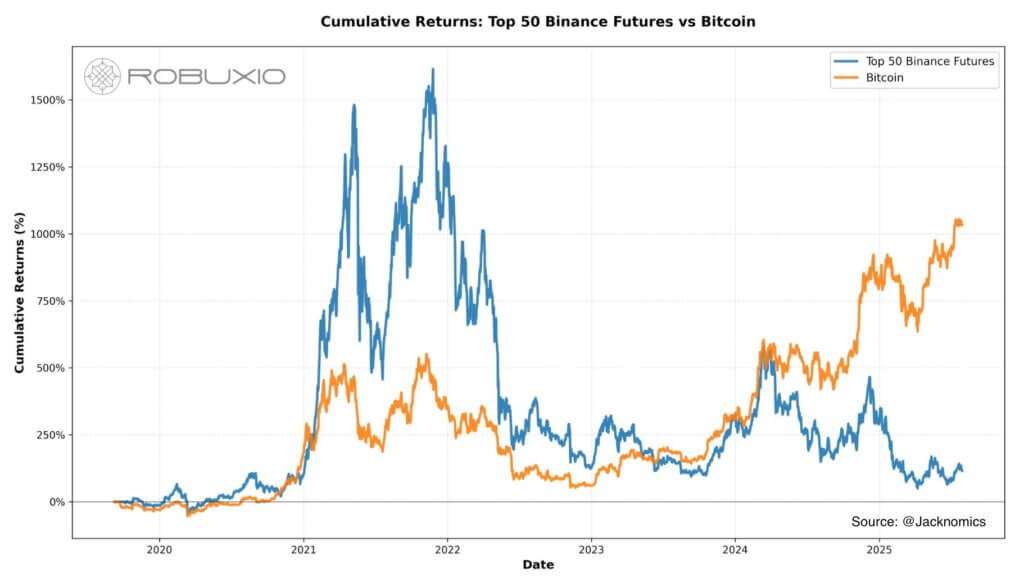
This demonstrates market maturity, with less excitement, fewer parabolic charts, and a market acting more like a standard financial system. However, for those seeking quick returns, it feels disappointing.
The Unsatisfying Bull Run
This bull cycle is more draining than exciting. Bitcoin’s persistence confirms crypto’s long-term potential. Yet, the remainder of the market, including innovation, retail participation, and widespread optimism, has suffered.
Perhaps this is part of the evolution process. Alternatively, it could signal a deviation from core principles, with meme coins overshadowing the true purpose. Crypto Birb explains:
“We got played. BY OURSELVES. This is our punishment for choosing hype over utility.”
Ultimately, this bull run will be remembered not for its profits, but for its lesson: not all cycles are intended for wealth accumulation. Some serve as reminders of our fundamental objectives.