

Despite a marginal increase of 1.4% in Bitcoin’s mining difficulty, the hashprice – representing a miner’s daily income for each unit of computational power used in block creation – has held steady at roughly $48 per PH/s (petahash per second).
Figures provided by CoinWarz indicate that the Bitcoin network difficulty reached 113.76 trillion at block number 889,081 on March 23rd, a rise from the preceding period’s figure of 112.1 trillion.
According to reports from TheMinerMag, a hashprice level under $50 places financial strain on Bitcoin miners who are utilizing older generation hardware, such as the Antminer S19 XP and S19 Pro.
The combination of older mining equipment and decreased network transaction fees raises the risk of pushing some miners into unprofitable operations, potentially forcing them to temporarily shut down their machines until they upgrade their ASICs (application-specific integrated circuits) or until more favorable network conditions arise.
Bitcoin mining companies have faced challenges ever since the Bitcoin halving event in April 2024, which reduced the block reward to 3.125 BTC for each block mined. This event, along with increasing network difficulty and recent volatility in the crypto markets due to macroeconomic uncertainties, has further impacted miners.
Bitcoin mining difficulty over time. Source: CoinWarz
See Also: SEC Clarifies: Proof-of-Work Mining Not Securities Dealing
Bitcoin Miners Start 2025 Under Pressure
Research conducted by JPMorgan, a financial services institution, reveals that publicly traded Bitcoin mining firms experienced a collective loss of 22% in their stock values during February 2025.
The JPMorgan report also noted that even mining firms who have diversified their business activities into areas such as artificial intelligence and high-performance computing data centers, in an effort to compensate for reduced mining revenues, are still encountering significant financial challenges.
The financial services company highlighted the launch of DeepSeek R1, an open-source AI model that was trained for considerably less than leading closed-source models while providing comparable performance. This situation contributes to the financial strain on large AI data centers.
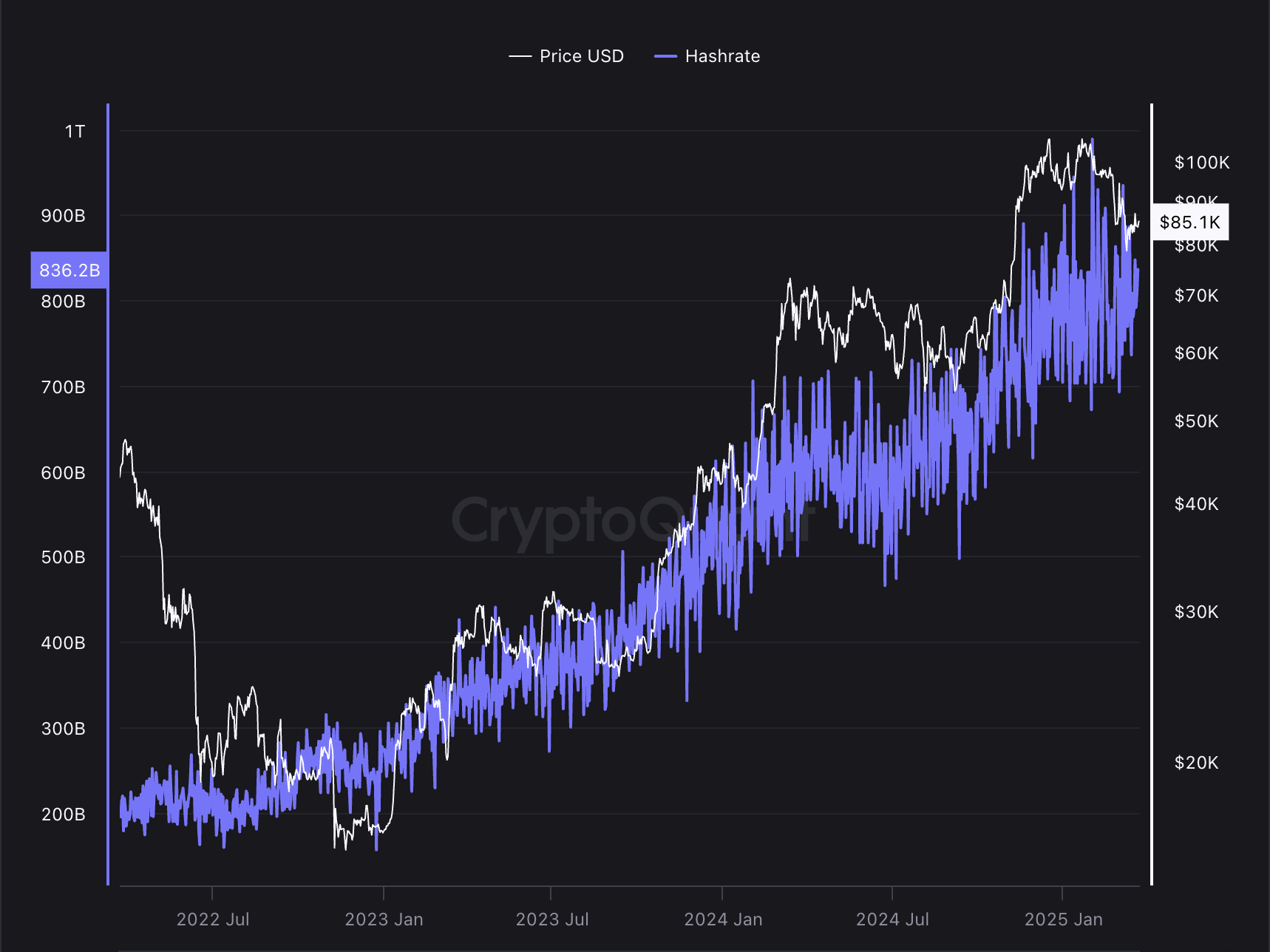
The overall trend for the Bitcoin network’s hashrate is upward, though short-term fluctuations exist. Source: CryptoQuant
The steady rise in the network hashrate, representing the combined computational power deployed on the Bitcoin network, leads to greater competition amongst miners, who are compelled to commit increased computing resources to remain profitable.
Concerns surrounding a potential extended trade conflict between the United States and Canada, coupled with ongoing news about tariffs, have created anxiety among miners.
Threats from Canadian government officials to impose tariffs on energy exports to the United States adds further pressure to an already struggling industry.