


The current market cycle has seen a surge in institutional investment directed toward Ethereum, pushing demand to unprecedented levels.
Data compiled by Strategic ETH Reserve reveals that spot Ethereum ETFs, alongside Digital Asset Treasury Companies (DATCOs), now collectively possess over 12.5 million ETH. This impressive figure accounts for approximately 10% of the total supply of ETH currently in circulation.
This signifies a remarkable increase since April when these same institutional entities held approximately 4 million ETH. At that time, their holdings represented less than 3% of the total available supply.
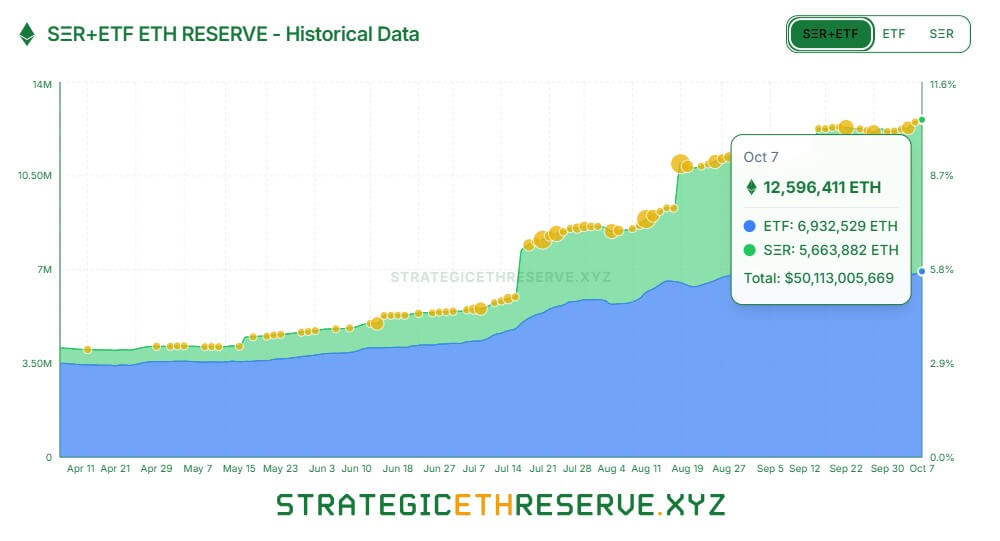
This substantial growth illustrates the increasing allocation of institutional capital toward Ethereum through regulated ETFs and treasury management. This trend coincides with the expansion of Ethereum network functionalities, particularly in the realm of tokenized assets and stablecoins.
Information provided by Token Terminal indicates that decentralized applications (dApps) built on the Ethereum platform currently manage user assets valued at over $365 billion. Additionally, the network’s native token, ETH, is trading at a multiple of 1.45x relative to the Total Value Locked (TVL) within its ecosystem.
Ethereum ETFs holding
Data sourced from Strategic ETH Reserve reveals that spot Ethereum ETFs presently hold 6.92 million ETH. Based on an ETH price of $4,448 at the time of reporting, these holdings are valued at approximately $30.76 billion. These assets are distributed across nine distinct products offered by eight different issuers.
BlackRock dominates the landscape, managing over 4 million ETH, equivalent to $17.6 billion. This represents over half of the total Ethereum held in ETFs. Grayscale follows, managing around 1.8 million ETH across its ETHE and ETH trusts.

Fidelity holds the third-largest position, with approximately 778,200 ETH. Bitwise follows with roughly 151,600 ETH. Several other issuers, including VanEck, Franklin Templeton, Invesco Galaxy, and 21Shares, each possess holdings of less than 100,000 ETH.
This strong accumulation trend reflects the increasing interest from investors in regulated avenues for Ethereum exposure.
According to SosoValue data, the cumulative net inflows into Ethereum ETFs have exceeded $15 billion since their introduction. This signals continued robust institutional interest despite fluctuations in the market.
ETH treasury companies
Ethereum-focused Digital Asset Treasury Companies (DATCOs) collectively hold 5.66 million ETH, representing 4.68% of the circulating supply. This is equivalent to $25.19 billion.
This reinforces Ethereum’s growing significance as a viable corporate treasury asset. Ethereum ranks second only to Bitcoin in terms of institutional accumulation for this purpose.
The months of July and August marked the peak of treasury expansions as numerous companies joined the trend of acquiring ETH. While the momentum has cooled off somewhat since then, the leading holders are still increasing their ETH holdings.
BitMine Immersion Tech leads the pack, holding 2.83 million ETH, valued at approximately $12.59 billion. This represents 2.34% of the total circulating supply. BitMine aims to ultimately control 5% of the total ETH supply, which it considers a strategic move in anticipation of broader network adoption.

However, the practice of establishing ETH treasuries has faced criticism from some industry observers. Concerns have been raised that some of these companies are being sustained by South Korean retail investors.
Bitcoin advocate Samson Mow has suggested that retail traders have approximately $6 billion allocated to what he describes as chasing the next “strategy play.”
Despite these concerns, asset management firm VanEck maintains that the robust institutional adoption trend highlights Ethereum’s potential to rival Bitcoin in the competition for dominance as a store of value.