


Ethereum is prioritizing user confidentiality with its updated strategic vision.
This November, at the Devcon event held in Argentina, the Ethereum Foundation plans to present Kohaku, a new digital wallet infrastructure. This is built to empower users to carry out transactions without disclosing unnecessary personal details or transaction data.
The project was initially unveiled on October 9th by Nicolas Consigny, a developer at the Foundation. He announced that a working demo of Kohaku and a software development kit (SDK) will be available for public testing at Devcon. The digital wallet is being constructed both as a browser extension and as a reference model for developers wishing to incorporate privacy features directly into their applications.
These innovations will provide users with the ability to conduct transactions, revealing only the bare minimum of information to the necessary parties.
As he explained:
“The goal of Kohaku is to limit each transaction participant’s knowledge to only what’s absolutely essential for the transaction itself. The tool aims to reduce the risks each participant is exposed to during the transaction to the lowest possible level.”
Kohaku represents just one aspect of a broader endeavor by the Ethereum Foundation aimed at establishing privacy as a core tenet of the blockchain.
On October 8th, the Foundation announced the creation of a new Privacy Cluster. This team comprises 47 engineers, researchers, and cryptography experts, all dedicated to embedding privacy across all levels of the Ethereum platform.
According to the Foundation, this initiative is vital for the blockchain’s future expansion because “privacy is a fundamental requirement to ensure the infrastructure is viable, reliable, and remains consistent with the principles of human freedom.”
Consequently, the new cluster will work closely with the Privacy and Scaling Explorations (PSE) initiative to further protocol-level confidentiality, spanning private payments to decentralized identification solutions.
Ethereum’s Focus on Confidentiality
The efforts of the Privacy Cluster will address several critical domains that will ultimately form the basis of Ethereum’s evolving privacy framework.
On the research front, the PSE teams are spearheading the development of advanced cryptographic methods, such as zero-knowledge proofs. This technology enhances scalability and privacy without sacrificing security.
The knowledge gained from this research is directly applied to the protocol level. Developers integrate these advancements into the fundamental Ethereum infrastructure, ensuring privacy features are ingrained in the network’s design from the outset, rather than tacked on as external fixes.
Moving to the application layer, projects like Semaphore, MACI, and stealth addresses illustrate how privacy can improve real-world applications, from decentralized governance to everyday transactions.
Achieving privacy on a large scale is not solely a technical issue; it presents regulatory hurdles as well.
To address this, the Foundation has established an Institutional Privacy Task Force to investigate how privacy-enhancing technologies can coexist with regulatory demands. The task force is expected to release guidelines connecting privacy tools to the frameworks utilized by businesses, financial institutions, and auditors.
This strategy reflects the long-held view of Vitalik Buterin that privacy should be a “fundamental human right embedded within protocol design,” not just an optional feature for experienced users.
The market appears to be validating the emphasis on privacy.
According to data shared by Crypto Rand, privacy-focused cryptocurrencies have outperformed the broader cryptocurrency market by 65.3% in the last 30 days. This indicates increasing interest in tools that guarantee transaction-level confidentiality.
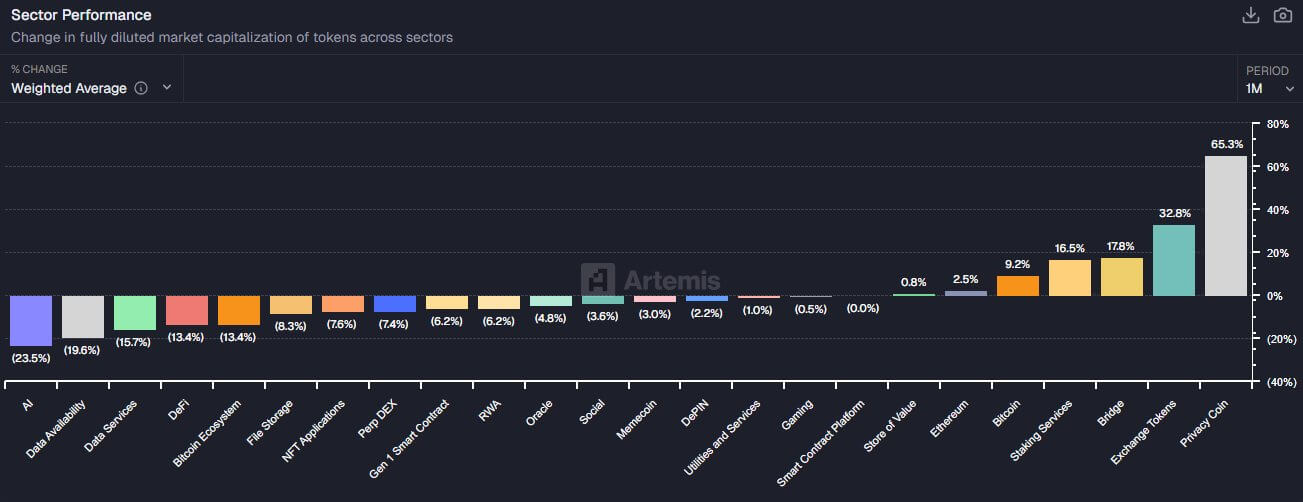
Ethereum’s renewed focus on privacy represents a shift from simply complying with regulations to proactively incorporating privacy into the system’s design. As data extraction by artificial intelligence expands and governments increase on-chain monitoring, Ethereum is wagering that a privacy-focused base layer is essential for wider adoption.
If Kohaku and the Privacy Cluster are successful, the next version of Ethereum could transform “private by default” from a mere slogan to a fundamental protocol standard.