

As layer-1 blockchains strive to stay competitive, voices within the Ethereum community are proposing a strategic pivot: embracing a role as layer-2 solutions on top of Ethereum.
On Monday, Jason Chaskin, who is in charge of application relations and research at the Ethereum Foundation, initiated a discussion suggesting that most layer-1 chains may eventually evolve into Ethereum layer-2s. He highlighted Celo’s recent transformation as a potential model for this shift.
Chaskin argued that Celo’s move allowed the network to decrease its inflation rate, simplify its codebase, accelerate block processing times, and deeply integrate with Ethereum, which he described as having “the largest developer community in crypto.”
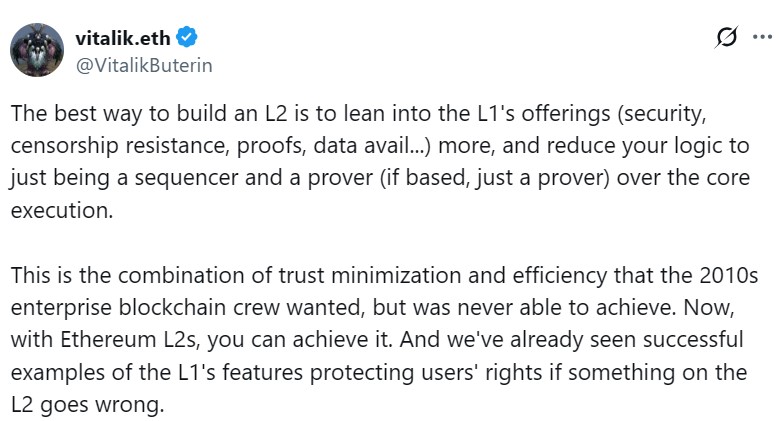
On Wednesday, Vitalik Buterin, a co-founder of Ethereum, contributed to the conversation by outlining a strategy for those interested in creating layer-2 networks.
Vitalik Buterin’s Proposed Strategy for Building Layer-2 Networks
Buterin expanded on the idea, asserting that the optimal method for developing a layer-2 solution is to fully leverage Ethereum’s inherent strengths, including its security infrastructure, data availability, and resistance to censorship.
He proposed that networks could minimize their operational complexity by focusing solely on the functions of a sequencer and a prover for core execution tasks.
Instead of starting from scratch and recreating existing infrastructure, Buterin suggested that layer-2 solutions should minimize their functionality and concentrate on their sequencer, which organizes transaction order, and their prover, which validates transaction validity and correct execution.
Buterin stated that this approach accomplishes the “trust minimization and efficiency” that enterprise blockchain developers sought in the 2010s but were unable to achieve.
“Now, with Ethereum L2s, you can achieve it,” Buterin wrote. “And we’ve already witnessed successful instances where the L1’s features protect user rights if something goes wrong on the L2.”
The comments from Chaskin and Buterin indicate a change in perspective for blockchain networks. As Ethereum enhances its capabilities, their suggestion is that the most effective strategy might be to move away from competing with Ethereum and instead start innovating and building upon it.
Related: Ether price stability above $3K sets stage for potential 1,100% surge: Analyst forecasts
Ethereum Foundation Unveils Plan for zkEVM Integration
Buterin’s remarks follow the Ethereum Foundation’s announcement of a roadmap to incorporate a zero-knowledge Ethereum Virtual Machine (zkEVM) into the Ethereum network within the next year.
On July 11, Sophia Gold, a developer within the Ethereum Foundation’s (EF) protocol support team, released a detailed plan to replace the current block execution method with zero-knowledge proofs (ZK-proofs).
This update would mean validators only need to examine ZK-proofs instead of re-executing entire transaction blocks for verification.
Magazine: TradFi’s adoption of Ethereum L2s for tokenizing real-world assets: An in-depth exploration