


Data from mempool.space reveals a shift in Bitcoin’s Lightning Network. The network’s capacity, which peaked at over 5,400 BTC in late 2023, has decreased to around 4,200 BTC by August 2025. This represents an approximate 20% reduction. However, experts in the field and developers suggest that this change isn’t necessarily a sign of declining use. Instead, they view it as a natural development in how the network is structured for routing and in the design of its underlying technology.
Lightning Capacity vs. Real-World Usage
The term “network capacity” refers to the aggregate Bitcoin value locked within publicly advertised payment pathways. These channels form the network’s routing infrastructure, enabling peer-to-peer transactions.
It’s crucial to understand, as explained in River’s 2023 Lightning Network report, that this figure doesn’t account for private channels, Bitcoin held in custodial services, or payments routed through multiple paths simultaneously. The same report highlighted that, despite only a moderate increase in capacity at that time, the volume of routed payments on the Lightning Network experienced a substantial surge of 1,212% between August 2021 and August 2023.
Coinbase’s incorporation of the Lightning Network in 2024 had a noticeable effect on transaction volumes. By the middle of 2025, Lightspark indicated that around 15% of all Bitcoin withdrawals on their platform were being processed through the Lightning Network.
CoinGate, a European company facilitating cryptocurrency payments, also reported a resurgence in Bitcoin’s dominance within crypto payment processing during 2025. Internal data from CoinGate attributes this in part to the increasing utilization of layer-2 networks, including the Lightning Network. In their quarterly report for 2024, CoinGate pointed out that Lightning was already responsible for over 16% of all Bitcoin transactions, a significant increase from approximately 6.5% just two years prior.
Coinciding with the decrease in public capacity is a longer-term trend: a reduction in the number of publicly visible Lightning nodes and payment channels. Data from mempool.space shows that these numbers have been consistently declining since 2022.
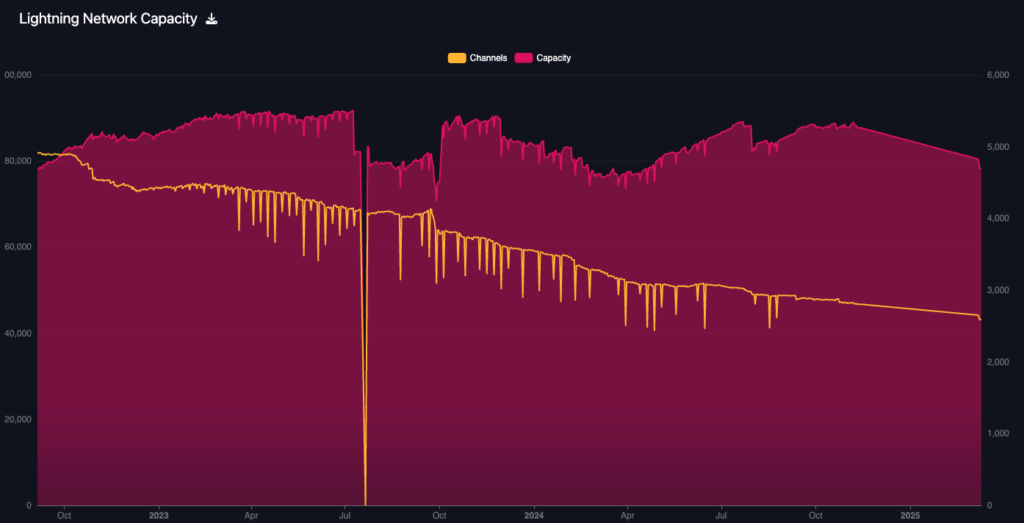
Developers attribute this trend partly to the concentration of routing through more effectively managed hub nodes and the incorporation of technological enhancements such as channel splicing. Channel splicing allows users to adjust the size of their payment channels without needing to execute transactions on the main Bitcoin blockchain. This diminishes the demand for entirely new channels and promotes more efficient utilization of available liquidity.
Ongoing Advancements in Lightning Network Technology
While the publicly visible network may appear to be shrinking, recent events indicate that the scope of the network’s potential applications is actually expanding. In January 2025, Tether announced the introduction of USDt (Tether’s stablecoin) to the Lightning Network through Taproot Assets, in collaboration with Lightning Labs.

This development paves the way for payments denominated in U.S. dollars and stablecoin-based international money transfers on the Lightning Network. These transactions wouldn’t necessitate locking up Bitcoin in payment channels, effectively disconnecting real-world usage from Bitcoin-denominated capacity metrics. Elizabeth Stark, CEO of Lightning Labs, stated that this integration provides the security associated with Bitcoin combined with the speed and scalability benefits of the Lightning Network.
At a fundamental level, developers are also tackling problems impacting payment dependability and channel stability. Research into vulnerabilities like jamming attacks and replacement cycling is ongoing through the Bitcoin Optech working groups. Simultaneously, features such as BOLT12 Offers and tools for automated liquidity management are making the Lightning Network more reliable for commercial use.
Furthermore, there is a significant increase in the number of applications built on top of the Lightning Network protocol. A notable example is L402, a standard enabling pay-per-request application programming interfaces (APIs) that leverage Lightning’s native authentication and micropayment capabilities. L402 is currently being implemented in early-stage AI agent systems such as LangChainBitcoin.
This design allows automated software agents to pay for each inference request or API response without the need for traditional bank accounts or static API keys. This offers a new kind of machine-to-machine payment flow that doesn’t rely on increasing network capacity for scalability.
These ongoing changes in protocols and real-world applications provide important context for understanding why public capacity alone may no longer be an accurate measure of the Lightning Network’s overall progress.
Developers contend that the Lightning Network’s current focus is shifting away from simply growing the amount of visible liquidity and toward maximizing the utility of each individual satoshi that is already in circulation.
While the trend in public capacity may be downward, other key indicators—usage, integration efforts, and technological improvements—point to a different, more positive narrative.