
Ethereum, a leading blockchain platform, often encounters hurdles related to scalability and transaction costs, especially during periods of heightened network activity. However, innovative Layer-2 solutions, like Linea, which employ zero-knowledge (zk) proofs, are significantly improving this situation.
This article delves into the details of Linea, exploring its potential to reshape the cryptocurrency environment by offering quicker and more economical transaction processing. We’ll examine this Layer-2 solution developed by Consensys and how it’s becoming a robust option for scaling blockchain operations.
What is Linea?
Linea, created by Consensys, is a Layer-2 (L2) blockchain initiative designed to overcome the scalability limitations of the Ethereum Mainnet. This zero-knowledge (zk) rollup technology securely enhances the capacity of the Ethereum blockchain while upholding its decentralized and secure nature. Linea is built on a Type 2 zkEVM Layer‑2 scaling framework, closely mirroring the Ethereum Virtual Machine (EVM). This allows developers to seamlessly create and implement decentralized applications (DApps) utilizing pre-existing smart contracts, eliminating the need for new code. Positioned as the “Home Network for the World,” Linea aims to be a central hub for everyday user interactions on the blockchain.
Key Features of Linea Blockchain
Linea presents several notable characteristics that distinguish it in the competitive Layer-2 blockchain landscape.
Zero-Knowledge Rollup (zk-Rollup)
Linea utilizes zero-knowledge (zk) rollup technology to optimize transaction handling by conducting them off-chain. These transactions are then aggregated into a single batch before being submitted to the Ethereum Mainnet. This approach reduces the burden on Ethereum, resulting in faster and more affordable transactions.
EVM Compatibility
EVM equivalence is a significant advantage of Linea. The project is entirely compatible with the Ethereum Virtual Machine, enabling developers to effortlessly transfer Ethereum-based DApps without complex modifications. This compatibility extends to development tools and smart contracts, making Linea easily accessible to developers.
Lower Fees and Scalability
Leveraging the zk-rollup mechanism, Linea can manage substantial transaction volumes with minimal fees. The zero-knowledge rollup proofs ensure swift and efficient transaction processing, making Linea an appealing choice for DApps, such as those in DeFi and gaming, that demand high transaction throughput.
Security
Linea places a strong emphasis on security, employing advanced features to enhance safety. The platform incorporates sophisticated cryptographic techniques, including zkSNARKs and lattice-based cryptography, to secure transactions. Additionally, Linea benefits from Consensys’ extensive experience and partnerships within the blockchain and cryptocurrency sectors.
How Does Linea Work?
Linea’s operational framework involves processing transactions in batches off-chain and producing validity proofs based on SNRKs, which are then sent to Ethereum for finalization. A key differentiator is its ability to provide immediate finality and rapid withdrawals, unlike the conventional seven-day fraud-proof periods. Here’s a simplified overview of Linea’s technical structure:
- Transaction Bundling: Transactions are grouped together off-chain on the Linea Layer-2 network.
- Validity Proof Generation: Linea uses zero-knowledge (zk) rollup cryptographic techniques to confirm the integrity of bundled transactions without disclosing specific transaction details.
- Mainnet Settlement: The zk-proof is submitted to the Ethereum Mainnet for final verification. The Mainnet finalizes the transactions upon verifying the zk-proof and confirming its validity.
What Is ConsenSys?
Consensys, established in 2014 by Ethereum co-founder Joseph Lubin, aims to develop applications and infrastructure that support the Ethereum ecosystem by creating DApps on the blockchain. Consensys is now a pivotal player in the cryptocurrency infrastructure domain. Its notable products include MetaMask, a widely used browser-based wallet; Truffle, a smart contract development infrastructure; and Infura, a crypto development suite.
Consensys initially introduced the Linea testnet to the public in March 2023, utilizing their zero-knowledge Ethereum Virtual Machine (zkEVM). This Layer-2 solution, built on Ethereum, was launched concurrently with Polygon’s zkEVM on Mainnet. Following the successful public testnet phase, Consensys announced the rollout of the Linea Mainnet alpha.
What Is Linea Mainnet?
The launch of the Linea Mainnet Alpha allowed the Linea ecosystem to gradually establish partnerships before its public release. The project onboarded over 100 strategic partners, including prominent names like PancakeSwap and Uniswap. Additionally, MetaMask has been fully integrated with its built-in bridging, swapping, and purchasing features.
To ensure the Mainnet alpha’s effectiveness, the development team dedicated considerable time to testing various upgrades to its architecture, aiming to enhance performance, user experience, and reduce transaction costs. The goal was to create a secure, reliable, efficient, and user-friendly Layer-2 rollup.
The release of Linea Mainnet Alpha offers significant benefits to developers, builders, and users within the Ethereum ecosystem. It provides faster transaction processing and lower fees compared to the Ethereum Layer-1 blockchain, opening up new possibilities for creating scalable Ethereum DApps.
Linea’s partners will soon begin migrating to the Mainnet Alpha release, making a broader range of scalable DApps available. This launch could positively impact areas such as decentralized social networks, gaming applications, identity solutions, and non-fungible tokens (NFTs). By leveraging Linea’s improved scalability, these DApps can achieve faster transaction processing at lower costs, driving innovation within the Ethereum ecosystem.
Linea (LINEA) Tokenomics
The Linea Token serves as the native token for the Linea ecosystem but is not used for gas fees; instead, ETH is used. Linea is designed to support users, builders, and liquidity providers, including Ethereum public goods. Users can earn Linea tokens by participating in the network’s growth. Access to the token is granted through usage, not necessarily capital.
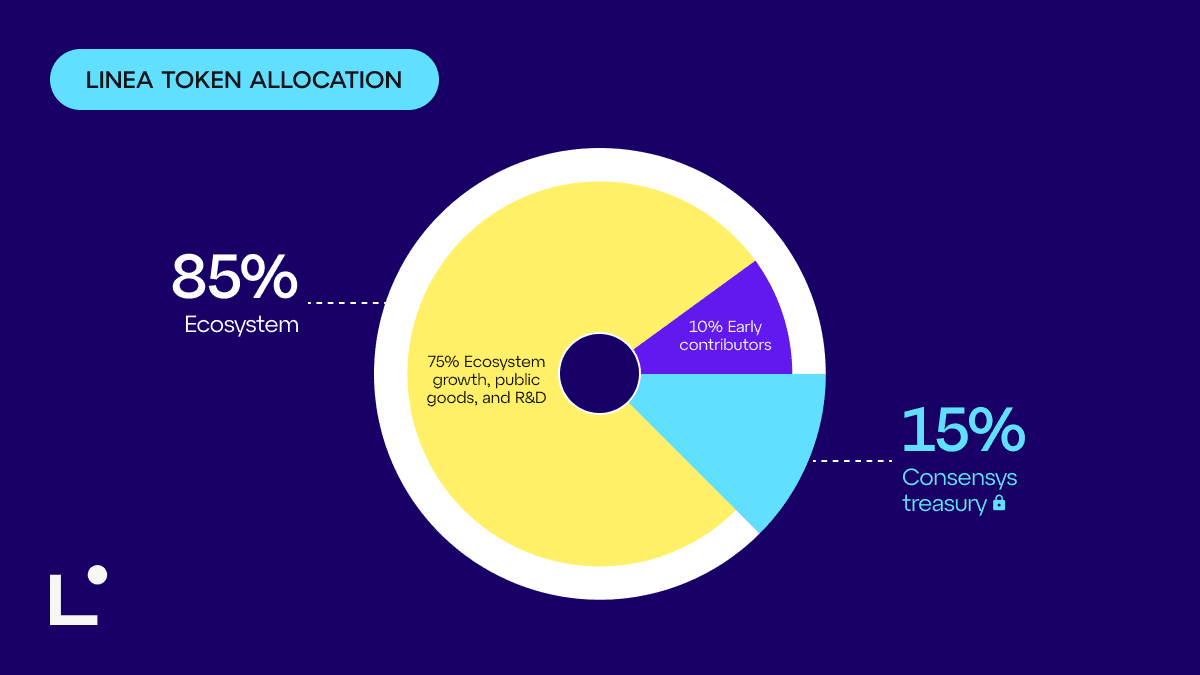
Linea announced a tokenomics model for 72 billion tokens, which is 1,000 times the initial circulating supply of ETH. The project allocated 85% to the ecosystem and the remaining 15% to the Consensys treasury.
Here is the allocation breakdown for the Linea token:
- Ecosystem fund: 75%
- Early contributors: 10%
- Consensys Treasury: 15%
Project Background
Linea is part of a growing number of Layer-2 projects associated with the Ethereum blockchain. The platform rolled out its Testnet in March 2023, followed by the Mainnet launch in July 2023. It is estimated that at least 5 million MetaMask wallets participated in the Mainnet and Testnet launches.
One week after the Mainnet launch, Linea introduced an NFT airdrop for users. The NFT collection, named Linea Voyage, featured art pieces based on contributions to the network, highlighting the emergence of a global network telling the stories of the project’s development and growth.
Funding and Investments
Linea’s funding was facilitated by its parent company, ConsenSys, instead of pursuing separate financing rounds. ConsenSys raised over $726 million between 2019 and 2022 through at least four financing rounds, attracting significant investment from various entities.
Contributors included Coinbase Ventures and Dragonfly, as well as companies from conventional finance sectors like SoftBank, Microsoft, and Temasek. This broad appeal demonstrates belief in the project’s potential.
What is Linea Voyage?
Linea Voyage was a nine-week campaign launched by the Linea network shortly after the public testnet to help beginners become familiar with the ecosystem and the available applications on the testnet. This campaign covered various aspects of the ecosystem, including decentralized finance, bridging, social apps, gaming, and on-chain analytics, tools, and infrastructure.
The campaign attracted over 5.5 million wallets, generating more than 47 million on-chain transactions. Participants could claim commemorative NFT rewards tiered according to points earned. Linea Voyage was designed to recognize and incentivize the community’s contribution across the past, present, and future. Voyage XP tokens were later introduced as a unified way to measure user contributions to the Linea network.
Linea Voyage XP tokens (LXP)
Linea Voyage XP tokens are inspired by video and role-playing games, where users gain experience points (XP). As the game progresses, the user’s Linea Voyage LXP represents their journey and experience within the Linea ecosystem. Eventually, these Voyage LXP tokens will be converted into custom ERC-20 tokens visible in a user’s MetaMask wallet.
Voyage LXP tokens are exclusively for use within the Linea ecosystem and are non-transferable. These tokens can only be distributed within the Linea community to promote network growth. While they may not have monetary value, they serve as a metric for measuring contributions to the project’s development. Voyage LXP owners become eligible for additional benefits within the Linea ecosystem.
Linea’s Ecosystem and Use Cases
The Linea network extends beyond being a Layer-2 solution for Ethereum, offering a diverse and vibrant ecosystem for various DeFi platforms and protocols. It also provides numerous services within the Web3 space:
Velocore
This decentralized exchange allows for the swapping of any ERC-20 tokens on the Linea network with high liquidity and low slippage. Linea employs its constant product market maker (CPMM) algorithm to integrate other DEXs within the Linea and Ethereum networks. Users can provide liquidity to multiple token pairs to earn fees and rewards, and automatically compound their earnings with a single click. Velocore is currently one of the most popular platforms within the Linea network, boasting over 50,000 users and over $100M TVL.
Linea Safe
Linea Safe is the network’s smart wallet, enabling users to manage assets, access DApps, and execute transactions within the network. The wallet acts as a gateway to the broader Linea ecosystem and the world of Web3, supporting multiple devices, signatures, and accounts, and implementing biometric authentication and wallet recovery. It is based on the Safe project, a trusted solution for Web3 security, making it a secure and user-friendly application.
Chainlink
Linea integrates Chainlink, a decentralized oracle network providing reliable data feeds. These oracles connect smart contracts to external sources, including weather conditions, market prices, and sports outcomes. Developers can leverage Chainlink’s data infrastructure to develop gaming, DeFi, and asset tokenization DApps.
How to bridge ETH or tokens to Linea
The following steps detail the process of bridging ETH or tokens to the Linea network:
- Step 1: Access the Linea Bridge: Visit the official Linea Bridge interface.
- Step 2: Connect your Wallet: Click “Connect Wallet” on the dashboard and select your preferred wallet.
- Step 3: Choose Networks and Assets: Select “Mainnet” as your source network and “Linea” as your destination network. Then, select the asset you wish to bridge, such as ETH or any other ERC-20 token.
- Step 4: Input Amount and Confirm: Enter the exact amount of the asset you intend to transfer. Review the details carefully and confirm the transaction within your wallet.
- Step 5: Claim Funds on Linea: Once the bridging process is complete, claim your funds by clicking “Claim Funds” on the bridging interface.
Conclusion
Linea is an innovative Layer-2 solution designed to address the scalability challenges within the Ethereum Mainnet. It introduces flexibility, allowing developers to build DApps without needing extensive knowledge of zero-knowledge technology. Linea’s architecture helps accelerate transactions and reduce costs while preserving the security and decentralization principles of Ethereum.
With the support of ConsenSys, Linea’s future looks promising, offering fresh opportunities for active participants, builders, and early adopters. It has the potential to become a core pillar of the Ethereum network and facilitate broader adoption.
FAQs
Can I use Linea with MetaMask?
Linea is pre-configured in MetaMask, ensuring full compatibility. Manual connection is not required.
What makes Linea different from other Layer 2 networks?
Linea stands out due to its EVM equivalence and the use of zero-knowledge (zk) rollups, allowing users to deploy existing Ethereum smart contracts without modifications. Additionally, zk rollups facilitate low fees and high throughput. The Linea network also burns 20% of gas fees in ETH, promoting Ethereum’s deflationary economics.
Does Linea have its token?
Due to its EVM-equivalence, Linea uses Ether as its native token for gas fees. However, plans are in place to officially launch the Linea Token at a future date, which could significantly reshape the Layer-2 blockchain landscape.
What tokens are on Linea?
According to the platform, the most swapped tokens within the Linea network are Wrapped Ether, USDC, Tether USD, and Foxy.