

Individual cryptocurrency miners are achieving success, securing entire Bitcoin block rewards even as the network’s computational power reaches near record levels.
Currently, the Bitcoin (BTC) network’s processing capacity, or hashrate, is estimated to be around 902 exahashes per second (EH/s), nearing its all-time high according to data from Blockchain.com. This high figure indicates increased competition and greater difficulty in mining, suggesting formidable challenges for independent miners seeking to win a block.
However, in the recent past, one solo miner defied these odds, successfully mining block 907,283 via the Solo CK pool. This individual earned the complete block reward of 3.125 BTC, which was valued at over $372,000 at that time. The miner also received transaction fees amounting to an additional $3,436.
This success wasn’t a singular occurrence. Earlier in July, another miner with a relatively modest 2.3 petahashes of computing power earned a full block reward. Similar achievements were also reported in June, March, and February.
Samuel Li, Chief Technology Officer at ASICKey, explained to Cointelegraph, “These individual miners are succeeding not solely due to luck, but because they utilize robust and efficient hardware.” He elaborated that modern mining equipment is designed to deliver “substantial hashrate” without consuming excessive power, unlike older setups.
Related: Solo Bitcoin miner scores $373,000 block reward
Focus on Efficiency
For miners operating independently, efficiency is paramount, according to Li. “Consider our KEYMINER A1,” he stated, “it consumes only 650 watts yet provides 1,100 TH/s when mining Bitcoin, resulting in roughly $1,200 in monthly profit. For those diversifying into alternative cryptocurrencies, it can generate up to $3,800 per month mining Dash.”
The KEYMINER A1 is part of ASICKey’s hardware lineup, which was launched last November and also features the KEYMINER X and KEYMINER PRO.
According to ASICKey, the KEYMINER X offers 2,300 terahash per second (TH/s) at a power consumption of 1,300 watts, while the PRO model delivers up to 5,800 TH/s at 2,800 watts. Based on current market conditions, the company estimates that the PRO model can generate monthly returns of up to $6,300.
However, despite advancements in ASIC (application-specific integrated circuit) efficiency, Li noted that the “underlying probability [of solo miners successfully mining a block] remains largely unchanged.”
“Solo mining remains primarily a game of chance, unless an individual controls tens of PH/s,” he explained, “which is essentially the minimum requirement for a realistically measurable statistical likelihood of success within a reasonable timeframe.”
Li further clarified that at the current Bitcoin network hashrate, a miner with one petahash (PH/s) of hashing power has approximately a 1 in 650,000 chance of successfully solving a block every ten minutes. It’s important to remember that one petahash (PH/s) is equivalent to 1,000 terahashes (TH/s).
Related: Tether plans to open-source Bitcoin mining OS; CEO says ‘no need’ for 3rd party vendors
The Appeal of Solo Mining
Li confirmed that there is a “noticeable resurgence” of interest in mining independently, but the motivations are varied. “Some miners are drawn to it not for reliable income, but for the possibility of securing a substantial reward – 6.25 BTC plus fees – which could be life-changing,” he observed.
While financial incentives are a significant driver, some individuals are motivated by philosophical reasons, valuing the decentralization of the network and the autonomy of operating separately from large, centralized mining pools.
According to data from Hashrate Index, Foundry USA, a mining pool based in the United States, continues to be the dominant force in Bitcoin mining, controlling 29.3% of the total hashrate. AntPool is next with 16.2%, followed by ViaBTC and F2Pool, holding 12.0% and 11.6% respectively.
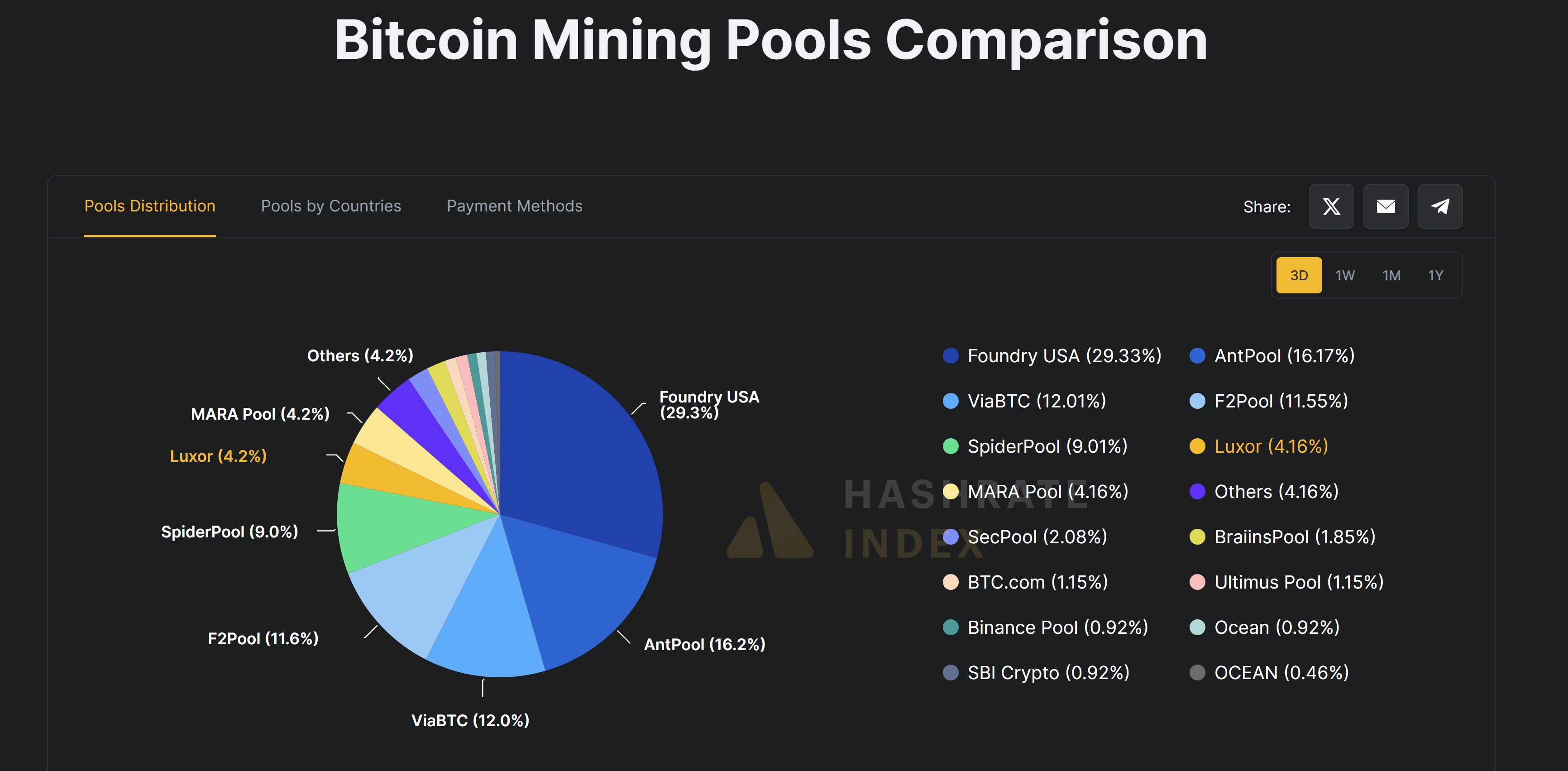
If a single mining pool (or a coordinated group of pools) controls more than half of the network’s processing power, it could theoretically execute a 51% attack, potentially enabling them to perform double-spending of coins. While such events are uncommon and costly, they could undermine trust in the Bitcoin network.
“In the end, having more solo miners, especially those utilizing clean energy sources and energy-efficient equipment, could contribute to a more robust and decentralized Bitcoin network, which aligns with the initial goal of open and unrestricted participation,” Li concluded.
Magazine: AI may already use more power than Bitcoin — and it threatens Bitcoin mining