Michigan’s proposed cryptocurrency reserve legislation is progressing, having advanced to a second reading in the state legislature on Thursday.
House Bill 4087 in Michigan, which outlines the circumstances under which the state could allocate funds to digital assets, is now under consideration by the Committee on Government Operations after a second reading.
This bill seeks to modify the existing Michigan Management and Budget Act to provide a framework for a strategic crypto reserve, although it does not specifically mention Bitcoin as the asset to be used.
This development occurs during a period of relative quiet regarding state-level initiatives involving Bitcoin reserves.
Introduced in February by Republican Representatives Bryan Posthumus and Ron Robinson, the bill proposes that the state treasurer be authorized to invest up to 10% of the “countercyclical budget” and “economic stabilization fund” into cryptocurrencies.
The proposed legislation details that any cryptocurrency holdings must be managed through one of three approved channels: a “secure custody solution,” a qualified custodian such as a regulated bank, trust firm, or state-regulated company, or exchange-traded products offered by registered investment firms.
The bill also permits the state to lend out cryptocurrency to generate additional income, provided it does not increase financial risk.
Crypto Reserve Bill Scope Extends Beyond Bitcoin
The legislation further specifies detailed technical security requirements for custody solutions. These include exclusive government control of private keys, complete end-to-end data encryption, prohibiting smartphone access, establishing geographically diverse and secure data centers, implementing multi-party authorization for transactions, and conducting regular security audits.
The digital assets that can be utilized for the strategic reserve are defined by the following criteria:
“Digital currency in which encryption techniques are used to regulate the generation of units of currency and verify the transfer of funds, and that operates independently of a central bank.”
Michigan Bitcoin Trade Council’s Opposition
The Michigan Bitcoin Trade Council has voiced opposition to the bill, arguing that “there is no market capitalization number listed in the legislation that would prevent other cryptocurrencies other than Bitcoin from being bought by the state.”
According to the state Bitcoin advocacy organization, permitting the inclusion of other crypto assets in a strategic crypto reserve poses “unnecessary risk,” because all other cryptocurrencies apart from Bitcoin are “centralized and subject to great risk.”
Few States Have Passed Similar Laws
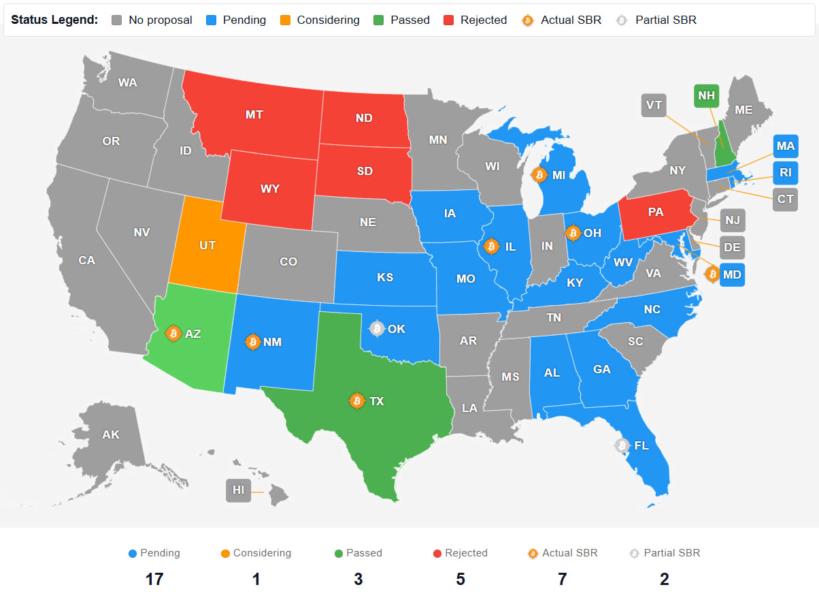
As noted by Bitcoin Laws, Michigan joins Massachusetts and Ohio as states with strategic crypto reserve bills that have reached the committee stage.
Currently, only New Hampshire, Arizona, and Texas have implemented laws allowing state treasurers to invest in Bitcoin and other crypto assets.
Strategic Bitcoin reserve bills have been rejected in Montana, North Dakota, South Dakota, Wyoming, and Pennsylvania. According to Bitcoin Reserve Monitor, legislation is currently pending in 17 other states.