
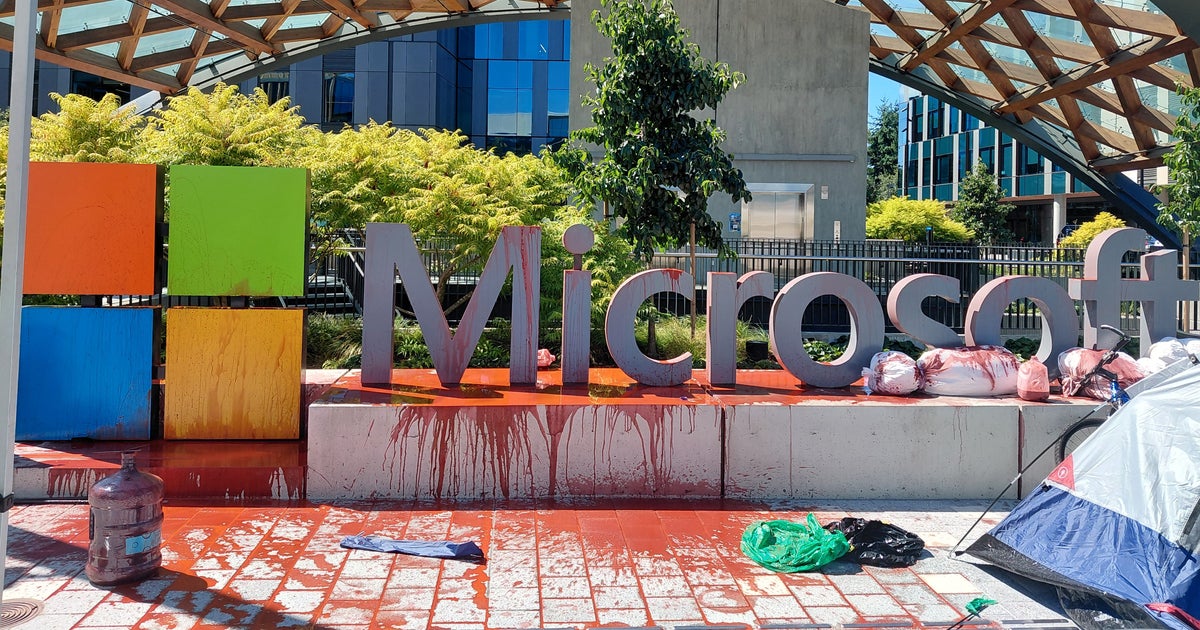
Each October, Microsoft organizes an Employee Giving initiative, letting employees nominate charities and then matching their fundraising efforts. Last October, a collective of Microsoft employees held a vigil to remember Palestinians who died due to Israeli military actions in Gaza. They gathered donations for organizations such as the Palestinian Children’s Relief Fund and honored tech professionals who lost their lives in the conflict.
Hosam Nasr / The Guardian
Abdo Mohamed, a former Microsoft machine learning engineer and one of the event organizers, stated, “We commemorated individuals like Shaaban Ahmed al-Dalou, a computer science student who became a martyr in Gaza. We also honored Aisha Noor Ize-Iji, a Washington state resident who died in the West Bank, and Mai Ubeid, a Palestinian tech worker who collaborated with Gaza Sky Geeks, a programming bootcamp supported by Google. These people’s stories deserve to be told. Palestinians who have fallen victim to the violence deserve a space for remembrance instead of simply being reduced to statistics.”
Mohamed says the vigil was a small gathering of “about 50 people, sitting in chairs in an open space during lunchtime” and followed company guidelines. However, that evening, Mohamed and another organizer, Hossam Nasr, were informed via email that they were terminated. Microsoft later stated that the event “disrupted” work and should have occurred off-campus. Mohamed believes the firings show Microsoft’s unwillingness to provide a “safe space” for employees to voice concerns regarding Israel’s actions towards Palestinians and Microsoft’s alleged support by providing technology to the Israel Defense Forces. Instead, according to Mohamed, “Microsoft has fostered an environment of intimidation, retaliation, and oppression for anyone wishing to speak out about the events in Gaza.”
Microsoft’s attempt to suppress the discussion appears to have backfired. Earlier this month, current and former Microsoft employees affiliated with the No Azure For Apartheid (NAFA) movement staged an occupation on Microsoft’s Redmond campus using tents and signs to protest the company’s relationship with the Israeli military. Just this week, protestors held a sit-in at the office of the company’s president. NAFA members have even protested outside Satya Nadella’s residence by canoe. The repercussions are now impacting Microsoft’s gaming operations.
In May, the Boycott, Divest, Sanctions (BDS) movement launched a campaign against Microsoft’s gaming division, urging people to cancel Game Pass subscriptions, avoid popular games like Minecraft and Call of Duty, and refrain from purchasing Microsoft products. A NAFA petition calling for Microsoft to divest from Israel has received signatures from game developers within prominent subsidiaries like Bethesda, Activision-Blizzard, and Mojang. Leading up to Gamescom 2025, unionized employees at Arkane Studios, the makers of Dishonored, publicly voiced their support for the BDS campaign, accusing their employer of complicity in genocide.
The ongoing Israeli military campaign in Gaza is in response to the attack led by Hamas on October 7th, 2023. It is also viewed as a continuation of violent oppression and dehumanization against Palestinians in Gaza and the West Bank. Reports state that approximately 62,000 Gazans have been killed by Israeli forces, including over 18,000 children, while approximately 1,800 Israelis have been reported dead, including casualties from the October 2023 attacks. Most of the casualties are civilians. The Guardian recently reported that alleged Israeli intelligence files indicate that 83% of Palestinians killed in the first 19 months of the war were non-combatants. Hundreds of thousands of Gazans have been injured and displaced, with their homes destroyed by airstrikes. The UN describes the famine facing refugees as “entirely man-made” due to Israel’s restrictions on aid entering Gaza.
As the Israeli military operation persists, the UN Human Rights Council and Israeli civil rights groups have accused the Israeli government of genocide, which they consider the most extreme form of ethnonationalist “Zionist” policies aiming to displace Palestinians from their ancestral homeland. In November 2024, the International Criminal Court issued arrest warrants for Israeli Prime Minister Benjamin Netanyahu and Defense Minister Yoav Gallant, charging them with “crimes against humanity.” Corporations with ties to Israel are facing scrutiny for potentially enabling these actions. In a report published in July, UN Special Rapporteur Francesca Albanese condemned the international tech sector for participating in Israel’s “economy of genocide,” stating that “repression of Palestinians has become progressively automated, with tech companies providing dual-use infrastructure to integrate mass data collection and surveillance, while profiting from the unique testing ground for military technology offered by the occupied Palestinian territory.”
Microsoft is among the companies highlighted in Albanese’s report, stating that its “technologies are embedded in [Israel’s] prison service, police, universities and schools – including in colonies.” Investigations by The Guardian, +972 Magazine, and Local Call support Albanese’s claims, alleging that Microsoft’s dealings with the Israeli military sharply increased after October 2023. Earlier in August, the publications reported that Microsoft worked with Israeli intelligence unit Unit 8200 to store and process surveillance data collected from Palestinian phones, using generative AI to facilitate airstrikes in Gaza.
Microsoft has disputed certain accusations, saying in May that although they have provided technology to the Israeli military since October 2023, “no evidence to date indicates that Microsoft’s Azure and AI technologies have been used to target or harm people in the conflict in Gaza.” They have recently announced an additional “external” review of their business relationships in Israel, but otherwise have remained silent on the matter. At Gamescom, Xbox representatives prevented developers from answering questions concerning ties to Israel and mass layoffs. Microsoft did not respond to requests for comment regarding reports about Unit 8200.
Microsoft prides itself on its humanitarian and philanthropic efforts. Yet Abdo Mohamed suggests that Microsoft operates using a “double standard” regarding Palestine, deploying HR resources to quell worker concerns. In the wake of the October 2023 atrocities, Microsoft released a company-wide message expressing support for Israel. As the Gaza invasion continued, Microsoft employees advocated for the company to issue a statement calling on the Israeli military to cease the violence.
“An internal petition called on Microsoft to endorse a ceasefire,” says Mohamed. “At the time, many people began voicing their concerns internally, using approved channels, such as contacting their executive heads or the internal forum ‘senior leadership connection’.”
Microsoft
According to Mohamed, Microsoft management was unreceptive to these efforts, even through official channels. “[We told them that] Palestinians deserve dignity and access to food, water, and shelter, but these concerns were dismissed.” Mohamed and colleagues also attempted to organize events where Palestinians could discuss their families’ experiences with the Nakba, the displacement of approximately 750,000 Palestinian civilians during the 1948 Arab-Israeli wars. “However, the event was shut down for being ‘too educational.'”
Mohamed also mentioned that other workers were “investigated using weaponized HR policies” with “interviews and intimidation over months, just for something like ‘Palestinians will receive their dignity from the Jordanian sea to the Jordanian river’.” (The phrase about Palestinian freedom “from the river to the sea” has been interpreted as hate speech by commentators who argue that it implies the destruction of Israel.) Other Microsoft employees “who had been spewing anti-Arab, anti-Palestinian hate rhetoric against those who speak up, had been able to do that with impunity, and without seeing any repercussions,” Mohamed added. Microsoft declined to comment on claims of a “double standard” within HR or the circumstances regarding the firings of Mohamed and Hossam Nasr.
Mohamed drew a contrast between the corporation’s continued ties to Israel and Microsoft’s suspension of sales in Russia following the 2022 invasion of Ukraine and divestment from apartheid South Africa in 1986. He felt betrayed by what he considered Microsoft’s hypocrisy surrounding generative AI, given his past projects, including Xbox recommendation algorithms and the ROG Xbox Ally.
“Microsoft holds responsible AI summits and is a guest speaker at the UN’s ‘AI for Good’ summit,” says Mohamed. “How can a company that has long presented itself as responsible regarding technology and its use take this position of admitting to working for a military being tried for plausible genocide, with arrest warrants against its generals from the ICC, without taking real steps to cut cloud and AI contracts?”
No Azure For Apartheid / Rock Paper Shotgun
Concerning his firing, Mohamed feels that Microsoft was “scared” of the increasing criticism against their Israel policy and desired to preempt employee action. “They wanted to set the precedent that speaking up comes at a cost, like termination.” He sees this as “a miscalculation” that has fueled the outcry over Microsoft’s partnerships in Israel, now impacting the gaming business.
The reason there aren’t more game developers joining the BDS campaign is because divesting from Microsoft is not easy. Microsoft technology influences much of culture: 71% of desktop PCs run Windows, and Xbox, alongside Game Pass, enables access to millions of players. Highlighting the complex nature of disengagement, the BDS campaign suggests protest actions: rather than immediately converting to Linux, it recommends minimizing or phasing out exposure. However, some boycott participants have gone “cold turkey”.
Among developers openly participating in the boycott is daffodil, the primary developer of STREET UNi X, a stylish sports sim reminiscent of a PS1 Tony Hawk game, where Tony Hawk uses a unicycle instead of a skateboard. STREET UNi X has earned positive reviews on Steam, and daffodil planned to port the game to consoles via the ID@Xbox program. However, they cancelled the port in support of the BDS campaign.
Daffodil sees solidarity with Palestine as part of a wider struggle involving activism against climate change, support for indigenous movements in Canada, and advocating for exploited animals. This interconnectedness mirrors personal experiences with transphobia. Daffodil has faced discrimination related to their unicycle performance in the game’s trailer.
“I encountered the topic of Israel’s occupation through jokes and memes over 20 years ago,” daffodil tells Rock Paper Shotgun via email. “I’ve known about the ‘conflict’ for most of my life. But it wasn’t until around 2021 that I watched Abby Martin and the Empire Files reports on the occupation, and Israel’s apartheid state, that I grasped the situation. At the time, Israel was breaking what was supposed to be a ceasefire by bombing Palestinian neighborhoods, killing hundreds.”
Badru of Ice Water Games is also boycotting and announced they would remove their game Tenderfoot Tactics from Xbox. Badru is a member of the Palestine Solidarity and Internationalism Working Group in the Seattle chapter of the Democratic Socialists of America. “One of my close friends was Palestinian, so I always had some knowledge,” Badru says. “But I didn’t truly understand the events in Palestine until some time in the last 5 to 10 years. Seeing it directly on social media has been helpful. I’ve also educated myself by studying socialist history and theory to comprehend why the world is the way it is.”
Ice Water Games created Tenderfoot Tactics independently, splitting revenue based on the hours contributed. The developers democratically decide what to do with the IP, including removing it from Xbox, Badru explains. Although Tenderfoot Tactics didn’t make “a ton of money”, they believe joining the boycott took “a couple hundred bucks a month, maybe.” Badru adds that, “it’s frustrating after putting the work into porting it to the platform,” but that “we did get a lot of support after our announcement, and saw a small sales boost on Steam, which will likely offset the lost income from Xbox.”
For daffodil, divesting from Xbox represents a significant decision. Daffodil developed STREET UNi X in their free time over four years. After partnering with Gamma Space and Weird Ghosts, a funding group for underrepresented developers, daffodil could fully focus on the project.
“STREET UNi X is my first commercial game, my first Steam release, and a project that took me over six years,” they stated. “I’ve been struggling to release the game on consoles. I tried releasing it on Nintendo Switch, applying for developer access repeatedly since before the game was released. I’ve been denied eight times with no explanation.” (Daffodil received another rejection email from Nintendo at the time of the interview.)
Gamma Space Collaborative Studio
A console release could benefit daffodil greatly, because of the game’s Steam success. “I can’t rely on my games to cover my living expenses right now,” daffodil mentions. “I currently contract level design work to pay my bills.” Daffodil sought to release the game on PlayStation, but found this impractical due to requirements related to internet protocols and email addresses. Microsoft’s ID@Xbox program seemed more accessible.
When daffodil announced they would withdraw the port, Microsoft did not address their objections regarding Israel and Palestine. Instead, they sent instructions for account deactivation and hardware return. “I feel let down,” says daffodil. “I don’t have access to opportunities with Nintendo and Sony [or] working with Microsoft means they will profit from my labour and use that profit to perpetuate injustice and provide Israel’s occupational forces with Azure and AI tools that actively slaughter, starve, torture, and dehumanize the people of Palestine.”
Boycotts rarely result in immediate change, and can sometimes backfire. Nike increased revenue by $6 billion from consumer reaction against adverts featuring Colin Kaepernick. Still, boycotts have brought meaningful change, including pro-Palestinian actions against companies and institutions like Puma, Barclays, and Pret.
In 2020, Microsoft divested from an Israeli facial recognition tech developer that was used at West Bank checkpoints after civil liberties groups protested. Similar to the boycott of South Africa, organizers must plan long-term, which is why BDS doesn’t require people to discontinue all Microsoft services to participate.
No Azure For Apartheid / Rock Paper Shotgun
Daffodil attributes the reluctance to join the boycott to privilege: “we can relax when we don’t see the problems in front of us.” They also noted a “generalized nihilism” when faced with disaster. “We think caring too much is embarrassing,” they say. “We are taught that if you speak out, you will lose your job, family, community, and must conform. I’ve lost friends, don’t speak with my family, and have been fired for organizing workers.”
They mention that it’s hard for developers to speak out during mass layoffs: “The world is designed to make us afraid to rock the boat, lest we become the target.” Daffodil joined the boycott to remind other workers of their power to bring about change. “I am encouraging others to take a stand, but worry that I lack the influence needed to be taken seriously in calls for total liberation.”
Badru says that there is more support for Palestinians than it seems. There are practical obstacles: “Some [developers] don’t have control over storefronts or messaging,” mentions Badru, “due to publishers or deals with Xbox.”
“Unlike us, many depend on Xbox sales for livelihood,” Badru continued. “This decision is harder and could result in closing companies or laying off employees. Most game companies are undemocratically run, and the owning class often prioritizes profit over people and may favor or be ambivalent about the genocide.” He added that some companies are unwilling to criticize Microsoft because they also work with military organizations, and Microsoft’s defense industry contracts extend beyond Israel.
Ice Water Games
Badru expects endorsements to increase as these challenges are resolved. “For teams wanting to support Palestine, action is difficult and time-consuming,” he stated. “Game development is planned years in advance, including target platforms. Funding is tied to storefront releases. If a company is mid-development on an Xbox game, they need to finish and release it, then choose other platforms for their next game. This boycotting is practical and widespread, as it causes less chaos.”
The audience also influences this pressure. A group of reactionary players views games as apolitical, even if they don’t have a stance on the conflict. To protest is to face their ire.
Badru observes that “our audience is often children, or those who wish they were” and that games “are less accessible to poorer people or people outside the imperial core” who are more politically aware. “Our experience [during the boycott] has been supportive because we’ve cultivated this audience,” Badru continues. Badru has found that “the public is pro-Palestine and willing to discuss it,” more than online interactions may show. “I believe this is true of the games audience as well.”
Abdo Mohamed didn’t elaborate on how Microsoft’s actions have affected their own career. But he mentioned that leaving has given him moral clarity. “Seeing the company’s role in Israel’s apartheid and genocide, and not being able to stand up for my principles, and not being able to prioritize people over profits, had always been a challenge. Every time I censored myself during my time at Microsoft, I questioned if I stood for my principles.”
Mohamed never directly contributed to services used by Israeli intelligence. “My background is in machine learning and AI, but I was lucky to not work on weaponized technology,” he said. Given that AI depends on data to train models, it is reasonable to wonder whether the Israeli surveillance collaboration was fed back into Microsoft’s consumer-facing services.
Rock Paper Shotgun
Mohamed suggests there might be a clear division. “It is unclear how the surveillance data is fed back to Microsoft. It seems like it is sensitive data that isn’t used for training the models.” He argues that it’s irrelevant whether Microsoft widely uses data from its partnership with the Israeli military.
“There were people directly working on the technology in our worker base. Your labor was used,