

The following analysis is provided by Shane Neagle, Editor In Chief at The Tokenist.
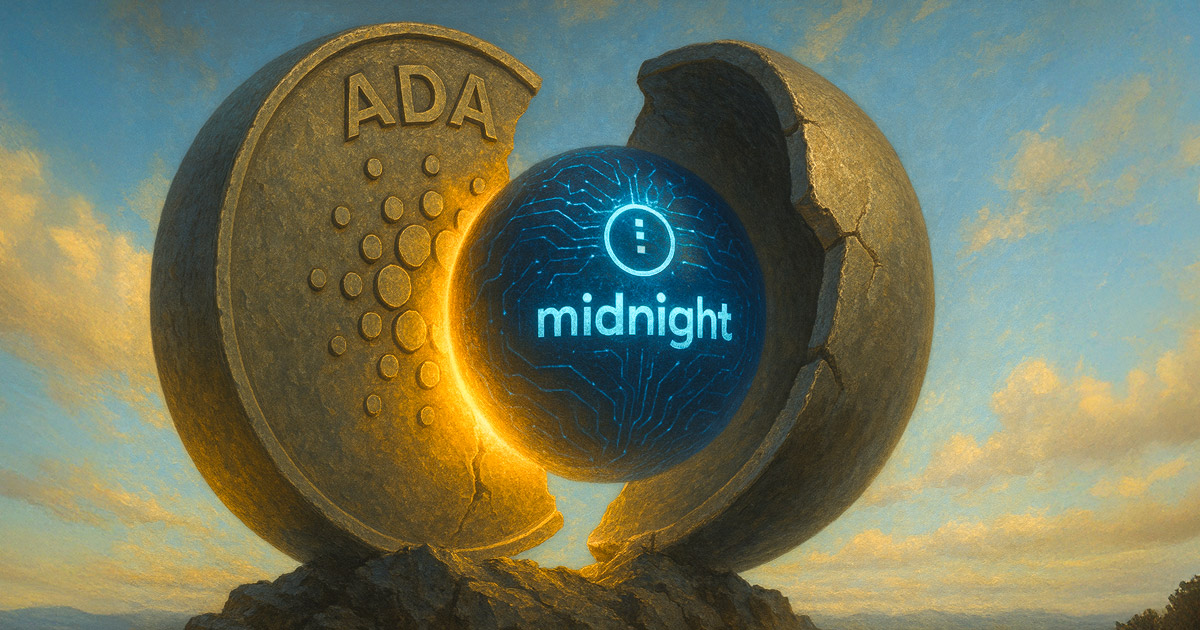
The Midnight Foundation unveiled its initial tokenomics documentation on June 23rd. Earlier that month, Charles Hoskinson, a key figure behind Ethereum (ETH) and the originator of Cardano (ADA), described Midnight as potentially “the most significant development in Cardano’s history,” contingent on its ultimate success.
Despite a recent dip in the altcoin market and an increasingly crowded crypto landscape with numerous tokens, new ventures merit scrutiny. A change in administration could signal a more welcoming environment after perceived regulatory pressures on crypto projects.
Given this backdrop, what makes Midnight noteworthy?
Cardano’s Rationale for Midnight
Cardano is often considered to be behind other blockchain platforms such as Ethereum or Solana. Looking at the Total Value Locked (TVL), Cardano currently holds the 20th position per DefiLlama, with $360 million secured across approximately 50 decentralized applications (dApps). In comparison, Solana boasts $10 billion TVL over ~240 dApps, while Ethereum exceeds Solana by a factor of 8.
Cardano’s cautious, research-focused approach to smart contract creation and blockchain architecture is largely responsible for this lower market presence. The effort is focused on preventing vulnerabilities that could tarnish its reputation.
Hoskinson has also identified the limited availability of stablecoins as a contributing factor, suggesting the conversion of roughly $100 million in ADA tokens to USDM stablecoins issued by Moneta Digital LLC, a regulated service.
Furthermore, Hoskinson has optimistically projected that the altcoin market could experience trillions in value, with Cardano poised to play a significant role, assuming Cardano scaling proceeds according to plan and following increased stablecoin availability after the Genius and Clarity Acts. But what contributions will Midnight bring?
An Introduction to Midnight
Midnight is closely connected to Cardano’s Input Output Hong Kong (IOHK), which has been rebranded as Input Output Global (IOG). While the Cardano Foundation, based in Switzerland, focuses on growing the blockchain ecosystem through adoption and community engagement, IOG spearheads the software engineering behind Cardano’s foundational technology and development roadmap.
Fahmi Syed, the current president of the Midnight Foundation, which was launched in May, previously contributed to Polkadot and Kusama through Parity Technologies, and was involved in the project via IOG. Prior to his engagement with crypto, Syed served as the COO of Fifthdelta, a UK-based startup that emerged from Citadel money managers in 2021.
The Midnight Foundation describes the network as a “fourth-generation blockchain engineered for secure, compliant, and private decentralized applications.” Let’s examine what this statement implies.
- Traditional finance institutions are often wary of adopting blockchain technology due to the inherent transparency of most blockchains. The public visibility of transactions on platforms like Ethereum and Bitcoin poses challenges for safeguarding customer data and upholding financial privacy.
- Midnight seeks to address this concern by delivering programmable privacy, making use of zero-knowledge proof cryptography. This technology allows for the validation of data and transactions without disclosing the identities involved, promoting regulatory compliance.
Specifically, Midnight Network employs ZK-SNARKs (Zero-Knowledge Succinct Non-Interactive Arguments of Knowledge) and its unique smart contract programming language, Compact. Although zero-knowledge proof computations are typically resource-intensive off-chain, this approach decreases on-chain burden without needing a trusted setup, depending on the particular implementation.
This method could lead to increased fees for individual transactions because of the higher computational demands. However, ZK-rollups mitigate this by aggregating numerous transactions into a single cryptographic proof, ultimately reducing on-chain load and transaction costs.
In essence, Midnight’s objective is to serve as an intermediary between private and public ledgers, thus eliminating the public exposure of on-chain transactions. The linchpin for achieving this lies in Midnight’s Zswap ledger, which allows atomic token swaps.

After all, atomicity is essential for cross-chain transactions across different token types and privacy layers. Overall, Midnight Network presents a promising project. For the crypto market to truly flourish, creating a unified blockchain environment where users can seamlessly transact across various components is crucial.
Deployment of the Midnight Ecosystem
Currently, Midnight is showcasing 52 dApps across sectors such as infrastructure, DAOs, DeFi, wallets, NFTs, prediction markets, gaming, AI, and others that could benefit from programmable privacy. Midnight, similar to many crypto initiatives, is introducing two types of tokens:
- NIGHT – This is the core utility token for on-chain governance and ecosystem incentives, allocated to network participants securing the platform. NIGHT is native to both Cardano and Midnight.
- DUST – In contrast to ETH, which covers transaction costs across Ethereum dApps, NIGHT does not serve this purpose. Instead, NIGHT tokens generate DUST, a renewable resource.
- Participants holding NIGHT tokens can use the DUST produced to conduct transactions at no cost, creating an inherent incentive. DUST degrades following its generation (after NIGHT token holders assign the DUST address), preventing it from maintaining value.
Midnight’s emphasis on privacy drove the decision for this approach, as DUST avoids leaving metadata traces unlike single-token ecosystems. This setup also makes the system resistant to MEV manipulation.
According to the Midnight tokenomics and incentives whitepaper, published in June 2025, the NIGHT token supply is capped at 24 billion, minted on Cardano and reflected on the Midnight network.
This limited supply means that increased transaction volume will not expand it. Midnight TGE, a subsidiary under the Midnight Foundation, manages this tokenomics model, along with the Treasury and Reserve.
The Reserve is responsible for allocating NIGHT tokens to block producers on the network, categorizing them as uncirculated supply.
The Midnight Token Airdrop
The “Glacier Drop,” the first phase of the rollout, is an airdrop running from July to August, distributing 50% (12 billion NIGHT tokens) to Cardano (ADA) holders, 20% to Bitcoin (BTC) holders, and 30% across Ethereum (ETH), Ripple (XRP), Solana (SOL), Avalanche (AVAX), BNB Chain (BNB), and Brave (BAT) holders.
Every quarter, 25% of the NIGHT token supply will be unlocked, with the entire unlock process spanning 360 days. NIGHT tokens are initially locked to avert supply shocks and will become gradually tradable. To promote adoption, crypto holders holding a minimum of $100 across the specified chains are eligible to receive NIGHT tokens.
Following the Glacier Drop, two additional claim phases, Scavenger Mine and Lost-and-Found, will follow. Those interested in participating should visit the official website and review the claim instructions via the NIGHT Claim portal.
In Conclusion
Features such as atomic swaps, privacy, and cross-chain interoperability have long been desired in the crypto space. Komodo, for instance, launched the open-source AtomicDEX in mid-2019. However, Midnight Network seems to be a more all-encompassing project by combining these elements.
Importantly, Midnight maintains a connection with Cardano, which still has substantial capital. The Cardano blockchain has a history of building relationships with governmental entities and various organizations. In early 2025, Grayscale filed to convert Grayscale Cardano Trust into a publicly traded spot ETF.
The absence of a regulatory environment perceived as adverse, may create more favorable conditions for Cardano and projects associated with it. Consequently, both ADA and NIGHT enthusiasts should maintain cautious optimism, recognizing the associated risks while remaining open to the potential opportunities.