

Recent on-chain analytics indicate that this scenario could be plausible. Data from CryptoQuant reveals that profit-taking has surged to a peak not seen since 2026, with unrealized gains for traders reaching 33%.
At the same time, the divergence between Bitcoin’s Spot and Futures markets is expanding, signaling an increase in speculative trading activities.
Additionally, insights from Santiment highlight potential reasons why this configuration may benefit Bitcoin.
The chart above illustrates that a significant segment of Bitcoin holders is back in accumulation mode. Wallets containing between 10 and 10,000 $BTC have seen an increase in holdings by 41,025 $BTC within the past ten days, raising their total to 13.64 million, which amounts to 67.93%.
In other words, large investors are continuing to buy.
Combining the factors of rising profit-taking and renewed whale activity indicates a clear shift from short-term holders (STHs) to long-term holders (LTHs). This suggests that Bitcoin’s current sideways movement around $85k might be less indicative of weakness and more reflective of stronger hands acquiring supply.
If this trend continues, it could pave the way for Bitcoin to reach $90k in early Q4, aligning with the bullish sentiment building in the options arena.
Bitcoin’s $90k potential faces liquidity challenges
The market is clearly indicating that Bitcoin’s recent drop is tied to liquidity issues.
In essence, for Bitcoin to trade below the $83,000 threshold, coupled with rising Treasury yields, a stronger dollar, climbing oil prices, and renewed geopolitical tensions, it signals tighter financial conditions and decreased market liquidity.
Why does this matter? Utkarsh Ahuja, the Founder and Managing Partner of Moon Pursuit Capital, shared insights with AMBCrypto:
If investors can secure more than 5% from a 10-year US Treasury, riskier assets must offer attractive compensation for their added risk. This principle applies across diversified portfolios.
He added,
Investors should consider whether they are adequately compensated for the risks they undertake. When comparing yields from safer investments, the situations of weak balance sheets, excessive leverage, and speculative valuations become increasingly difficult to justify.
In straightforward terms, rising yields enhance the attractiveness of safer assets, which tends to dampen interest in riskier options like Bitcoin, especially when liquidity is already constrained and leverage is increasing across the board.
However, the recent employment report may act as a positive catalyst, potentially adding weight to Bitcoin’s chances of surpassing the $90k mark. Yet, there is a caveat.
With liquidity already under pressure, weak spot demand, and climbing speculative activities, can tokenization alone create the necessary upswing in liquidity for the crypto market to maintain its upward course?
RWA growth is positive for DeFi, yet with caveats
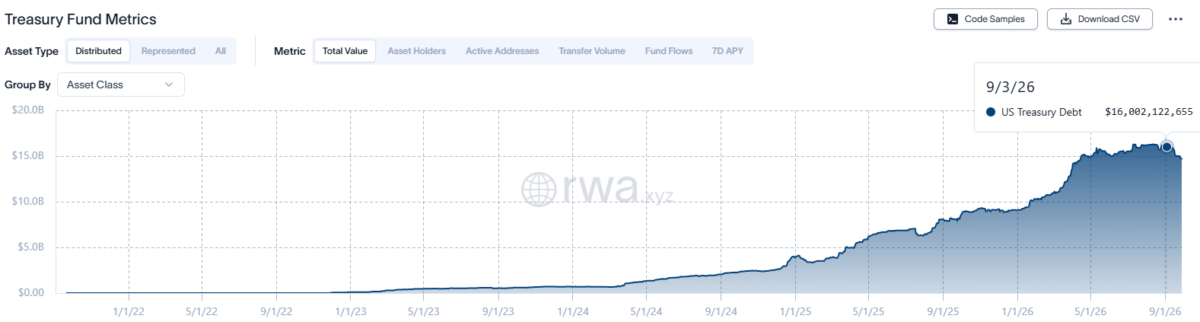
Tokenization is a significant contributor to this growth. The Real-World Asset (RWA) sector has surpassed $38 billion in on-chain assets, with millions participating in tokenized markets. This surge is largely propelled by tokenized Treasuries, among other assets.
The chart below indicates that U.S. tokenized Treasury funds are set to conclude Q3 with a record total of $16 billion in assets. This consistent increase highlights a growing demand for tokenized yield products.
As interest in U.S. Treasuries climbs, it could forge a stronger liquidity connection between traditional finance (TradFi) and cryptocurrency.
However, Ahuja cautioned that this trend should be considered separately from Bitcoin’s short-term price fluctuations.
I’m keeping an eye on institutional tokenization because it follows a different timeline than daily crypto prices.
Furthermore,
Bitcoin can decline even as the infrastructure supporting digital assets progresses, and investors need to differentiate between these two scenarios.
Ultimately, the market does not interpret rising tokenized Treasury yields and increased TradFi investments in DeFi as a positive signal for Bitcoin.
This is largely because the available liquidity isn’t substantial enough to counteract the growing speculative interests, leaving the liquidity challenge surrounding Bitcoin [$BTC] unchanged.
Could Bitcoin mirror its post-midterm downturn?
Considering the factors discussed above and historical patterns, a crash in mid-Q4 cannot be overlooked.
Bitcoin seems to be entering a classic accumulation phase, with short-term holders slowly transferring their assets to long-term holders. However, historical context presents a risk. With the U.S. midterm elections looming one month away, Bitcoin’s performance after past midterms cannot be ignored.
After the elections in 2010, 2014, 2018, and 2022, Bitcoin experienced declines of 72%, 65%, 52%, and 27%, respectively. This raises the question: could $BTC repeat this trend? The current situation keeps the risk factor very much in play.
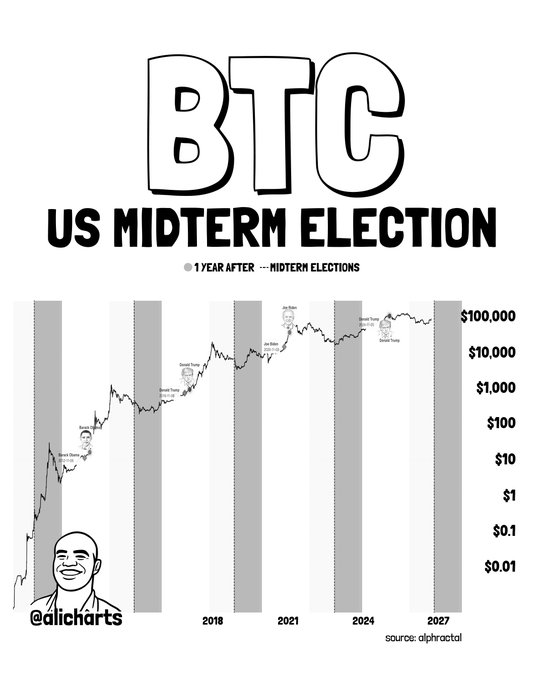
The logic is compelling: the supply of Bitcoin is consolidating among larger holders, new investors are remaining on the sidelines, macroeconomic fears are intensifying, and liquidity remains restricted.
Given these historical trends, a sell-off by these substantial holders could trigger a more severe downturn.
Without a significant influx of liquidity, there may not be enough demand from spot purchases to absorb the selling pressure, putting $BTC at risk of a sharp decline.
Therefore, with the midterms approaching, a retest of the $73k mark is possible if a liquidity unwind leads to cascading effects across the futures and options markets.
Conclusion
- Whale accumulation supports the potential rise to $90k, but insufficient demand and tight liquidity pose risks.
- As the midterms draw near, a liquidity crunch could push Bitcoin down toward $73k.