

A recent study reveals that the burgeoning Bitcoin (BTC) mining sector has already generated over 31,000 jobs across the United States. This includes positions directly involved in mining operations and those in supporting industries.
The report, compiled by the Perryman Group and released by the Texas Blockchain Council and The Digital Chamber, two blockchain advocacy groups, highlights that a dozen states are responsible for the majority of Bitcoin mining activity nationwide.
Leading the way in job creation is Texas, with more than 12,200 positions stemming directly from Bitcoin mining and associated support industries.
The study further indicates that Bitcoin mining contributes upwards of $4.1 billion to the nation’s gross domestic product annually. It also plays a crucial role in stabilizing local power grids by providing load-balancing capabilities.
The significance of mining infrastructure has increased following pronouncements from former US President Trump emphasizing the importance of the United States leading the Bitcoin mining industry and developing electrical infrastructure to support both mining and AI data centers to ensure global competitiveness.
Related: US mining companies face supply constraints due to Bitmain delivery delays
Annual economic advantages derived from Bitcoin mining. Source: Texas Blockchain Council
Bitcoin Mining and High-Performance Computing Gain National Prominence
During the 2024 US presidential campaign, Donald Trump frequently voiced his ambition to position the United States as the “world’s leading cryptocurrency hub” and to achieve dominance in the artificial intelligence sector, citing it as a critical national security imperative.
These high-performance computing applications necessitate considerable energy consumption and infrastructure development, which President Trump deemed a national priority. Trump elaborated:
“We plan to construct power plants directly at these sites. We will streamline regulatory processes, minimizing unnecessary burdens, and will leverage fossil fuels for electricity generation, as this is essential. We will also explore the use of nuclear energy.”
According to Trump’s vision, achieving supremacy in both Bitcoin mining and AI requires at least doubling the current energy output of the United States.
These significant energy demands have prompted technology and mining companies to investigate alternative renewable energy sources, including nuclear power.
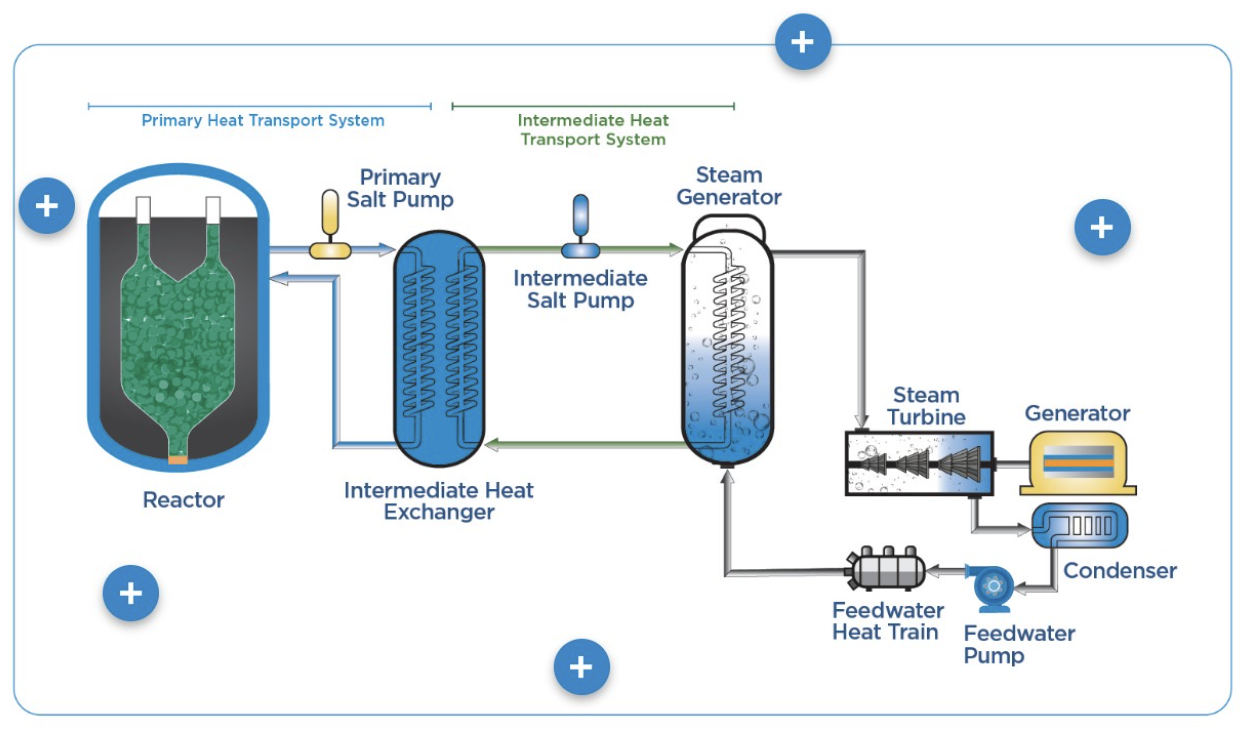
Diagram illustrating energy flow within a small-scale nuclear reactor. Source: Kairos Power
In October, Google entered into an agreement with Kairos Power, a nuclear power engineering firm, to develop a compact nuclear reactor to power its AI operations. The project is anticipated to be operational by 2030.
Small-scale nuclear reactors represent an innovative technology allowing for on-site construction and integration within facilities. These reactors are designed to be sufficiently compact, even fitting within an 18-wheel truck.