
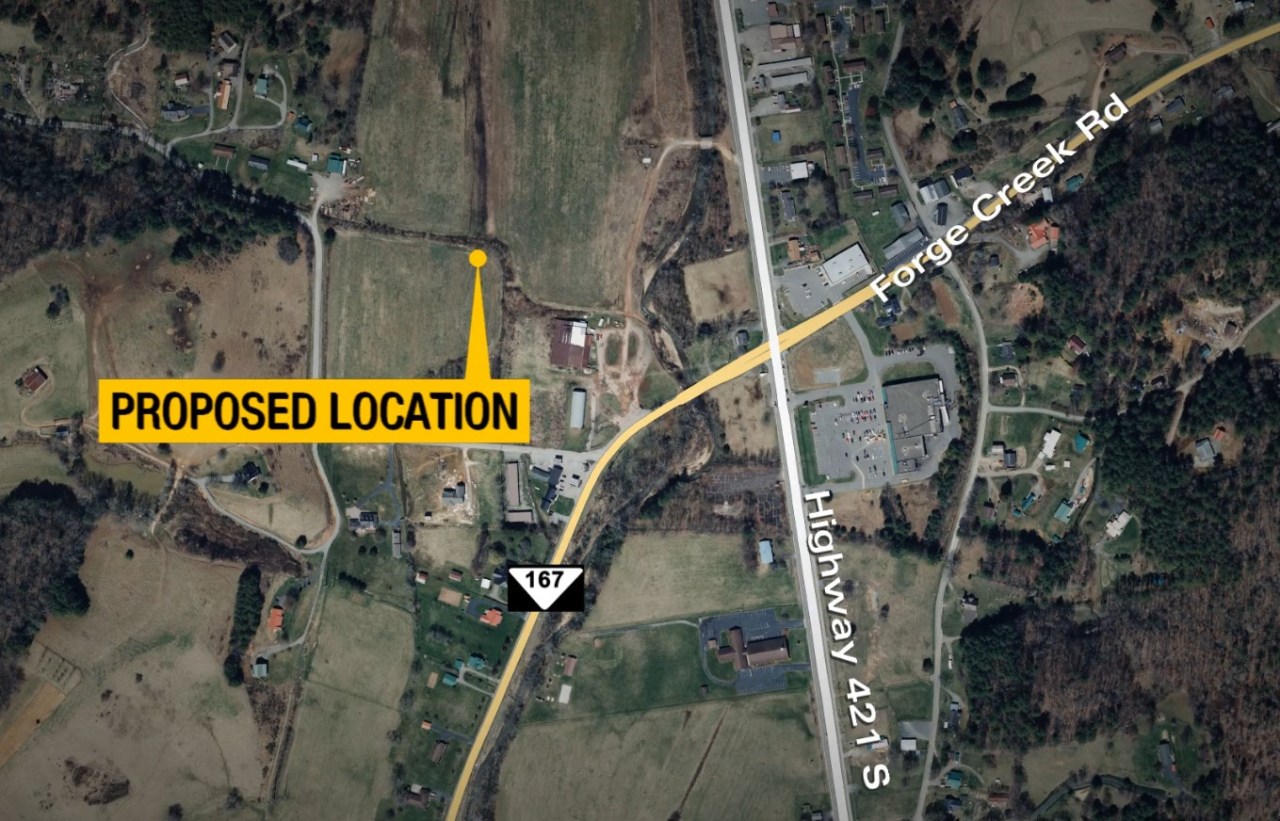
MOUNTAIN CITY, TN (WJHL) — A prominent player in the Bitcoin mining industry is eyeing Mountain City as the location for a new 30-megawatt facility. If all goes according to plan, the operation could be up and running in as little as six months, but no more than a year, following the necessary approvals.
CleanSpark, a company headquartered in Nevada, plans to establish its facility on a 50-acre plot situated at the intersection of Highway 421 and Rainbow Road. This location is conveniently near Johnson County Community Hospital. Rodney Metcalf, CEO of Mountain Electric Cooperative, shared this information with News Channel 11 on Tuesday. According to Metcalf, the financial gains from this venture would more than compensate for the reduced electricity consumption and associated revenue resulting from the anticipated closure of the Parkdale Mills plant in late 2024, which is also located in the vicinity of the proposed mining site.
Metcalf emphasized the potential benefits of the proposal, stating that the substantial power demand from CleanSpark could contribute to maintaining affordable electricity rates for other users. He further noted that the power agreement will prioritize providing electricity to residential customers and other essential services during periods of peak demand.
Harry Sudock, Senior Vice President at CleanSpark, confirmed to News Channel 11 via email that the company is in the final stages of preparing the site plans and grading designs for the project. These plans will be submitted to Mountain City’s planning department and commission for their final review and approval.
“The utility company and the Commissioners have proven to be exceptional partners, and we firmly believe that a CleanSpark data center will be a valuable asset to Mountain City,” Sudock stated.
CleanSpark holds a significant position among Bitcoin mining companies in the United States, often ranked as the second, third, or fourth largest. Its primary operational sites are located in Wyoming, Tennessee, and Georgia.
During the Mountain City Council meeting on March 4th, Mayor Jerry Jordan highlighted that the CleanSpark project represents a substantial investment ranging from $40 to $50 million, which is expected to generate “significant property tax” revenue for the city if it comes to fruition.
Bitcoin “mines” are essentially vast arrays of powerful computers that tackle intricate mathematical problems. In return, they are rewarded with newly “mined” Bitcoin or receive transaction fees for validating Bitcoin transactions. Similar to other data centers that utilize computers for artificial intelligence or other computationally intensive tasks, Bitcoin mines consume considerable amounts of electricity and can sometimes produce substantial noise due to the cooling fans necessary to regulate the temperature of the computer hardware.
Sudock assured that the cooling technology employed at the Mountain City facility, which is located near residential and commercial areas, is designed to minimize noise pollution.
“We are recognized within the industry for our innovation in immersion cooling techniques,” he explained. “Certain implementations of this technology offer substantial noise reduction advantages, and these are the types of designs we plan to implement in Mountain City.”
Metcalf, drawing on his experience with BrightRidge when the utility company faced community opposition to the region’s first Bitcoin mine in Limestone, largely due to noise concerns, stated that Mountain Electric’s leadership meticulously examined the CleanSpark proposal specifically with noise mitigation in mind. CleanSpark acquired the company formerly responsible for the Limestone facility, which is obligated to cease operations or relocate by the spring of 2026 as part of a settlement agreement resulting from a lawsuit.
Regarding the plans for Mountain City, Metcalf clarified that “the only air conditioning units visible on the exterior will be similar to those used for a standard commercial building, serving solely to regulate the temperature for the staff working inside.”
“You’ll be able to hold a conversation at a normal volume inside the building while the computers are running,” Metcalf assured.
Existing Substation Offers Ample Capacity
Metcalf revealed that the closure of Parkdale Mills represented a significant loss, as they were one of Mountain Electric’s top two energy consumers. Parkdale Mills consumed up to 22 megawatts, but its usage was less consistent compared to CleanSpark, which is expected to operate its equipment continuously. The nearest electrical substation is situated less than a mile away from the Rainbow Road property.
“If we cannot replace that lost megawatt consumption, we need to find a way to recover the associated revenue,” he explained.
Any potential rate increases would be distributed among the Co-Op’s 36,600 customers, spread across 700 square miles of mountainous terrain in Tennessee and North Carolina. While CleanSpark’s per-kilowatt rate may be lower than Parkdale Mills’ was, Metcalf projects that the steady 30-megawatt demand from CleanSpark could generate roughly double the revenue that the Co-Op earned from Parkdale Mills, after accounting for Mountain Electric’s payments to TVA for power supply.
These rates are determined by TVA’s “Power Flex” program, according to Sudock. This program prioritizes meeting the electricity needs of other customers during periods of peak demand driven by extreme weather conditions.
“The Power Flex program aligns our energy consumption between our mining operations, the requirements of TVA’s system, and the energy needs of Mountain City,” Sudock explained.
“Mountain City will greatly benefit from the revenue generated through our power purchases, while also potentially enhancing the overall reliability of the power grid,” he added. “We have established demand response programs throughout our portfolio and have a proven history of supporting the communities in which we operate.”
Final approval from local authorities could be granted as early as next month.