
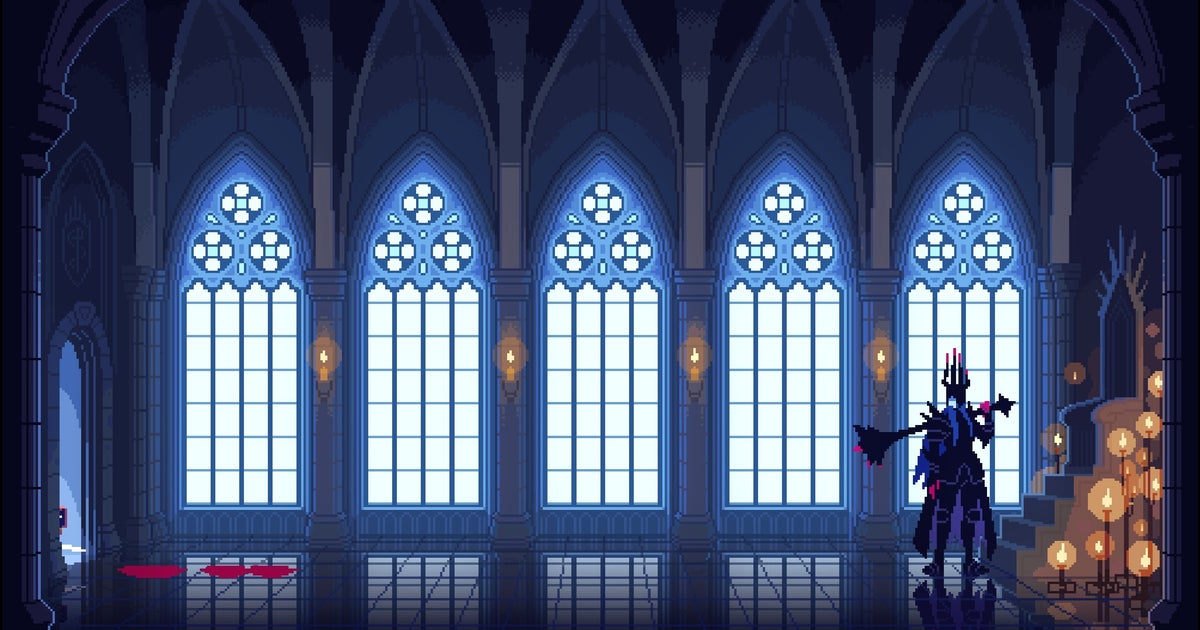
Around ten minutes into The Dark Queen of Mortholme, there’s a beautifully silent scene. You, as the Dark Queen, have just dispatched the persistent hero for what feels like the hundredth time. With the same casual disregard as brushing crumbs off a table, you vaporize their body in a burst of purple energy.
Each time, the hero confidently returns through the doorway, ready for another beating, just as the Queen is about to relax back onto her throne. This is the game’s core idea: a playful nod to, and twist on, Soulslike games. It also begs the question: how frustrating must it be to be on the receiving end of such unrelenting optimism? They preach “persistence against all odds,” but from the Queen’s perspective, they’re practically immortal.
We start to empathize with the Queen’s growing irritation. We consider the burden that her fearsome reputation places on her as an individual. (Like Rapunzel says, every time I want to unwind, some idiot tries climbing up my hair). But this time, something feels different. The hero is delayed, and there’s a subtle hint of yearning in the Queen’s gaze towards the entrance. Is she actually beginning to… *enjoy* these encounters? The scene encapsulates a simple truth, and a stark tragedy: absolute power, once the initial excitement fades, can lead to stifling stagnation. When you eat the same soup every day for decades, you might develop a strange fondness for the fly that comes along for swimming lessons.
Initially, the hero just stands there, easily defeated by a bored swipe of the Queen’s mace. They quickly realize that movement is essential. Soon, they have new skills: a gap-closing charge and a potent magical fire attack, telegraphed with the fairness one expects from such powerful moves.
Naturally, the hero learns how to counter each of the Queen’s attacks. Later, an achievement called “out of tricks?” pops up when you’ve used all of the Queen’s abilities. This is a trophy that feels like an admission of defeat, a brilliant example of using in-game rewards to enhance the storytelling; a feature I wish was more prevalent. These hints of stagnation are juxtaposed with moments of potential growth. Dialogue choices offer opportunities for curiosity or dismissal. We soon discover that the Queen is surprisingly unfamiliar with her own castle. If she had explored, she might have hidden the treasure chests better.
But she hasn’t, and so the hero returns with chainmail, then a shortbow, then a gleaming sword. For the first time, they deplete one of the Queen’s four health segments. It dawns on me that the hero is destined to triumph. Bloodstains accumulate on the floor, but the Queen’s tactics remain unchanged. Never challenged, the Queen had no reason to seek out growth. Now, confronting an opponent who could push her to evolve, she’s likely doomed. How typical: a true catalyst for change appears precisely when it’s too late to act.
A memorable boss fight requires a fitting theme, and here, it’s all dramatic organ music, grand and nightmarish. Buried within the track is a child’s melodica; its plastic, honking sound is jarringly distracting. I’ve decided that represents the hero. It makes me think more deeply about boss themes in general: are they meant to celebrate the boss’s power and spectacle, or the hero’s struggle? The best themes, I believe, do both and neither. They are odes not to individuals, but to the moment itself. The duel.
Despite the annoying melodica, I have two main issues with The Dark Queen Of Mortholme, a worthwhile game that wastes no time delivering its inevitable setup and crescendo. The first is a line spoken by the Queen about halfway through, something along the lines of “against the strength of the system, your actions are pointless.” This tells you the point outright! Less subtle than a punch in the face, honestly.
The second isn’t actually in the game itself, but rather on its Steam page: “Experience a (macabre, short-form), second-person indie.” This immediately positions the Queen as a mere camera lens, a supporting character. These two criticisms share a common thread: they both insist on dictating how the player should feel about a story that’s concise enough to allow for plenty of personal interpretation within a lunch break.
But, fine, I can accept it. It’s not my story to tell. Perhaps this is an unpopular opinion, but an artist owns their work; I’m simply a visitor. I can’t criticize these nudges too harshly, despite how clunky they are. However, I feel compelled to offer my own interpretation through a deeply self-indulgent anecdote. And yes, interesting games always inspire self-indulgent anecdotes.
A writer I greatly respect, both professionally and personally, once told me over a plate of cold fried calamari on a pleasant Los Angeles evening (an evening I soon ruined with my desperate and self-centered need to get embarrassingly drunk, even in casual social settings – thereby embodying the cliche of how an LA evening unfolds), that they had lost faith in the ability of stories to create meaningful change. I responded with a pop-science factoid that I’m fond of: the phenomenon of perceptual filling-in. Reality is often chaotic and blurred. It’s messy, and we require the artifice of beginnings, middles, and ends to make sense of it all: motivations and obstacles, and reasons for engaging with the chaos in the first place.
Stories cannot lose their power because they are the fuel that drives us. I can’t remember what they said next, because I was too busy waiting for their approval to appreciate what I believed was an insightful thought. I’m convinced that if I’d just listened, I’d have a more nuanced understanding of the situation. Perhaps they would have shattered my belief completely, but I still maintain that stories are all we have, and compelling stories from different perspectives are the only things powerful enough to alter the stories we’re assigned.
At least, that’s the story I tell myself. The story that The Dark Queen Of Mortholme presents is one where the hero still gets all the best moments. In this sense, it’s quite conventional, despite its unique presentation. The Queen’s real tragedy, as with so many characters who threaten to defy convention, is that she remains trapped within a narrative. And whether by intention or necessity, it remains someone else’s story.
“Perhaps it would be an act of kindness,” the Queen muses about the possibility of the hero’s defeat and surrender, “to be freed from the burden of trying?” The hero replies, “No thanks!” (So cliche!)
Sounds good, doesn’t it? And I honestly love it. It ignited a desire to fight within me. Yet, if anything could prove that there are no truly original stories, it’s a game that markets itself as subversive, only to arrive at the same destination as everything else.