
A significant portion of the world is embracing standardized cryptocurrency regulations, with 73% of relevant nations having enacted legislation to enforce the Financial Action Task Force’s (FATF) Travel Rule.
This rule, mirroring practices in traditional finance, requires digital asset service providers to gather and exchange user transaction details. On June 26th, the FATF published its yearly assessment. This report highlights the growing convergence between national regulatory actions and the FATF’s overarching global framework for combating money laundering (AML).
This development is a direct consequence of the FATF’s sustained efforts over the years to integrate cryptocurrencies into existing AML and Counter-Terrorist Financing (CFT) compliance structures.
For the second year running, the FATF singled out stablecoins and decentralized finance (DeFi) as areas of concern, emphasizing their increasing involvement in illegal financial activities, including those perpetrated by North Korean entities. The organization intends to release in-depth studies on stablecoins, offshore crypto platforms, and DeFi by next summer, offering clues about future global crypto regulatory directions.
The FATF’s Central Role in Shaping Crypto Regulation
In 2019, the FATF broadened its Travel Rule scope to encompass cryptocurrencies and exchanges, incorporating it into its broader AML/CFT guidelines. This expansion was included as an interpretive note to Recommendation 15 (R.15), one of the FATF’s core 40 recommendations.
As of 2025, only one of 138 assessed jurisdictions demonstrates complete compliance with R.15. However, 40 jurisdictions are now considered “largely compliant,” an increase from 32 in 2024. Additionally, three jurisdictions have moved out of the non-compliant category.
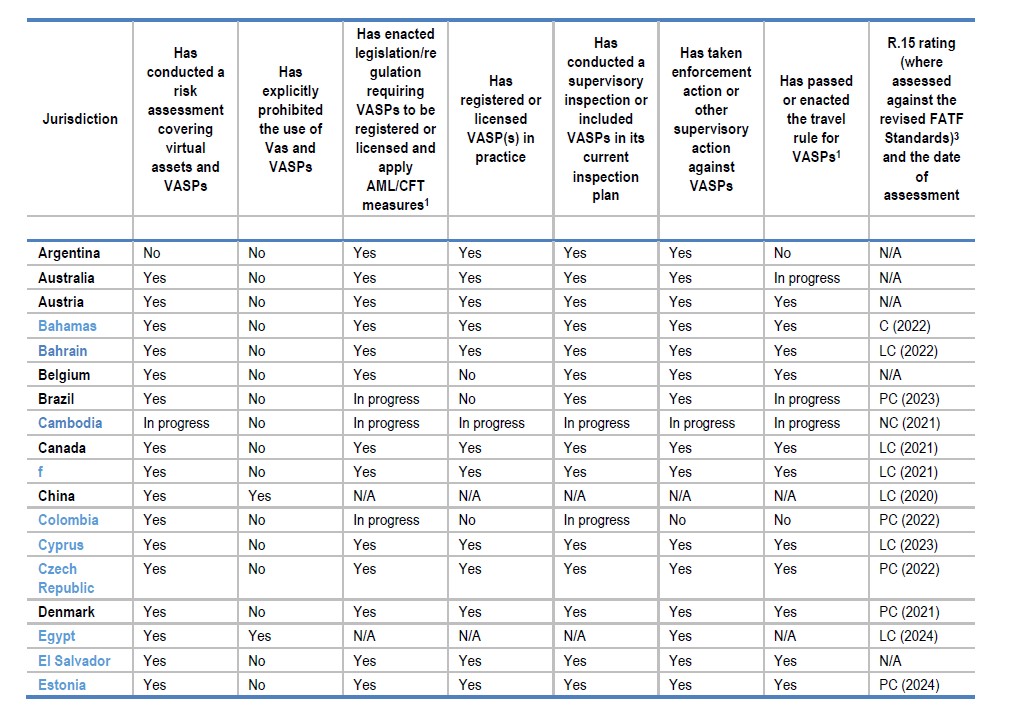
Compliance signifies that a jurisdiction has implemented laws that mandate the licensing or registration of virtual asset service providers (VASPs), such as crypto exchanges and trading platforms, or has legally recognized entities conducting VASP activities. According to Joshua Chu, co-chair of the Hong Kong Web3 Association, licensing requirements across various jurisdictions exhibit “very similar” features, especially in regions competing to establish themselves as “crypto hubs,” including Singapore, Dubai, and Hong Kong.
The Monetary Authority of Singapore (MAS), the nation’s central bank, recently cautioned crypto exchanges that engage in regulatory arbitrage by sidestepping local licensing requirements and relying solely on overseas customers. These exchanges were instructed to either secure a license or cease operations by the end of June.
Related: Will crypto firms ousted from Singapore find refuge elsewhere?
This action has fueled debate regarding Singapore’s true ambitions in the digital asset space. Some industry observers suggest that Hong Kong could be the primary beneficiary of its regional competitor’s crackdown on unlicensed exchanges.
Chu cautioned that those seeking more favorable conditions in rival crypto hubs may be disappointed, as all are bound by the same FATF regulations. In fact, Singapore has granted a larger number of crypto licenses compared to Hong Kong.
“Regulators operate under deadlines. They often release timely announcements (likely informed by the FATF’s draft report) to strategically improve their standing before the formal report’s publication,” Chu explained.
“Consequently, numerous jurisdictions have intensified their efforts to strengthen oversight, refine risk assessments, and enforce the FATF Travel Rule. The FATF’s June 2025 report underscores this urgency, revealing that despite advancements, significant gaps remain in risk assessment, licensing, and enforcement.”
Hong Kong is also rapidly implementing new crypto regulations. In May, the Legislative Council approved its upcoming Stablecoin Ordinance. The city then issued an updated policy statement concurrently with the FATF’s report.
The FATF reported that an increasing number of nations have formalized their approach to regulating crypto sectors, with 82% of 163 respondents indicating they have chosen a regulatory direction. Jurisdictions typically pursue one of two primary paths: authorization or prohibition, with prohibitions ranging from partial to complete bans.
Prohibition is gaining traction among members of the Middle East and North Africa Financial Action Task Force and the Eastern and Southern Africa Anti-Money Laundering Group. However, the FATF cautions that jurisdictions should consider this approach carefully, as comprehensive bans can be resource-intensive and difficult to maintain.
“When jurisdictions opt for prohibition over regulation, they do not eradicate crypto activity within their boundaries. Instead, they relinquish oversight, enforcement capabilities, and the ability to monitor illicit financial flows,” Hedi Navazan, chief compliance officer of 1inch Labs and vice chair of the Digital Asset Task Force of the Global Coalition to Fight Financial Crime, stated.
“Let’s face it, crypto transcends borders,” she added.
China, an FATF member, has implemented partial restrictions on cryptocurrency-related activities, such as transactions and mining. Yet, the decentralized nature of blockchain technology ensures that cryptocurrencies remain broadly accessible to the public. Despite Beijing’s ban on Bitcoin (BTC) mining, Chinese mining pools still control the majority of the network’s hashrate.
FATF Focuses on Stablecoins and DeFi
For the second consecutive year, the FATF’s report allocated dedicated sections to stablecoins and DeFi in its latest update.
Stablecoins have been a prominent topic in the crypto space in 2025, with key jurisdictions advancing legislative proposals for stablecoin licensing, including the GENIUS Act in the United States, which paves the way for technology firms to launch private stablecoins. The European Union has furthered its efforts with the Markets in Crypto-Assets (MiCA) Regulation, establishing rules for stablecoin issuers.
Related: Senate Advances GENIUS Stablecoin Bill Amid Systemic Risk Concerns
However, stablecoins are increasingly associated with illicit activities, including their use by North Korean actors suspected of financing the nation’s weapons programs. Industry estimates suggest that 63% of illicit transaction volumes were denominated in stablecoins.
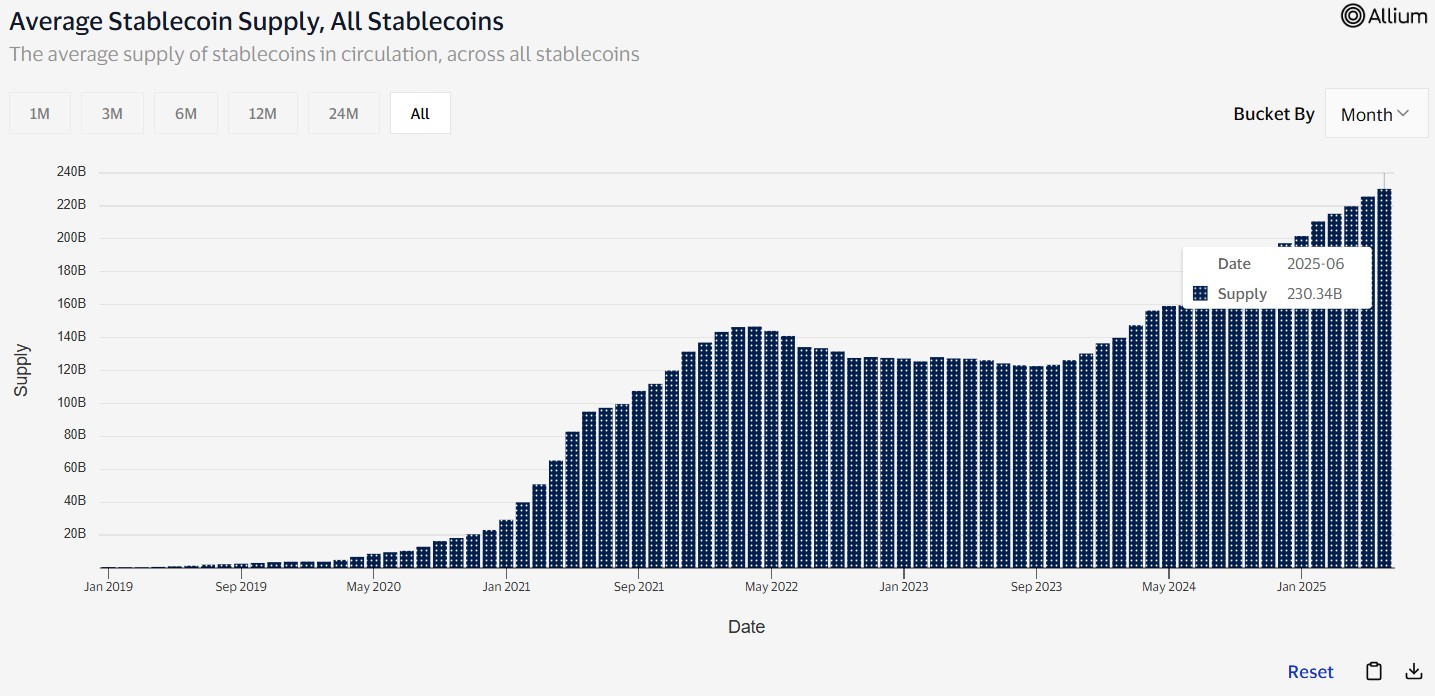
“Stablecoins, particularly USDT on the Tron network, have become the preferred tool for illicit actors. From North Korean hackers to scam networks, this is no longer a minor issue,” Navazan noted.
Despite increasing regulatory scrutiny, many jurisdictions struggle to apply FATF standards to DeFi. The FATF’s 2025 report indicates that nearly half of the jurisdictions that have implemented or are developing the Travel Rule believe that some DeFi platforms should be licensed as VASPs, but most have yet to identify any such entities.
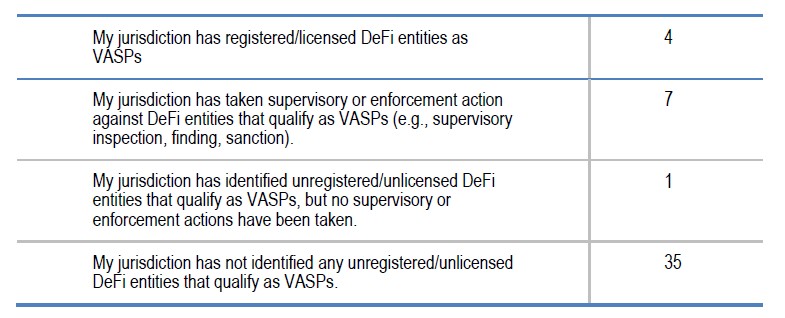
Out of 47 jurisdictions that assert DeFi can be subject to VASP regulation, 75% have yet to identify or license a single DeFi platform.
Ignoring FATF Standards Can Lead to Economic Isolation
The FATF’s influence is deeply ingrained within the United Nations framework, with multiple UN Security Council resolutions encouraging member states to adopt FATF standards.
“This implies that jurisdictions have powerful incentives to align their regulations with FATF’s evolving standards, driven not only by goodwill but also by the desire to avoid significant repercussions,” Chu explained.
Gray listing serves as a potent enforcement tool for the FATF, subjecting a jurisdiction to heightened monitoring and resulting in economic and reputational consequences. Dubai, an emerging crypto hub, was previously on the gray list before the United Arab Emirates was removed in 2024.
“While the FATF does not legislate, disregarding its guidance would be unwise. Regulators worldwide heed the FATF’s pronouncements. This has consistently been the case,” Navazan stated.
“Nations that fail to comply with these standards risk not just a low rating, but also economic isolation.”
The FATF’s statements, including its annual crypto updates, offer insights into the trajectory of global regulations. With stablecoins and DeFi identified as key areas of concern in 2025, the FATF’s planned research into these sectors is poised to shape the next wave of compliance requirements.
Magazine: The Secrets Behind the Success of Crypto Founders Under 25