

A central principle in on-chain analytics for deciphering market dynamics hinges on “time-based recording” and “price-linked recording”. The transparent nature of blockchain records every on-chain transaction, revealing two essential elements:
- The time the cryptocurrency moved – the timestamp.
- The price at which the transaction was executed – the pricestamp.
This straightforward yet effective concept allows calculating the realized acquisition cost—the initial investment in those digital assets at the time they were transferred.
Over time, we can observe the potential gains or losses on those cryptocurrencies based on variations in the market price. Alternately, should those same assets move again, we can determine their actualized gain or loss based on the variance between their initial price and the price at which they are now changing hands.
Throughout the evolution of on-chain analysis, numerous metrics have emerged that quantify the average acquisition cost of investors, along with their potential and actual profitability. These measures offer valuable viewpoints into market actions and investor attitudes. Key examples include:
- Realized Market Value & Realized Valuation: These metrics assess the worth of cryptocurrencies based on their last on-chain activity rather than the current trading value.
- MVRV Ratio: This ratio compares the market value against the realized capitalization, serving as an indicator for profitability and for identifying potentially overbought or oversold market conditions.
- Net Unrealized Profit/Loss (NUPL): This measures the combined unrealized gains or losses held across the entire cryptocurrency market by all participants.
- Spent Output Profit Ratio (SOPR): This indicator reveals whether cryptocurrencies are, on average, being sold for a gain or at a loss.
- Net Realized Gains/Losses: This tracks the aggregate gains and losses investors realize when moving their cryptocurrencies on the blockchain.
Introducing Cost Basis Distribution (CBD)
A more detailed method for examining Bitcoin’s acquisition cost is the Unspent Transaction Output (UTXO) Realized Price Distribution (URPD) metric, previously introduced by the Glassnode team. Instead of simply calculating the average acquisition cost across the entire network, URPD divides the supply into defined price ranges, allowing for understanding of how much supply has gathered at specific price points—essentially charting the network’s cost structure comprehensively.
While URPD offers insightful data for comprehension of the current cost breakdown, it does have a limitation: it does not take time into account. This can complicate attempts to examine the evolution of accumulation zones or how investor acquisition costs change when cryptocurrencies move.
To address this deficiency, the Cost Basis Distribution (CBD) is being introduced. This metric is designed to improve upon and expand the insights offered by URPD. CBD provides two key enhancements:
- Enhanced Visual Representation with Time
- CBD makes use of a heatmap, including fixed price ranges (y-axis) over a selected period, to allow for a clearer visualization of the shifts and trends in acquisition costs as time progresses.
- Address-Specific Method
- CBD calculates data on a per-address basis, unlike URPD, which examines raw UTXOs. This approach offers two major benefits:
- A more precise depiction of acquisition cost, as CBD calculates the average acquisition cost per address, offering a more representative overview of individual network participant behaviors.
- Alignment of the methodology with account-based blockchains, making the metric applicable to a more expansive array of digital assets.
- CBD calculates data on a per-address basis, unlike URPD, which examines raw UTXOs. This approach offers two major benefits:
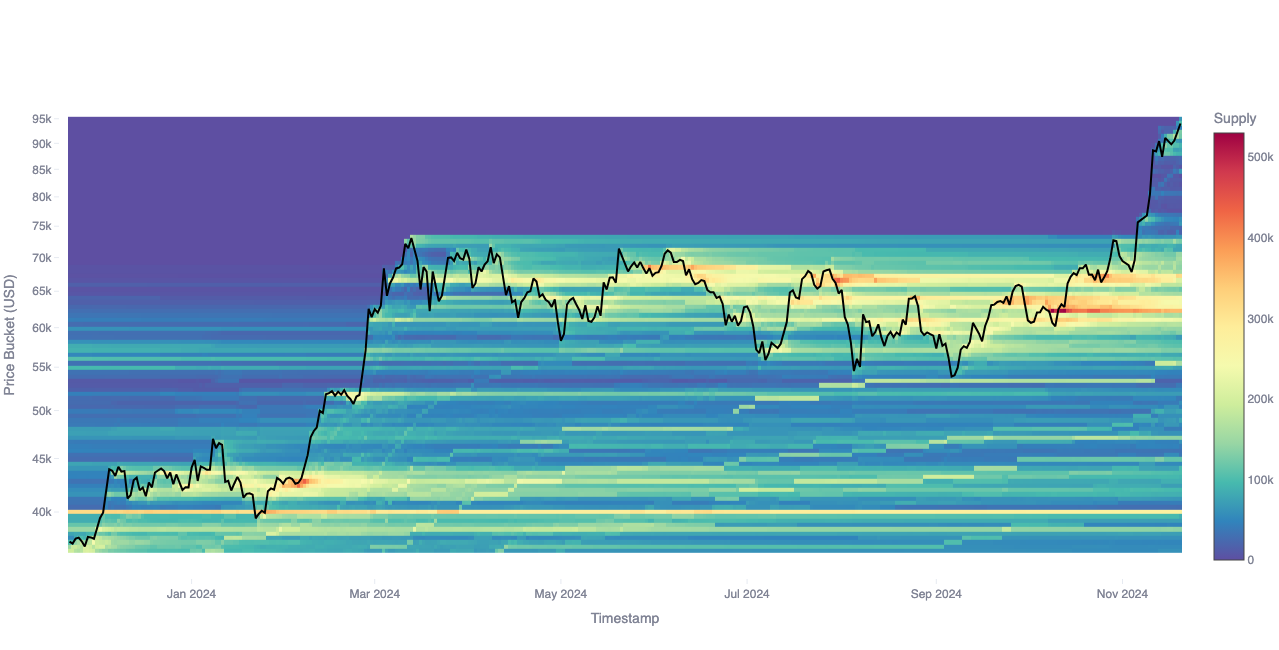
CBD reflects the total Bitcoin supply held by addresses with acquisition costs within specific price bands, represented by color intensity in the heatmap (z-values). CBD emphasizes aggregate acquisition costs, unlike URPD which tracks supply collected at particular price levels. This focus gives a clearer understanding of how investor costs shift as they engage in buying and selling.
Key Insights
The Cost Basis Distribution (CBD) yields significant understanding of Bitcoin’s market behavior by drawing attention to critical acquisition cost levels. Representing critical price levels as an aggregate of individual market participants, these zones offer a straightforward and thorough view of investor behavior.
CBD identifies actual accumulation patterns through on-chain data, making it a robust supporting tool for affirming traditional TA levels. This is in contrast with conventional technical analysis (TA) which uses price and volume alone to infer support and resistance.
By tracking evolving cost basis patterns, CBD enables investors to see how supply migrates throughout various price levels over time. It reveals the functions different price ranges fill as distribution or accumulation zones in various market cycles, delivering crucial insights into market sentiment and risk. For example:
- Accumulation during price drops can reflect the value and conviction perceived by investors.
- Distribution during price surges may signal profit-taking or a decline in confidence.
These observations enable investors to improve their entry and exit strategies by using data founded on real market behavior. CBD’s finely detailed, time-sensitive view of Bitcoin’s acquisition cost gives market participants a robust framework for comprehension of trends, management of risks, and informed decision-making.
Use Cases Utilizing CBD
CBD moves beyond pinpointing the current location of cryptocurrency supply acquisition costs, providing insight into shifts that reflect market sentiment. Supply dynamics indicate the levels at which market participants have either gained or lost confidence.
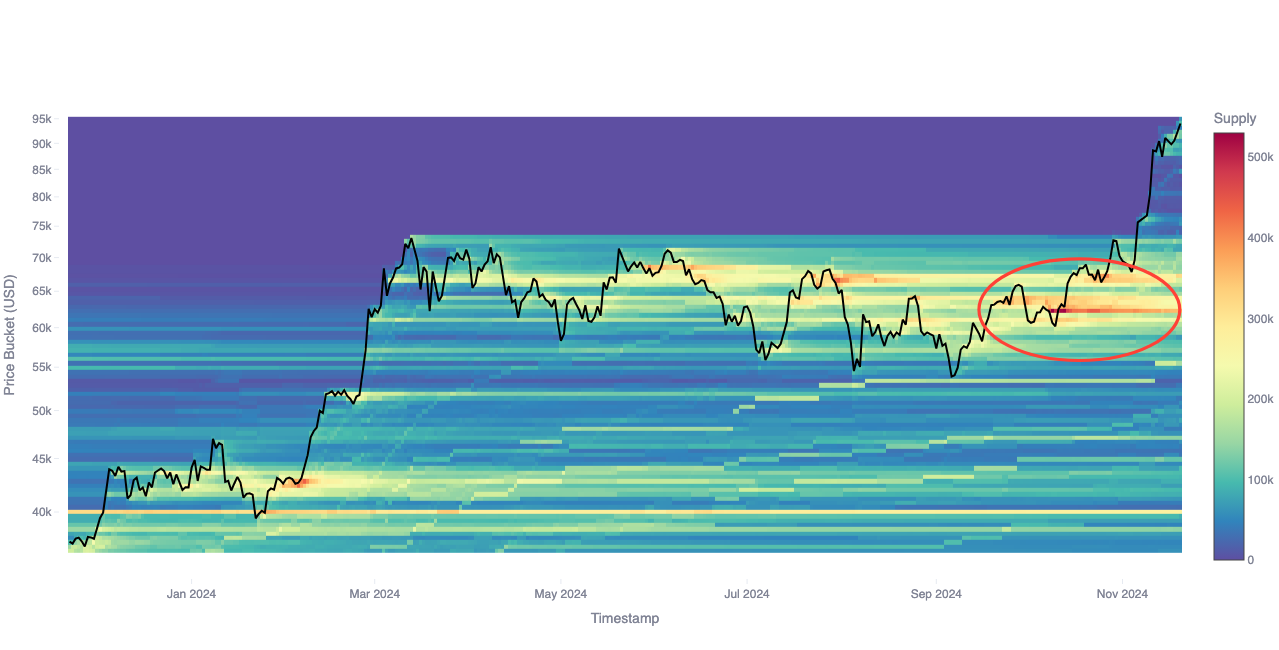
An example is the robust period of accumulation observed in October 2024, just before the market peaked at $70,000, as shown by the red zone in the heatmap. As prices went up, traders redistributed their digital assets, reducing the amount of cryptocurrency supply at this level and shifting the heatmap colors to light orange and yellow.
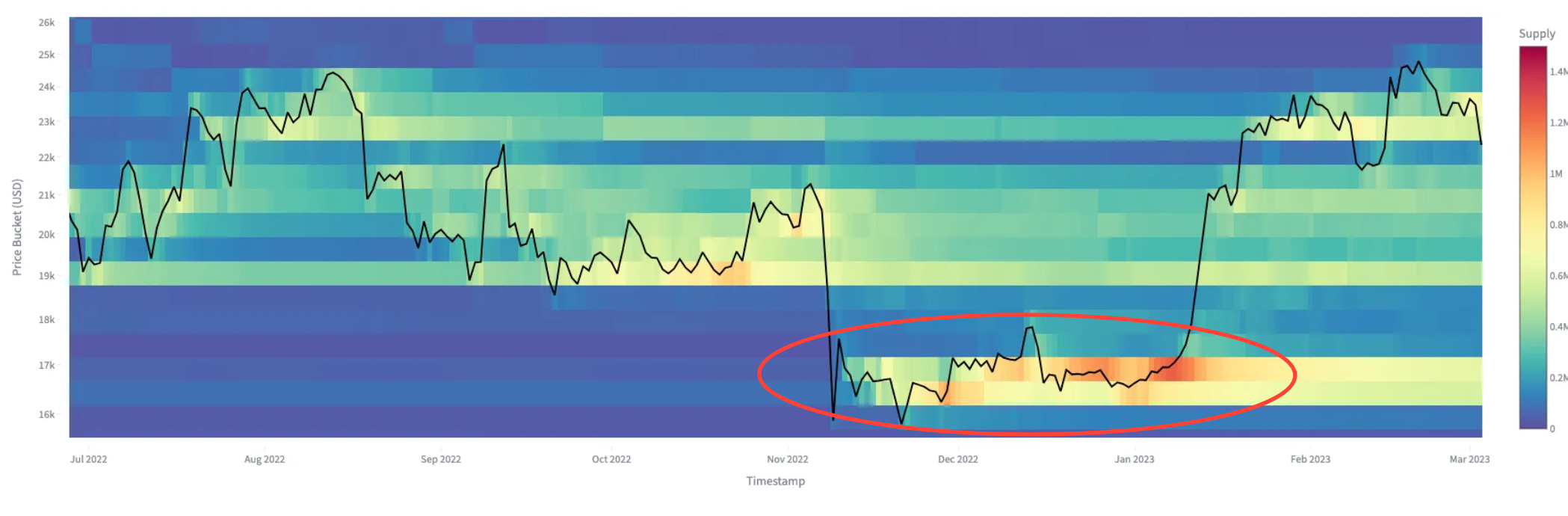
Another example occurred during the FTX collapse in November of 2022. Cryptocurrency supply was consistently accumulating in the $16,000–$17,000 range, providing a resilient floor amidst market instability. This indicates the strong confidence that long-term investors felt at that price level.
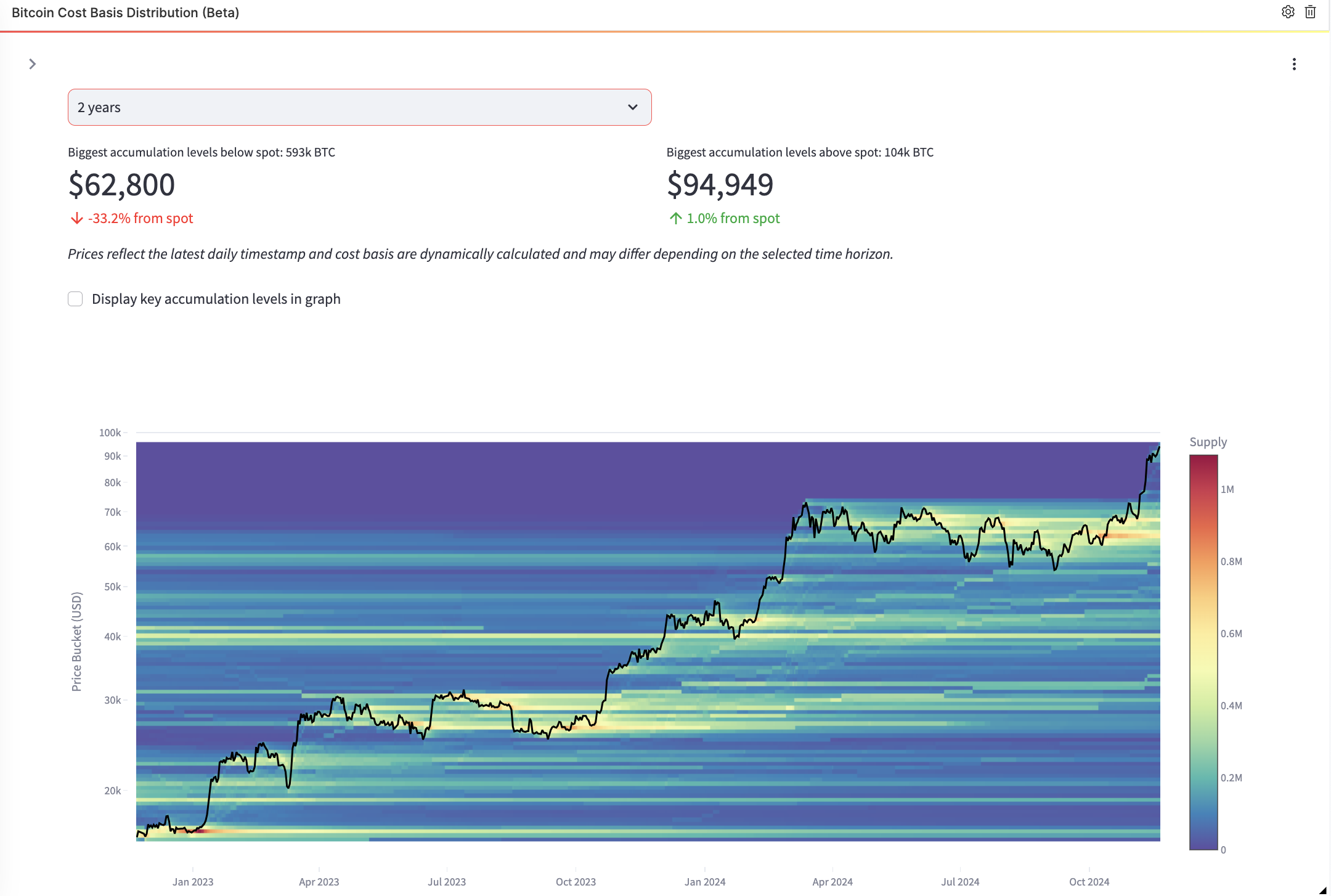
CBD is available now, together with other derived metrics, on Glassnode Studio.
Other Metrics Derived From CBD
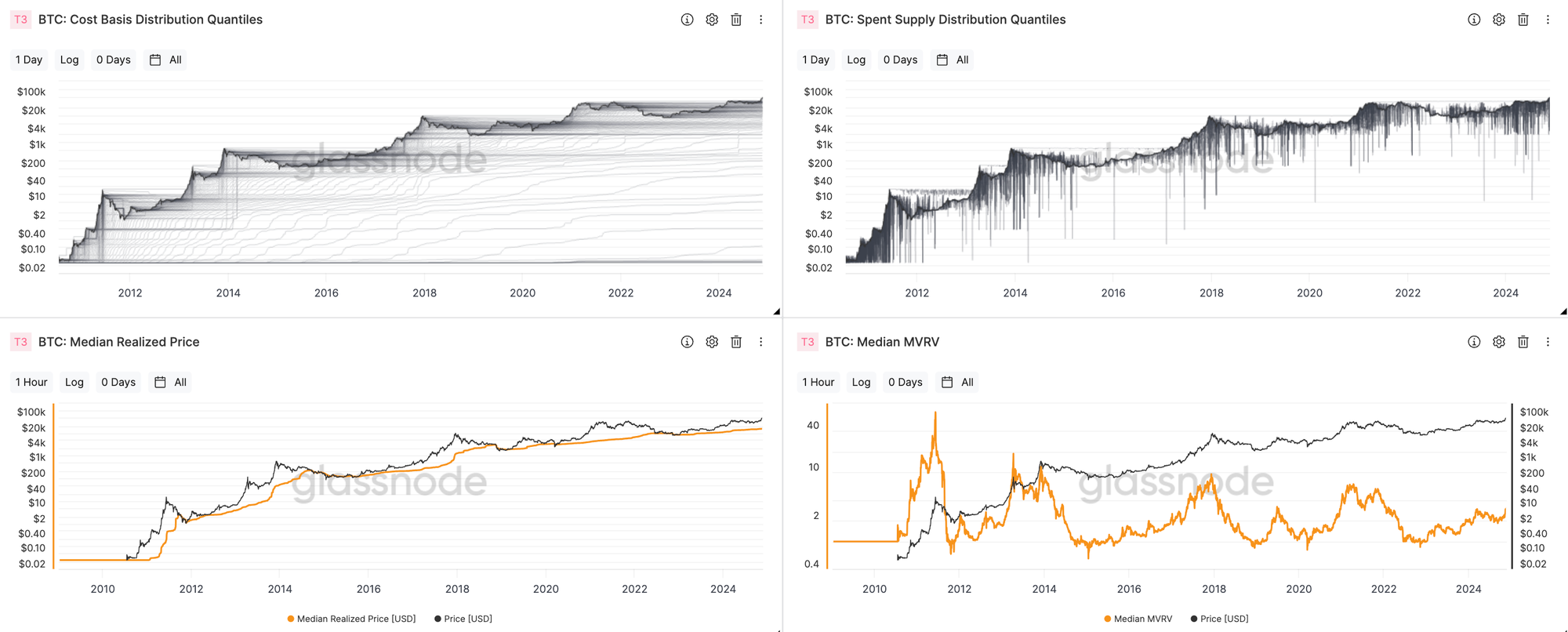
Several derived metrics have been developed based on the versatile CBD framework, allowing for more in-depth analysis of supply dynamics. These progressive metrics build upon CBD’s initial observations, while incorporating novel dimensions of comprehension:
- Spent Supply Distribution Quantiles: By dividing the acquisition cost of digital assets being spent into 100 quantiles, this metric captures granular selling activity. Significant spikes in this distribution are suggestive of participants across various price levels exiting their positions. This behavior often corresponds to the development of important resistance levels or temporary price ceilings, reflecting adjustments in market dynamics.
- Cost Basis Distribution Quantiles: Based on realized prices, this metric divides the supply distribution into 100 quantiles (percentiles). Dense clusters of quantile lines highlight noteworthy price levels.
- Median Realized Price & MVRV: By comparing the current market price against the median realized price, Median MVRV offers views of Bitcoin’s aggregate valuation compared to a more central acquisition cost. High values suggest the market price has surpassed the typical acquisition cost, hinting at possible overvaluation. Low values may indicate that prices are undervalued. As opposed to the mean realized price which may be skewed by outliers, the Median Realized Price is the price at which half of the current supply was last moved. This provides a balanced depiction of acquisition costs from across the entire supply.
Future Enhancements
CBD metrics will be extended to include all supported assets. Additionally, API endpoints will be introduced for heatmap data, simplifying integration into risk management and trading systems. CBD constitutes a major advancement in on-chain analysis, combining the effectiveness of traditional technical analysis with insights offered by on-chain data. Whether you’re assessing market strength or pinpointing entry and exit points, CBD and its related measurements give a powerful, data-driven view into supply dynamics.