
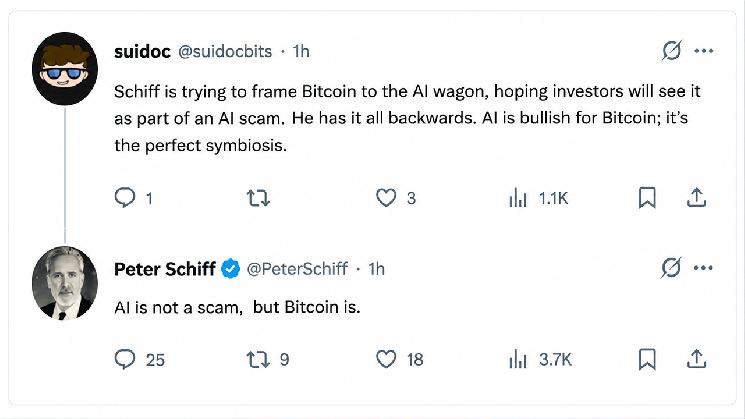
A well-known advocate for gold and a long-time critic of $BTC expressed his views on Sunday. He claimed that supporters of Bitcoin are trying to associate the cryptocurrency with the rapidly growing AI investment sector, despite the possibility that these technologies could actually compete against one another.
“Backers of Bitcoin are attempting to link it with the success of AI, anticipating that investors will see it as part of the AI boom. They have it all wrong. AI does not promote Bitcoin; it actually poses a risk to it,” Schiff posted on the X platform.
“AI stands in competition with Bitcoin for speculative funds, electricity, and resources. Bitcoin miners are already feeling this impact. Some mining companies have started to adapt parts of their operations to cater to AI and high-performance computing (HPC), as these sectors can provide alternative revenue streams.
Nonetheless, this shift does not necessarily endanger the Bitcoin network itself but creates competition for Bitcoin mining firms that must weigh the benefits of using available power for mining versus AI-related computations.
Bitcoin was engineered to adjust to changes in mining participation. Approximately every 2,016 blocks, the network recalibrates its mining difficulty to maintain a block generation pace of around ten minutes. If significant computing resources depart from Bitcoin, the remaining miners will find that their operations become easier over time.
Supporters of $BTC and critics of Schiff quickly engaged in this discussion, with one user responding, “AI poses a greater risk to gold than to Bitcoin, Peter.” Schiff, seemingly skeptical, replied, “In what way?” The user then proceeded to outline their perspective:
“You could ask AI yourself … But here’s the breakdown … 1. AI can discover vast new gold seams. 2. Robotics make mining significantly cheaper. 3. AI accesses low-grade or deep-sea gold. 4. Advanced technology enhances gold recycling. 5. Future asteroid mining could increase supply dramatically. 6. More supply + reduced scarcity → lower gold prices.”
AI Security Concerns Escalate
Schiff’s secondary argument elaborates on the issue, suggesting that advancing AI could identify weaknesses in Bitcoin’s code, cryptography, wallets, or network that human developers might have missed. Software vulnerabilities are real, and Bitcoin is not inherently immune to programming errors. Wallets, exchanges, and Bitcoin software can have flaws, which is why ongoing reviews and testing by developers are crucial.
However, discovering a flaw does not equate to altering Bitcoin’s monetary principles. The cap of 21 million Bitcoins is upheld by independently functioning nodes—computers that confirm transactions and validate whether blocks comply with the network’s regulations. Any software that tries to generate Bitcoins outside of these established norms would be rejected by nodes that uphold those rules.
A major breach in Bitcoin’s cryptographic structure would signify a far more significant dilemma. Modern banking, secure online operations, corporate frameworks, and government communications all rely heavily on cryptographic integrity. Therefore, if an AI were to compromise widely used cryptographic systems, the implications would extend well beyond just Bitcoin.
Enhancing Security with AI
Additionally, treating AI purely as a potential threat overlooks its capabilities. Developers and cybersecurity experts can utilize the same technologies to analyze code, find flaws, automate testing processes, and pinpoint weaknesses before malicious actors can take advantage of them.
This brings the focus of Schiff’s strongest argument back to economic concerns instead of the survival of Bitcoin itself. AI competes with Bitcoin miners for resources such as electricity, funding, and data centers, potentially leading to tighter profit margins and driving the industry to seek cheaper energy solutions.
The key question now is whether this competition will significantly divert computing power away from the Bitcoin network and whether AI will yield notable progress in identifying vulnerabilities. At this moment, the rivalry between AI and Bitcoin mining can be measured, albeit with complexity, while the fear of AI undermining Bitcoin’s foundational rules seems misplaced.