
Cyber Correspondent, BBC World Service

BBC
The Zambezi River’s powerful cascade creates a thunderous sound as it plunges over the rocks, forming raging
rapids.
Amidst the Zambian wilderness, another distinctive sound pierces the natural symphony – the characteristic hum of
a Bitcoin mining operation.
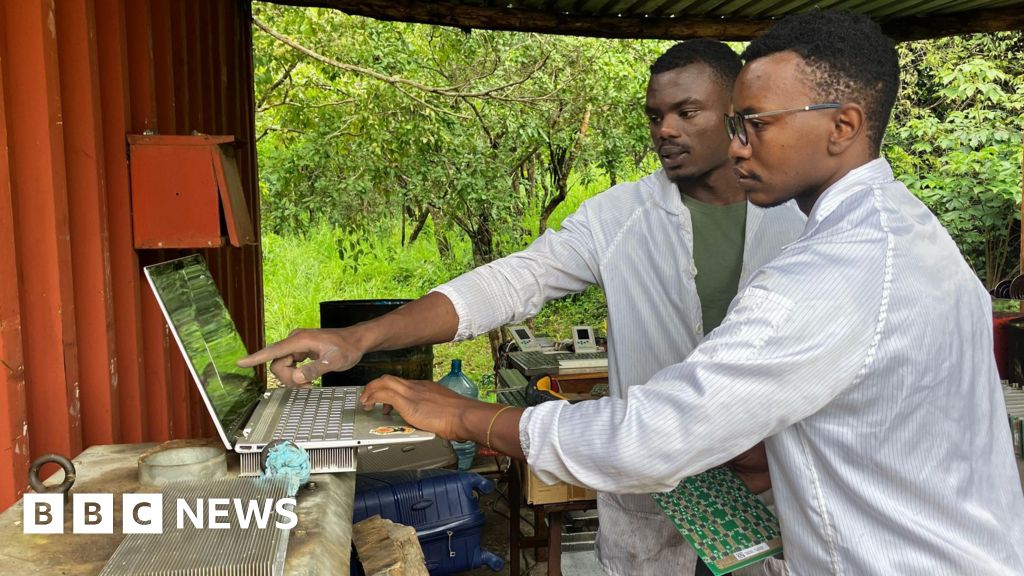
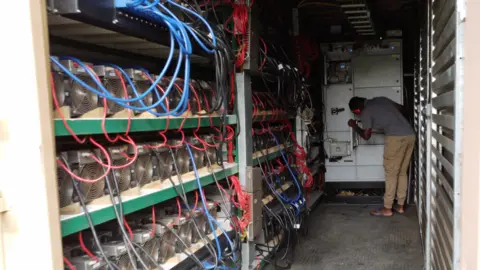
“That’s the sound of opportunity!” exclaims Philip Walton, grinning as he examines the shipping container filled
with 120 computers tirelessly processing complex equations to validate Bitcoin transactions.
These computers are automatically rewarded with Bitcoin by the network in return for their computational efforts.
Located near the border with the Democratic Republic of Congo in Zambia’s far northwestern region, this particular
Bitcoin mine is unique compared to others I have visited.
Typically, water and electronics are a risky combination, but the river’s closeness is precisely what drew Bitcoin
miners to this place.
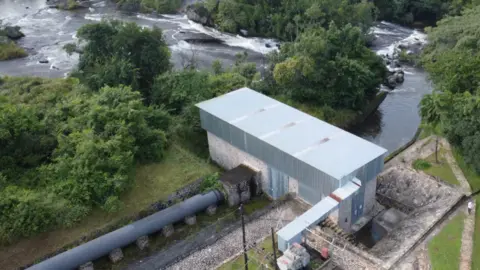
Philip’s mining setup is directly connected to a hydroelectric plant, harnessing the Zambezi’s flow through large
turbines to generate continuous, clean energy.
More significantly for Bitcoin mining, this power source is cost-effective.
It was cost effective enough that Philip’s Kenya-based company, Gridless, transported their shipping container
filled with sensitive Bitcoin mining computers along rough, narrow roads for 14 hours from the nearest city to
establish their operation here.
Each computer earns about $5 (approximately £3.90) daily, with earnings fluctuating based on Bitcoin’s fluctuating
price.
Occasionally, Philip checks his smartwatch, displaying the fluctuating dollar value of Bitcoin.
Currently, it’s around $80,000 per coin, but Philip states that they can still profit even when the coin’s value
drops, thanks to the affordable electricity and their partnership with the power company.
“To achieve greater mining profitability, we recognized the need to collaborate with the local power company and offer
them a share of our revenue. That’s why we are willing to operate in such a remote location, which allows us to
secure cheaper power,” he explains.
Zengamina hydroelectric plant is significant but functions as a mini-grid – a self-contained power system for the local
community.
The plant’s construction was completed in the early 2000s, funded by $3 million in charitable donations.
Daniel Rea, a British-Zambian, oversees the site, continuing his missionary family’s original project aimed at
providing electricity primarily to the local hospital.
Currently, it supplies power to roughly 15,000 individuals in the surrounding area. However, the project has faced
financial challenges due to slow adoption within the community.
Enabling Bitcoin miners to set up operations has been transformative for the business.
“Daily, we were losing over half of the energy we could potentially generate, meaning we weren’t earning revenue to
cover our operating expenses. We needed a substantial energy consumer in the area, and that’s where our
partnership with Gridless changed everything,” Daniel explains.
The Bitcoin mining activity contributes roughly 30% of the power plant’s total revenue, enabling them to maintain
affordable prices for the local residents.
Bitcoin and its financial implications are generally far from the thoughts of Zengamina’s residents.
The town itself is located a short distance from the power plant and consists of a small cluster of simple structures
scattered around a crossroads.
Only one store possesses a refrigerator, and a group of children gather around a computer, taking turns selecting songs,
much to the chagrin of adults going about their day.
Although the hydroelectric plant was commissioned in 2007, connecting it to the town and subsequently to individual
homes and businesses took several additional years.
Therefore, some residents, like Damian the barber, are still enjoying the novelty of having electricity connected just
a year and a half ago.
“Before electricity, I was restricted and couldn’t accomplish much. When I gained electricity, I acquired everything
simultaneously.”
He is not exaggerating. His small barber shop is brightly lit at night, featuring a TV playing music videos, strings of
Christmas lights, and the constant buzzing of his hair clippers. Young individuals congregate in his barber shop,
almost like a youth center.
“Having electricity has revolutionized my life,” he smiles. “The income I generate from the barbershop is enabling me
to pay for my school fees once again.”
Adopting electricity is mainly a business decision for Damian. At home, he uses a single light bulb to illuminate the
two rooms that constitute his small residence.
Elsewhere in the town, sisters Tumba and Lucy Machayi sit at a crossroads, observing the happenings around them.
Like numerous other young individuals, they are focused on their phones.
“Before the town had electricity, it was practically undeveloped,” Lucy describes.
They recall relying on small solar panels for the limited electricity they had.
“No refrigerator, no television, no mobile phone network,” Tumba adds.
“Electricity has fundamentally transformed the lives of people here,” Lucy emphasizes.
“We can charge our phones, and we have network connectivity. We can communicate with each other.”

Many local residents are either unaware or indifferent to the presence of the Bitcoin mining operation that contributes
to the hydro plant’s continued operation.
However, they will soon witness the container making its way through the town again as it moves on to another location.
Zengamina Hydro has received a substantial investment to aid in its expansion to additional villages and integration
with the national grid.
The surplus energy that the mining operation was utilizing will soon be sold back to the national grid, making Bitcoin
mining no longer economically viable at Zengamina.
Phillip and his team are accepting of this development, emphasizing that it is positive. Their time there was successful,
and they are pleased to have assisted Zengamina while also generating a good return on their investment in
Bitcoin.
The company states that they will set up their bitcoin mine next to sources of underutilized energy in various
locations.
Gridless is already operating six such sites in three different African nations.
North of Zengamina, a separate Bitcoin mine consumes excess energy from a hydroelectric plant managed by Virunga National
Park in the Congo, which they assert is used to finance conservation initiatives.
Now, Gridless intends to embark on a bold new strategy – constructing their own hydroelectric plants from the ground up
to mine Bitcoin and bring power to rural communities.
Janet Maingi, co-founder of the company, mentions they are actively seeking tens of millions of dollars for this
endeavor.
She states that they are focusing on models of the “run-of-river” type, such as the one at Zengamina, and that the
continent is rich in “untapped hydro potential.”
She elaborates, “A consumer-driven, adaptive energy strategy is crucial for achieving affordable, scalable, and
sustainable energy access that satisfies the requirements of African communities.”
The company is not a charitable organization and firmly believes that Bitcoin is essential for ensuring the long-term
financial viability for developers and investors.
Locating a new plant or tapping into existing ones is actually the simplest part.
The company still encounters opposition from some authorities and businesses who regard Bitcoin mining as a greedy and
selfish application of power that should be used for more essential services, like providing electricity for
rural populations.
However, the company contends that the primary motivation is consistently to sell to the highest bidder, which they
maintain will always be the local community.
History reveals that large-scale Bitcoin mining can strain public energy grids without proper incentives or regulations.
For example, a mining boom in Kazakhstan between 2020 and 2021 caused a 7% increase in the nation’s energy
consumption before the authorities intervened to regulate the burgeoning sector.
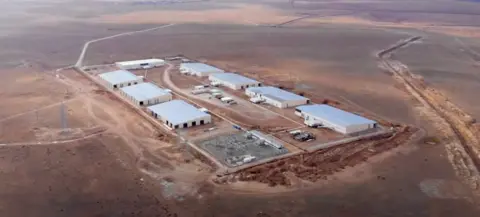
Conflicts have become common in the US – the new heartland of Bitcoin mining – between miners, locals, and residents
when electricity is in high demand.
Authorities have established agreements with some major mining firms to ensure that they shut down their computer-filled
warehouses when the grid needs balancing.
For instance, Greenidge gas power plant in New York, which was renovated to mine Bitcoin, was ordered to halt mining in
January to supply electricity to the grid during a period of extremely cold weather.
Such agreements must be widespread if President Donald Trump’s goal of having Bitcoin “mined, minted, and manufactured
in the USA” is to be realized.
The environmental impact of the industry is also a significant concern. It is estimated that Bitcoin mining consumes as
much energy as a small country such as Poland.
However, according to researchers at Cambridge University, who conduct annual assessments of Bitcoin’s energy usage,
there is a trend toward a more sustainable energy mix.
Setups like the one at Zengamina represent a minor part of the broader mining context.
<