
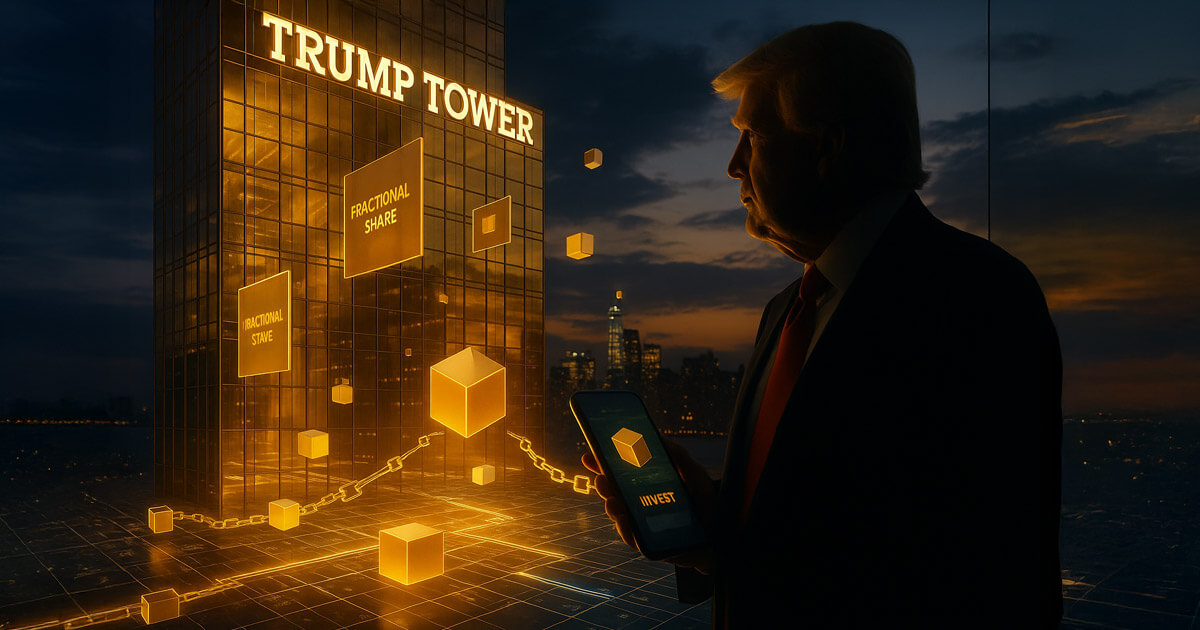

World Liberty Financial (WLFI), a blockchain company with ties to the Trump family, is reportedly moving forward with plans to tokenize significant portions of Donald Trump’s extensive real estate assets.
The initiative seeks to transform some of the most recognizable Trump properties into digital investment opportunities. This would potentially open up access to retail investors who typically wouldn’t have the means to invest in such high-value real estate.
By offering fractional ownership via blockchain technology, WLFI aims to bridge the divide between exclusive real estate holdings and the general investing public.
Furthermore, according to WLFI co-founder, Zak Folkman, the project’s ambitions extend beyond real estate. The company is actively investigating the feasibility of bringing real-world commodities onto the blockchain.
A CNBC report quoted him stating:
“We’re not just considering it, we are actively developing it. We see a lot of potential in commodities, from oil and gas to cotton and timber. We believe these should all be traded on the blockchain.”
How Could Trump Benefit?
The precise proportion of Trump’s real estate portfolio slated for tokenization remains undisclosed. However, Forbes estimates the value of his real estate holdings, including iconic buildings like Trump Tower, at $1.2 billion. Even a relatively small-scale tokenization program could generate considerable liquidity and returns for investors.
To illustrate the potential financial implications for the former president, CryptoSlate has created several scenario models.
In a conservative scenario, with only 10% to 20% of the portfolio tokenized, the initiative could raise between $120 million and $240 million.
Assuming a 3% net operating yield on the tokenized assets, this could translate to annual returns of $3.6 million to $7.2 million, while allowing Trump to retain majority control.
A mid-range scenario, involving 30% to 50% of the portfolio, could unlock up to $600 million and generate significantly higher returns, without relinquishing majority control to outside investors.
Under this projection, the venture could generate a 5% yield, resulting in annual revenues ranging from $18 million to $30 million.
The most ambitious approach, involving the tokenization of 70% or more of his holdings, could potentially raise almost the entire book value of the portfolio. This would provide nearly a billion dollars in immediate liquidity and generate annual yields approaching $80 million for investors, provided market conditions remain favorable.
Therefore, each scenario highlights the trade-off between Trump’s control over his assets and the potential scale of financial benefits for all parties involved.