


Renewed worries over trade relations between the U.S. and China have triggered a wave of risk aversion, resulting in the cryptocurrency market shedding approximately $200 billion in total valuation.
This downturn has put a stop to Bitcoin’s tentative recovery, which followed a significant liquidation event last weekend that saw $19 billion wiped out.
Bitcoin price struggles
According to data obtained by CryptoSlate, the entire cryptocurrency market capitalization has decreased by 3%, sliding from $3.96 trillion to $3.79 trillion within a single day.
Bitcoin has encountered resistance above the $115,000 level and has since declined by over 3% to $110,500, testing a critical near-term support area.
Notably, Ethereum, the second-largest cryptocurrency by market capitalization, mirrored Bitcoin’s downward trend. ETH experienced a 4% drop below $4,000 before making a slight recovery. BNB also faced selling pressure, retracing 12% from its recent peak to $1201 at the time of this report.
Other prominent digital assets in the top 10, including XRP, Solana, Dogecoin, Tron, and Cardano, saw even steeper declines, falling by more than 5% and contributing to the overall market losses.
The widespread sell-off occurred after reports surfaced that China had announced new sanctions targeting five U.S. subsidiaries of Hanwha Ocean, a major South Korean shipbuilding company.
This action effectively prohibits Chinese entities from engaging with the sanctioned companies, representing a significant escalation in the ongoing tensions between Beijing and Washington.
This development aligns with earlier warnings issued by Chinese authorities on October 13 via an X post, stating their intention to take necessary measures to safeguard their legitimate rights and interests.
Beijing’s restrictions were implemented shortly after U.S. President Donald Trump threatened to impose 100% tariffs on select Chinese goods as a response to new export control measures.
ETF outflows reinforce market caution
The prevailing macroeconomic uncertainty compounded existing vulnerabilities within the cryptocurrency market following the recent liquidation event.
On October 13th, U.S. spot Bitcoin and Ethereum ETFs experienced combined outflows of approximately $755 million, signaling continued hesitancy among institutional investors.
According to data from SoSo Value, Bitcoin-linked funds reported $326 million in redemptions, largely driven by outflows from Grayscale’s GBTC and Bitwise’s BITB.
Notably, other issuers, including Fidelity, also witnessed significant withdrawals from their respective funds. However, BlackRock’s IBIT stood out as an exception, attracting fresh capital inflows of approximately $60 million.
Ethereum ETFs fared even worse, recording an estimated $428 million in outflows, primarily led by BlackRock’s ETHA product.
Despite these recent setbacks, Bitcoin and Ethereum ETF products have demonstrated remarkable success this year, amassing over $76 billion in combined inflows since their launch in 2024.
What’s next for BTC price?
Timothy Misir, Head of Research at BRN, shared with CryptoSlate that Bitcoin’s crucial technical range lies between $110,000 and $108,000.
He explained that this zone represents a key area of market liquidity. A decisive break below this level could pave the way for a decline toward $104,000, while successfully reclaiming and closing above $115,000 would likely stabilize near-term momentum and potentially lead to a move towards $125,000.
Misir also highlighted the decreasing open interest as an indication that crypto traders are reducing their risk exposure. This reduces the likelihood of sudden liquidation events, but also suggests that any potential upward movement will depend on genuine spot buying rather than leveraged trading.
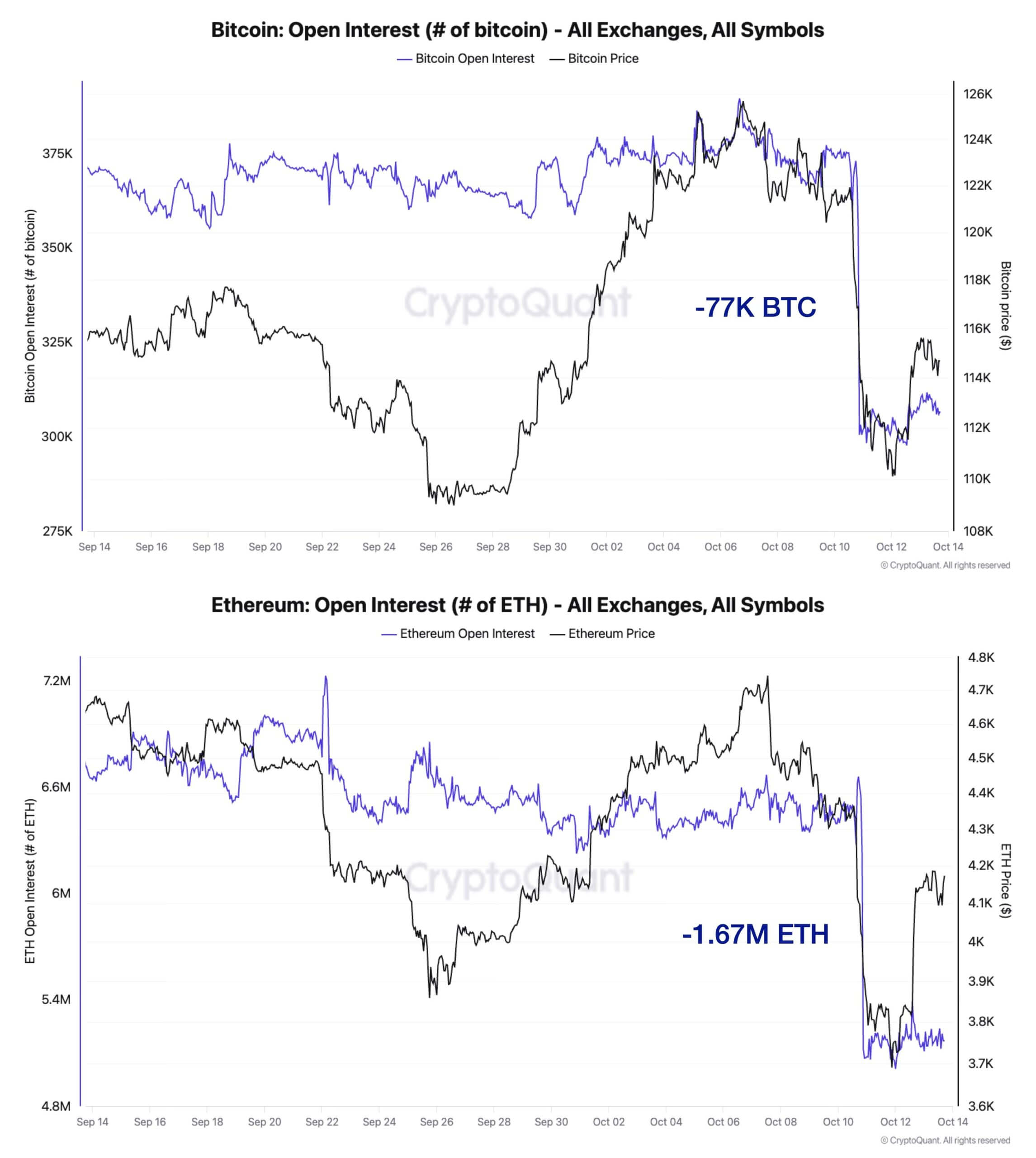
He further stated that consistent ETF inflows exceeding $500 million per day would serve as a strong indication of renewed market strength.
Misir concluded:
“The market has entered a phase of risk management. With institutional flows turning neutral to negative and leveraged traders largely exiting their positions, price movements are now primarily influenced by spot reallocations and macroeconomic developments. This reduces both the likelihood of a swift breakout and the risk of a leverage-driven crash.”