

Innovative payment solutions company, Ripple, is reportedly exploring a significant venture: a $1 billion digital asset treasury (DAT). The goal is to build and manage a substantial XRP reserve for the long haul.
A recent report by Bloomberg suggests that this initiative might be funded using a Special Purpose Acquisition Company (SPAC) model. Commonly used in traditional finance, a SPAC raises capital through an IPO, with the intention of merging with a specific company later.
In this case, the SPAC would function as a treasury, systematically acquiring XRP. This would effectively establish a continuous, dedicated buyer for the cryptocurrency.
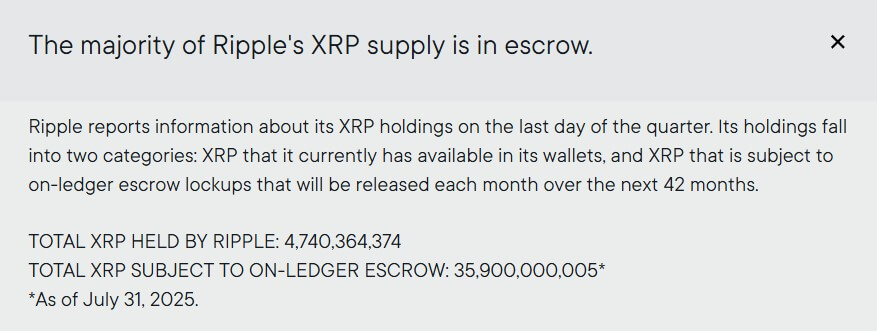
Furthermore, reports indicate that Ripple intends to contribute a portion of its readily available XRP holdings – roughly 4.7 billion XRP valued at approximately $11 billion. This contribution would provide the treasury with immediate operational capital and signal Ripple’s strong belief in the XRP ecosystem.
The Relationship Between Ripple and XRP
It’s important to understand that Ripple and XRP are separate entities, though often linked. Misunderstandings about their relationship are common.
Ripple operates as a private entity focusing on developing global payment technologies. These solutions utilize digital assets, including XRP and their own Ripple USD (RLUSD), to facilitate transactions.
Notably, Ripple is also the largest single holder of XRP, possessing around 42% of the total 100 billion XRP in existence.
To manage the supply, Ripple has locked 35 billion XRP in escrow. Under a pre-defined, on-ledger schedule, one billion XRP are released monthly. Approximately 60% of these released tokens are typically re-locked, creating a mechanism that helps control the overall supply and maintain market confidence.
The proposed DAT would shift the focus from managing supply to actively generating demand.
Instead of controlling the release of XRP, Ripple would be fostering inflows by attracting institutional investment into an entity specifically tasked with purchasing XRP. This would represent a fundamental change from managing token emission to actively absorbing tokens from the market.
Companies Focused on XRP Treasuries
The concept of a company specifically dedicated to XRP isn’t entirely new. The crypto space has witnessed various attempts to create similar structures for other digital assets, including Bitcoin.
Over the past year, several firms have already explored the idea of establishing XRP-centric reserves, with varying degrees of success.
For instance, Trident Digital, based in Singapore, announced a $500 million fund in June. Similarly, Webus International aimed to raise $300 million in May to support its payment network for chauffeur services.
Furthermore, VivoPower International and Wellgistics also allocated smaller amounts, $121 million and $50 million respectively, to XRP treasuries.
However, the performance of these companies’ stocks has been underwhelming.
Since their announcements, these companies have experienced stock declines of up to 70%, highlighting the potential for digital asset treasuries to amplify both excitement and risk.
Yet, some companies, such as Webus and Wellgistics, are increasing their investments in the XRP ecosystem. They view XRP treasuries as long-term infrastructure plays rather than short-term trading opportunities, designed to support cross-border liquidity and enterprise payment solutions.
Nevertheless, Ripple’s proposed DAT would significantly surpass the scale of these existing initiatives.
At the current price of approximately $2.30, a $1 billion reserve translates to around 435 million XRP, representing about 0.75% of the 60 billion XRP currently in circulation, according to data from CoinGecko.
Potential Impact on XRP Price
A steady buying pressure from an XRP treasury could help establish stronger price support levels and enhance institutional confidence in the digital asset.
Data from CoinMarketCap indicates that XRP’s liquidity on major exchanges is noticeably lower compared to other prominent cryptocurrencies like Solana and Ethereum.
Across the top ten spot trading platforms, including Binance, Coinbase, Bybit, and Upbit, the combined ±2 percent order book depth is only around $51 million.
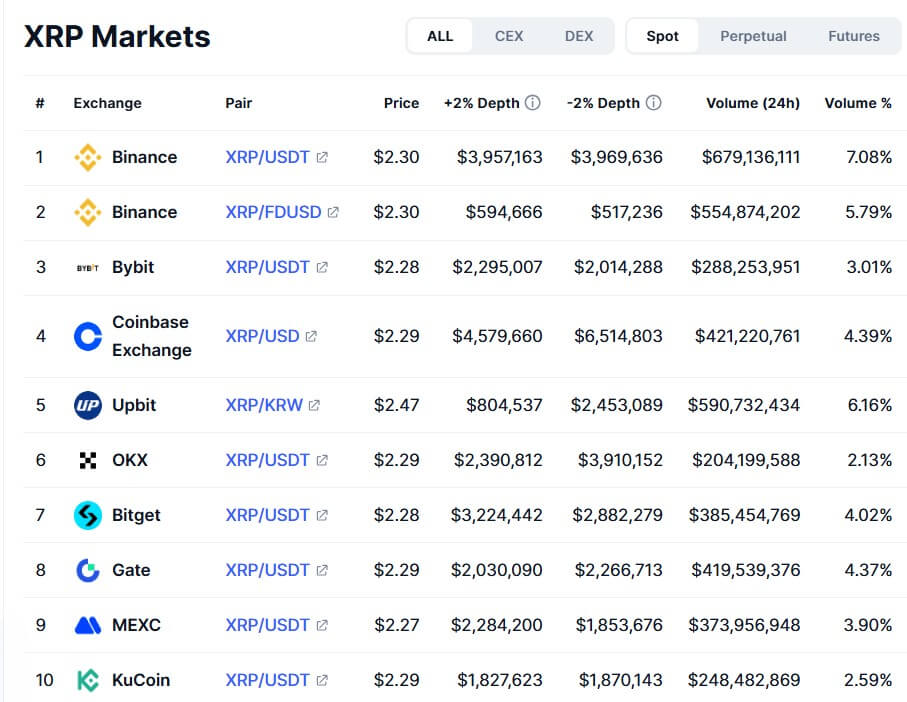
Given this level of liquidity, Ripple’s proposed $1 billion DAT, if deployed consistently over 90 days at roughly $11 million in daily purchases, could represent more than 20% of the total near-price liquidity available on any given day.
Furthermore, it would equate to approximately twenty times the total depth within that immediate trading range. This concentrated buying power suggests that the market could react more significantly to sustained buying activity from the DAT firm.
Based on CryptoSlate’s analysis of current exchange depth and historical price responsiveness, even measured buying activity could noticeably influence short-term valuations.
| Deployment pace | Share of visible depth absorbed | Modeled short-term impact* | Indicative move (from $2.30) |
|---|---|---|---|
| Slow (180 days) | ≈ 10 % | +2 – 3 % | $2.35 |
| Moderate (90 days) | ≈ 20 % | +6 – 8 % | $2.45 – $2.48 |
| Fast (45 days) | ≈ 40 % + | +12 – 15 % | $2.55 – $2.65 |
While such large-scale accumulation would almost certainly involve over-the-counter (OTC) trading and algorithmic execution to minimize visible slippage, the concentrated nature of XRP liquidity implies that even carefully managed deployment could lead to a temporary price increase of 8–15% before market conditions readjust.
However, these price gains would likely be temporary if the treasury stopped purchasing or if other XRP holders sold their holdings to capitalize on the increased prices.