

Some sources indicate that Robinhood is generating a higher revenue stream from its cryptocurrency offerings compared to its traditional stock trading services. As the company expands its presence in the digital asset sector, these ventures may significantly impact its established core business.
Published: July 31, 2025, 5:23 PM Eastern Time.
Financial technology leader Robinhood Markets, Inc. (HOOD) has revealed robust financial results for the second quarter of 2025. The organization’s latest report shows a total net revenue of $989 million, demonstrating a 45% surge from the previous year. Net income also saw significant growth, jumping by 105% to reach $386 million. A substantial portion of the company’s revenue comes from transaction-based activities, which grew by 65% to $539 million, including a 98% increase in crypto revenue, totaling $160 million.
Cryptocurrency revenue plays a significant role in overall growth, but its inherent unpredictability raises concerns. During the final quarter of 2024, crypto contributed 35% of Robinhood’s total net revenue, amounting to $358 million. This figure decreased in the first quarter of 2025, dropping to 27% or $252 million. Other sources of transaction revenue demonstrate much higher stability. Option trading, for instance, yielded $265 million in the second quarter, $240 million in the first quarter, and $222 million in the last quarter of the previous year.

This article is adapted from the Bits + Bips newsletter.
Sign up for free email updates here.
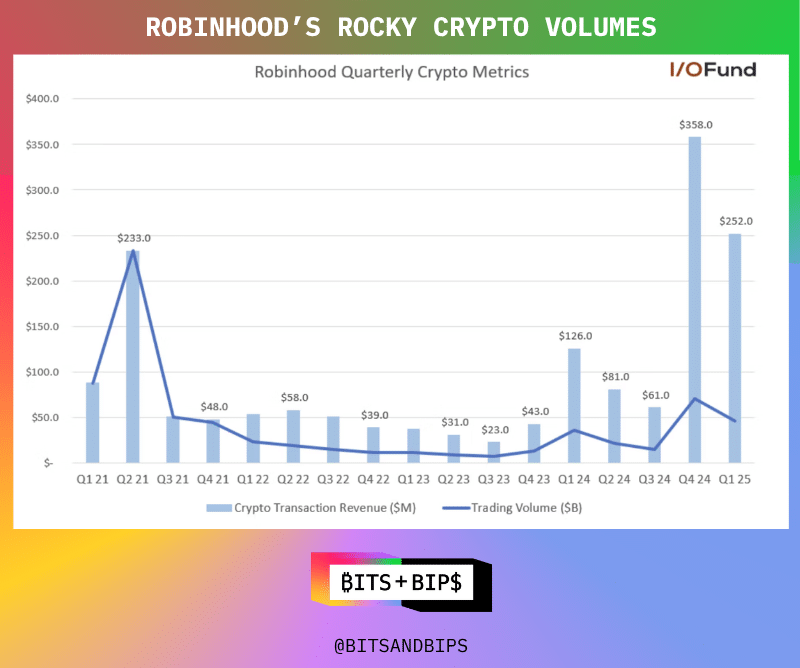
While cryptocurrency investments benefit Robinhood’s financial standing, the substantial variation in crypto contributions to its revenue may negatively impact its long-term stock valuation. It appears that the company is actively seeking a solution. Consequently, analyzing Robinhood’s digital currency goals is essential.
The market should be focused on Robinhood’s crypto ambitions. This is amplified following its June “To Catch a Token” event in Cannes, where it presented new features available to crypto users in both the U.S. and Europe. These features include perpetual futures, European tokenized stock trading, and crypto staking within the U.S.
Tokenization as a Solution for Managing Cryptocurrency Exposure
Robinhood understands that its dependency on crypto has its benefits and drawbacks. Vlad Tenev, the CEO, has openly discussed strategies for the company to diversify its income and reduce reliance on the volatile trading volumes of cryptocurrency. A key part of this strategy involves strengthening its crypto foundation by incorporating features that mirror its brokerage roots.
A primary strategy for crypto diversification is tokenization. This also reflects the company’s aspirations for its core brokerage services. Tenev stated in a CNBC interview after the June event that the primary goal of these offerings is to deliver user-friendly products, while the secondary goal is to illustrate how beneficial the fusion of crypto tech and traditional financial services could be.
Stock tokenization presents numerous opportunities, including the option for fractional stock trading and the trading of varied assets like private company equities. Theoretically, almost anything can be tokenized and traded, from artwork to wines. These possibilities contribute to Robinhood’s crypto approach that supports its core business. With successful implementation, tokenization can significantly expand the company’s interactions with investors by introducing new asset classes and diversifying transaction revenues.
Robinhood is already actively expanding in certain sectors. The company sparked controversy in June by announcing tokenized shares of OpenAI and SpaceX. This led to criticism, causing Tenev to clarify that these tokens were derivatives instead of equity in those companies. The ability to offer tokens linked to assets previously difficult to acquire—like shares in private companies—appeals to many investors. During a Q2 earnings call, Tenev said tokenization is “the biggest innovation in capital markets in over a decade.” A recent McKinsey report projects that tokenization could grow to a $2 trillion market by the end of the decade.
While Robinhood is at the forefront of tokenized trading, Gemini introduced tokenized stocks in the EU during June. Robinhood’s established and engaged user base gives it a significant advantage. It is also developing its blockchain, Robinhood Chain, to support these activities. Europe will likely be a testing ground before wider global deployment, particularly within the U.S., pending regulatory approval.
A Broader Perspective
When discussing crypto opportunities, Robinhood executives are focusing less on trading volumes and more on the technology itself, which could revolutionize the whole organization. Johann Kerbrat, general manager of Robinhood Crypto, noted at the Cannes event that the crypto market has two angles: one is digital assets such as Bitcoin and Solana, while the other is as fundamental technology that may reshape financial services. Kerbrat suggested that the latter idea is currently underexplored. In his keynote speech, Tenev queried what Robinhood would look like if it were entirely rebuilt using crypto technologies.
Robinhood’s product offerings provide insight. John Todaro, Managing Director at Needham & Company, quoted in Forbes, pointed out that Robinhood has ten business lines forecast to generate over $100 million in revenue within two years. These include Robinhood Gold, its subscription service that provides enhanced benefits, the Robinhood Gold credit card, and the Robinhood Strategies investment advisory service. In the latest quarter, Robinhood Gold subscriptions increased by 1.5 million, a 76% rise from the previous year, totaling 3.5 million. Robinhood’s strategy might involve exploring crypto tech to enhance expansion across different sectors. Tokenization is a prime example, and it is appearing in other initiatives. By fall, Robinhood Gold credit cardholders will be able to convert their rewards into crypto using Crypto Back. Robinhood could deploy crypto tech to reduce expenses or introduce new products.
Robinhood has extensive ambitions within and beyond the crypto world. It aims to become a leading global financial institution and intends to use crypto infrastructure to achieve this. Recent actions, like acquiring Bitstamp, a crypto exchange, which it purchased during the second quarter, planning to acquire the Canadian digital asset firm WonderFI, and announcing Robinhood Chain, demonstrate the company’s strong commitment. This strategy is not simply about digital currencies; it is about infrastructure. It is a grand design that impacts not just Robinhood’s future but the future of finance.